Targeting the Saudi Healthcare Market
A Strategic Playbook for 2026–2027
From distributor-led to partnership-driven: how global health companies win in the Kingdom’s new era.
Saudi Arabia is no longer just the largest healthcare market in the Middle East; it is one of the most dynamic and strategically important arenas for global health companies. Fueled by the transformative Vision 2030, the Kingdom has shifted its perspective on healthcare from a public service to a cornerstone of economic diversification. For international firms, the next 18 to 24 months represent a critical window of opportunity, but success will depend on a fundamental understanding of the new rules of engagement. The traditional playbook of appointing a distributor and waiting for tenders is obsolete. The new model demands localization, direct strategic control, and a partnership-driven mindset.
The Evolving Market Landscape
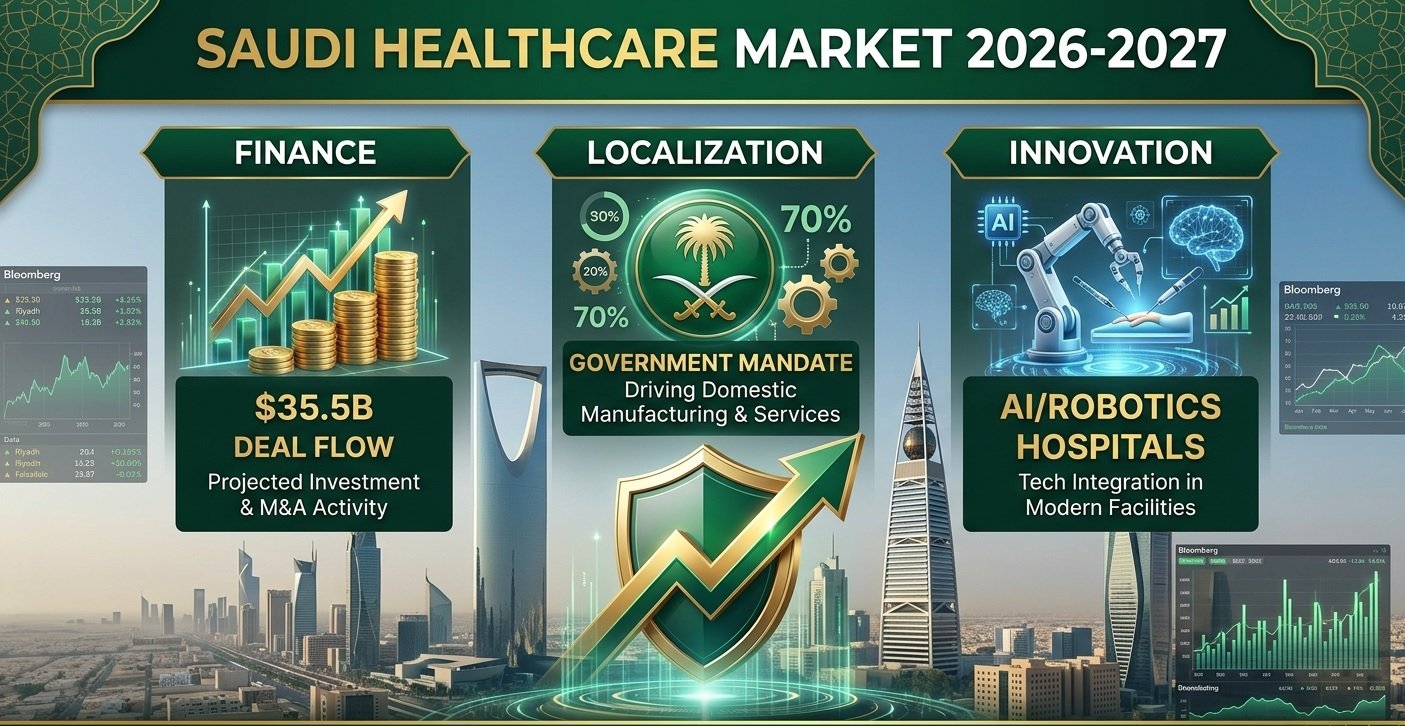
The sheer scale of opportunity is compelling. In 2025, the Global Health Exhibition alone facilitated a staggering $35.5 billion in deals, underscoring the liquidity and ambition within the sector. Government bodies, from the Ministry of Health to the Public Investment Fund (PIF), are aggressively pursuing partnerships to build a self-sufficient and advanced health ecosystem.
Recent deals highlight this new reality. The partnership between Wesam Medical Holding and US-based McLaren Health Care to establish a specialized cancer hospital in Riyadh exemplifies the preferred model: a local partner with market knowledge and assets joining forces with an international leader possessing advanced clinical and operational expertise. Similarly, Pfizer’s MOU with Lifera (a PIF company) to explore local drug manufacturing demonstrates that even global pharma giants are aligning with the Kingdom’s localization goals.
Core Strategic Pillars for Success
To penetrate and thrive in this market from 2026–2027, companies must build their strategy on four critical pillars.
1. Embrace Localization as a Market Access Imperative
This is the most significant shift. The Local Content and Government Procurement Authority (LCGPA) is actively enforcing localization requirements. Simply importing products is increasingly insufficient to win government tenders, which represent a dominant share of the market. As a recent industry analysis notes, NUPCO’s rejection of foreign bids when local alternatives exist is not a future threat—it is current practice.
- Pursue a Local Partnering Strategy: From joint ventures to technology transfer agreements – move from importer to domestic contributor.
- Develop a Localization Roadmap: Even with smaller contracts, plan for long-term localization – critical for medical devices and biopharma.
- Align with PIF-Backed Platforms: Entities like Lifera offer clear pathways to meet national goals and secure supply chain positions.
2. Rethink Your Go-to-Market and Operating Model
A purely distributor-led model is losing its effectiveness, particularly for strategic and service-intensive portfolios. A 2026 whitepaper from Eurogroup Consulting argues that manufacturers need “greater control over strategic accounts, tenders, service quality, data and local-content planning”.
- Establish a Direct or Hybrid Operating Model: A Regional Headquarters (RHQ) signals long-term commitment and direct control over key accounts.
- Redefine the Role of Partners: Saudi partners should focus on “execution under clearer governance, targets and reporting”.
- Leverage Digital Procurement Channels: Register on NUPCO’s e-marketplace and explore Wasfaty for public-private pharmacy distribution.
3. Master Procurement and Public-Private Partnerships (PPPs)
Government procurement is the key driver of market access. Companies must compete through NUPCO and major PPPs.
- Participate in Major Tenders and PPPs: Radiology Services PPP in seven hospitals across Riyadh, and the National Kidney Care Project (11,500+ beneficiaries, 6-year DRFM contract).
- Engage Early and Proactively: Decisions are shaped by clinicians, procurement, and finance – a direct presence enables earlier engagement.
- Understand Financing: The $500 million partnership between Seha Invest and Y-Innovations for the National Biotechnology Strategy shows the depth of available investment.
4. Navigate the Regulatory and Operational Complexities
The regulatory environment is evolving to support innovation while maintaining strict oversight.
- Comply with Digital Health Regulations: Sehhaty app and NPHIES compliance are non-negotiable. The new insurance product (effective Nov 2026) removes outpatient pre-approval, accelerating patient access.
- Prioritize Data and Technology Transfer: Demonstrate integration, workflow improvement, and measurable value.
- Commit to Workforce Development: Upskilling Saudi staff is a crucial component of any bid – as seen in the Wesam Medical–McLaren partnership.
🇸🇦 The time to act is now
The Saudi healthcare market in 2026–2027 is not for the faint of heart. It requires a long-term commitment, a willingness to share intellectual property, and a strategic shift from selling to building. The rewards, however, are immense for companies that successfully navigate this transition. The Kingdom is building a healthcare system for the future, and it is looking for partners, not just vendors.
— Strategic Playbook · 2026–2027
WordPress ready · copy and paste into Text editor
“`