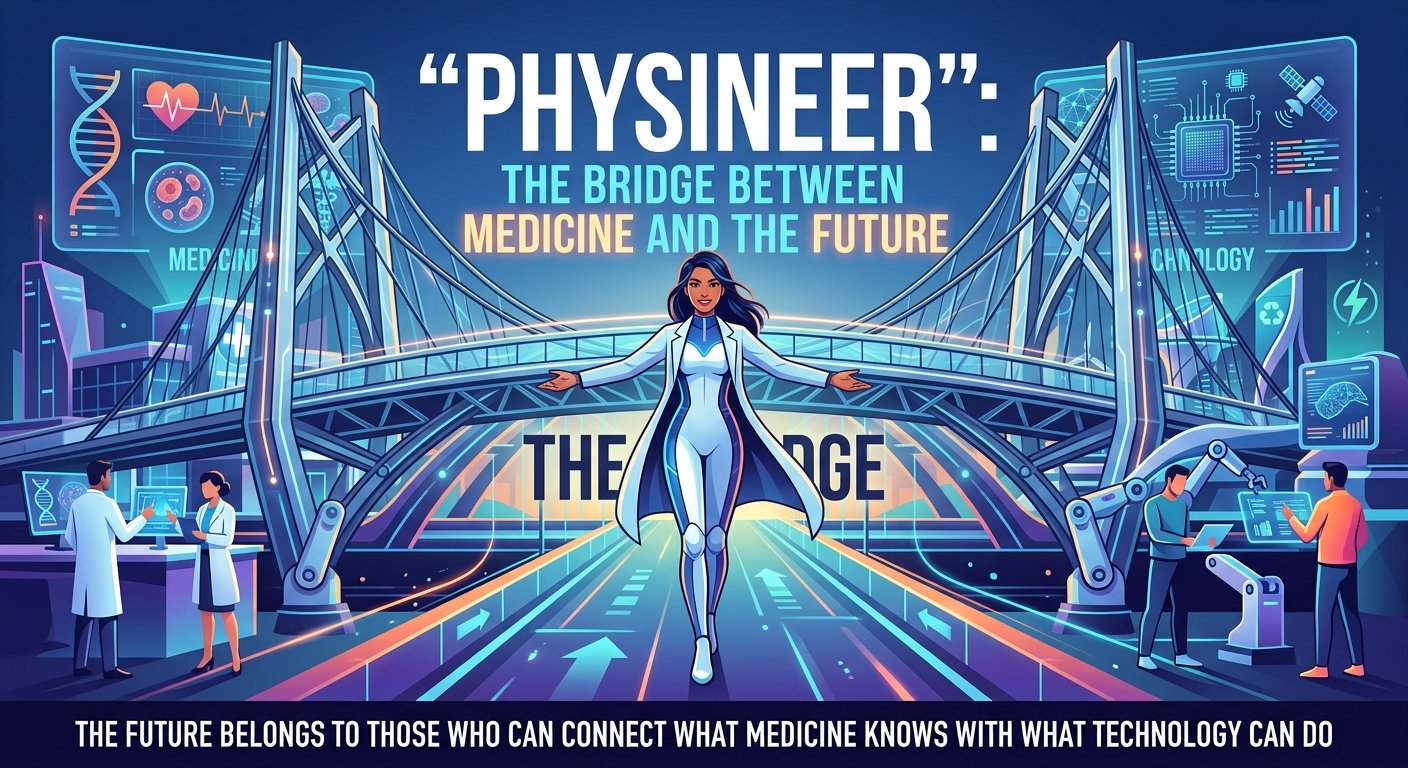
PHYSINEER: The Bridge Between Medicine and the Future The future belongs to those who can connect what medicine knows with what technology can do.
The Physineer Series — Redesigning Healthcare for the Intelligent Age
We built the machines. We trained the models. We digitized the records. We poured billions into artificial intelligence, electronic health records, and precision medicine.
And yet, the patient journey remains fragmented. The clinician remains burned out. The operating margin remains under siege. The promise of transformation remains just that—a promise.
We have been asking the wrong question.
It is not: Can technology fix healthcare?
It is: Who will build the bridge between what medicine knows and what technology can do?
The answer is not a tool. It is not a platform. It is a human archetype. It is the Physineer.
The False Dichotomies We Must Destroy
Healthcare has spent decades trapped in false choices. Human versus machine. Clinical intuition versus algorithmic precision. Physician versus administrator. Care versus efficiency. Tradition versus innovation.
These dichotomies are not merely wrong. They are dangerous. They force us to choose sides in a war that does not exist. They pit the people who heal against the people who build. They separate the art of medicine from the science of systems.
The Physineer refuses to choose.
The Physineer knows that the algorithm without the workflow is noise. That the workflow without the clinician is empty. That the clinician without the system is isolated. That the system without the patient is pointless.
The Physineer does not pick a side. The Physineer builds the bridge.
What the Bridge Actually Means
This series has traced the emergence of a new professional species. From the workflow architects who understand that AI is not a product but a redesign challenge. To the competency builders who know that degrees are slower than mindsets. To the new jobs being written into existence today because the old ones cannot carry the weight of tomorrow. To the leaders who will run healthcare not from a boardroom or a bedside, but from the intersection of both.
The Physineer is the thread that connects all of it. And the bridge is built from four fundamental equations:
Physician + Engineer
Not a physician who tolerates technology. Not an engineer who admires medicine. A professional who speaks both languages natively and knows that the hardest problems live in the translation layer between them.
Human + Technology
Technology does not replace the human hand. It extends it. The Physineer designs systems where empathy and computation reinforce each other, where the machine handles pattern and the human handles meaning.
Clinical Excellence + Systems Excellence
The best surgeon in a broken system saves fewer lives than a good surgeon in a great system. The Physineer knows that clinical excellence without systems excellence is a lottery. Systems excellence without clinical excellence is a warehouse.
Medicine + Innovation
Innovation is not disruption for its own sake. It is the disciplined redesign of care delivery. The Physineer innovates not to replace medicine, but to liberate it—from bureaucracy, from burnout, from the constraints of an industrial-age operating model.
The Three Imperatives
This manifesto is not a prediction. It is a demand. To health system executives, to board members, to policymakers, to educators, and to the professionals who will become Physineers—there are three imperatives:
One: Stop waiting for the perfect candidate. The Physineer does not arrive fully formed. They are built. Invest in the boundary-crossers already inside your organization. Give them authority, training, and air cover. Create the roles before the degrees exist.
Two: Stop buying technology and start designing systems. The next algorithm, the next platform, the next dashboard will not save you. What will save you is the human capacity to integrate, govern, and evolve technology within a clinical context. Buy capability, not products.
Three: Stop separating strategy from operations. The Physineer CEO does not delegate digital transformation to a committee. They live it. They hold the clinical, technical, financial, and governance dimensions in one decision-making architecture. The future belongs to leaders who can see the whole board.
The Future Is Not Automatic
There is no law of nature that says healthcare will improve. There is no guarantee that artificial intelligence will make medicine more humane, that digital transformation will make systems more efficient, or that innovation will make care more accessible.
These outcomes are not inevitable. They are designed. And they are designed by people.
The future of healthcare will not belong to physicians alone. It will not belong to engineers alone. It will not belong to administrators, data scientists, or technologists in isolation.
It will belong to those who refuse to stay in their lane. To those who cross boundaries not because they are confused, but because they see connections others miss. To those who build bridges where others see walls.
It will belong to the Physineer.
PHYSINEER
Physician + Engineer
Human + Technology
Clinical Excellence + Systems Excellence
Medicine + Innovation
Better Systems. Better Decisions. Better Care.
The bridge is built. The future is waiting.
Walk across.