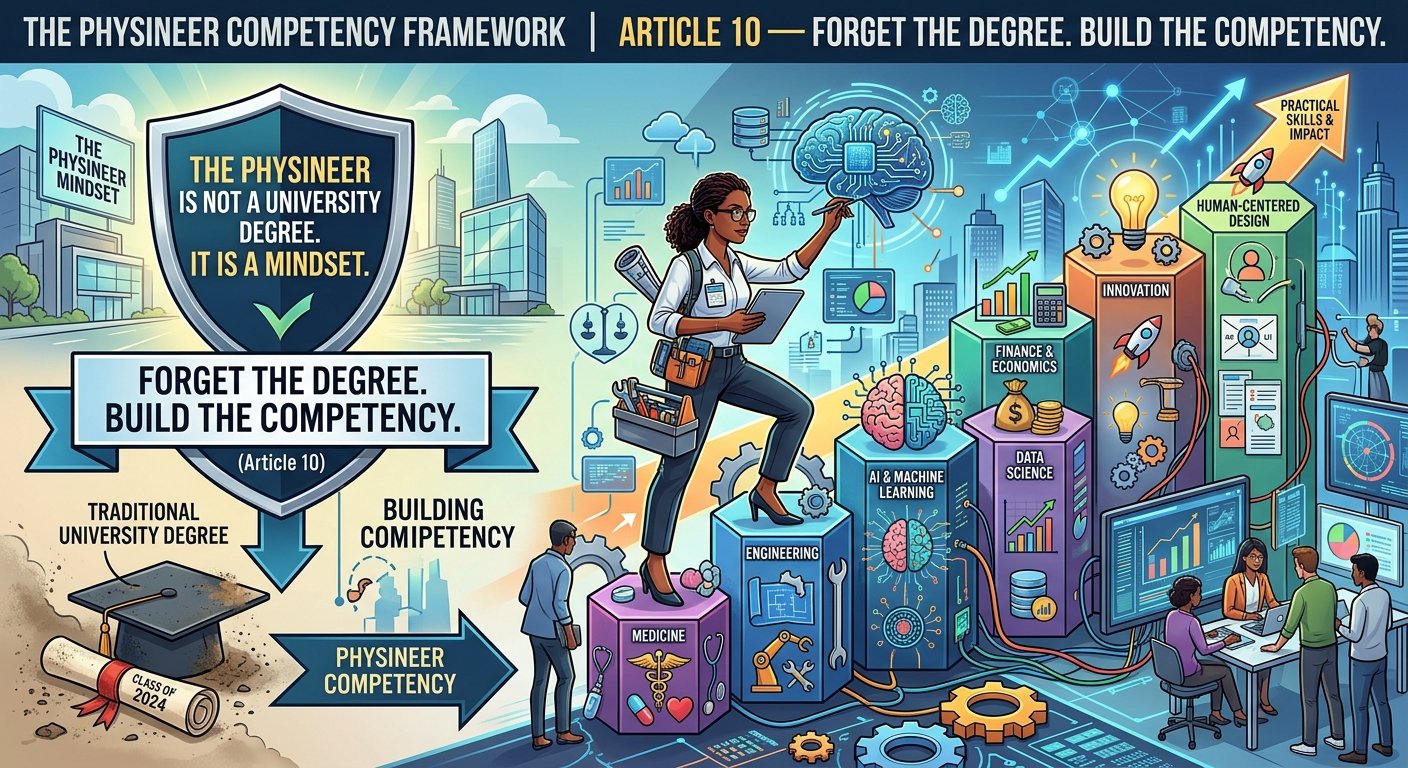
ARTICLE 10 Forget the Degree. Build the Competency. The Physineer is not a university degree. It is a mindset.
Healthcare organizations are making a costly mistake. They are waiting for universities to mint a new professional before they hire for the future. They scan resumes for credentials that do not exist, post job descriptions for degrees that have not been invented, and reject candidates who lack the exact title even when they possess the exact capability.
This is the degree trap—and it is suffocating transformation.
The Physineer is not a diploma. No accredited program currently produces a graduate with the precise blend of clinical reasoning, systems engineering, data fluency, financial acumen, governance discipline, and human-centered design that the modern health system demands. Waiting for one is not a strategy. It is a delay tactic disguised as prudence.
The organizations that win will not be those that hire the perfect degree. They will be those that build the perfect competency.
The Competency Stack
A Physineer is not defined by a single discipline. They are defined by the intersection of eight domains. No one masters all eight. But the Physineer mindset is the ability to navigate across them, translate between them, and synthesize them into operational reality.
Medicine
Not necessarily a clinical license, but a deep respect for and literacy in clinical workflows, patient safety, and the realities of care delivery. Without this, technology is built in a vacuum.
Engineering
Systems thinking, process design, and the ability to architect workflows rather than merely automate tasks. The Physineer sees the hospital as an integrated system, not a collection of departments.
AI
Enough literacy to understand what algorithms can and cannot do, where they create value, and where they introduce risk. Not necessarily the ability to build models, but the judgment to deploy them responsibly.
Data
The ability to interrogate data, distinguish signal from noise, and translate analytical output into operational decisions. Data fluency is now as critical as financial literacy.
Finance
Understanding total cost of ownership, ROI modeling, capital allocation, and the business case for technology. The Physineer speaks the language of the CFO and the CMO with equal fluency.
Governance
Regulatory navigation, risk management, ethical oversight, and the design of decision-making structures around technology. Governance is not bureaucracy. It is the infrastructure of trust.
Innovation
The discipline of moving ideas from concept to scale. Not creativity for its own sake, but structured experimentation, rapid iteration, and the ruthless prioritization of what works over what is novel.
Human-Centered Design
The conviction that technology must serve humans, not the reverse. Empathy for the clinician, the patient, and the administrator as end-users. Design thinking applied to the most complex service environment on earth.
Why Degrees Fail in Healthcare Transformation
The academic model is optimized for depth, not breadth. It produces excellent specialists and mediocre integrators. A computer scientist understands algorithms but not bedside alarms. A physician understands patient care but not API architecture. An MBA understands capital allocation but not clinical workflow.
The Physineer gap is an integration gap. Universities are not designed to produce integrators. Their incentive structures reward publication in narrow disciplines, not operational mastery across them. By the time a curriculum catches up to market need, the market has moved on.
Moreover, healthcare does not have the luxury of waiting. The competitive pressure from tech-enabled competitors, the margin compression from payers, and the operational demands of an aging population mean that talent must be developed now, not in the four-to-six-year cycle of a new degree program.
The Business Case: Build, Don’t Buy
Organizations that attempt to hire ready-made Physineers from the market will compete for a vanishingly small talent pool and pay a premium for candidates who may not even exist. The smarter strategy is to build them internally.
This requires a fundamental shift in human capital strategy:
- Hire for cognitive range, not credential alignment. Look for candidates who have crossed boundaries before—a nurse who coded, an engineer who worked in clinical operations, a physician who built a startup. The pattern of boundary-crossing matters more than the specific degree.
- Invest in stackable learning, not terminal education. Micro-credentials, executive education, cross-functional rotations, and apprenticeship models will outpace traditional degrees in speed and relevance.
- Create protected roles for integration. Dedicate headcount to professionals whose explicit mandate is to sit between departments and translate. Give them authority, budget, and air cover from the C-suite.
- Measure competency, not tenure. Performance evaluation for Physineer-track roles should assess outcomes across domains—clinical adoption, financial return, safety metrics, and team collaboration—not siloed productivity.
The ROI of Mindset Over Credential
A competency-based approach to the Physineer delivers measurable business returns:
Speed to value. Internal candidates already understand your culture, your EHR, your politics, and your patient population. They can generate impact in months, not years.
Retention premium. Professionals developed internally have higher loyalty and lower turnover. They are invested in the organization’s success because the organization invested in them.
Adaptive capacity. A mindset-trained workforce learns faster than a degree-trained workforce. As technology evolves, so does the team—without requiring another hiring cycle or another academic program.
Cost efficiency. The fully loaded cost of recruiting a unicorn external candidate—if one can even be found—often exceeds the cost of developing three internal candidates through structured competency programs.
The Executive Imperative
CEOs and CHROs must make a decision: will your organization be a consumer of credentials, or a producer of competencies?
If you wait for the perfect candidate with the perfect degree, you will wait forever. If you build the competency framework, identify the high-potential boundary-crossers already inside your walls, and invest in their development, you will create a talent engine that your competitors cannot replicate.
The Physineer is not a job title to be found on LinkedIn. It is a capability to be cultivated in your enterprise. It is a mindset that treats clinical complexity, technical possibility, and business reality as a single design problem.
Forget the degree. Build the competency. The transformation of your organization depends on it.
The Physineer is not a credential.
The Physineer is a choice.
Make it.