Algeria Healthcare Market 2024–2026: The Rise of Private Healthcare and the New Competitive Landscape
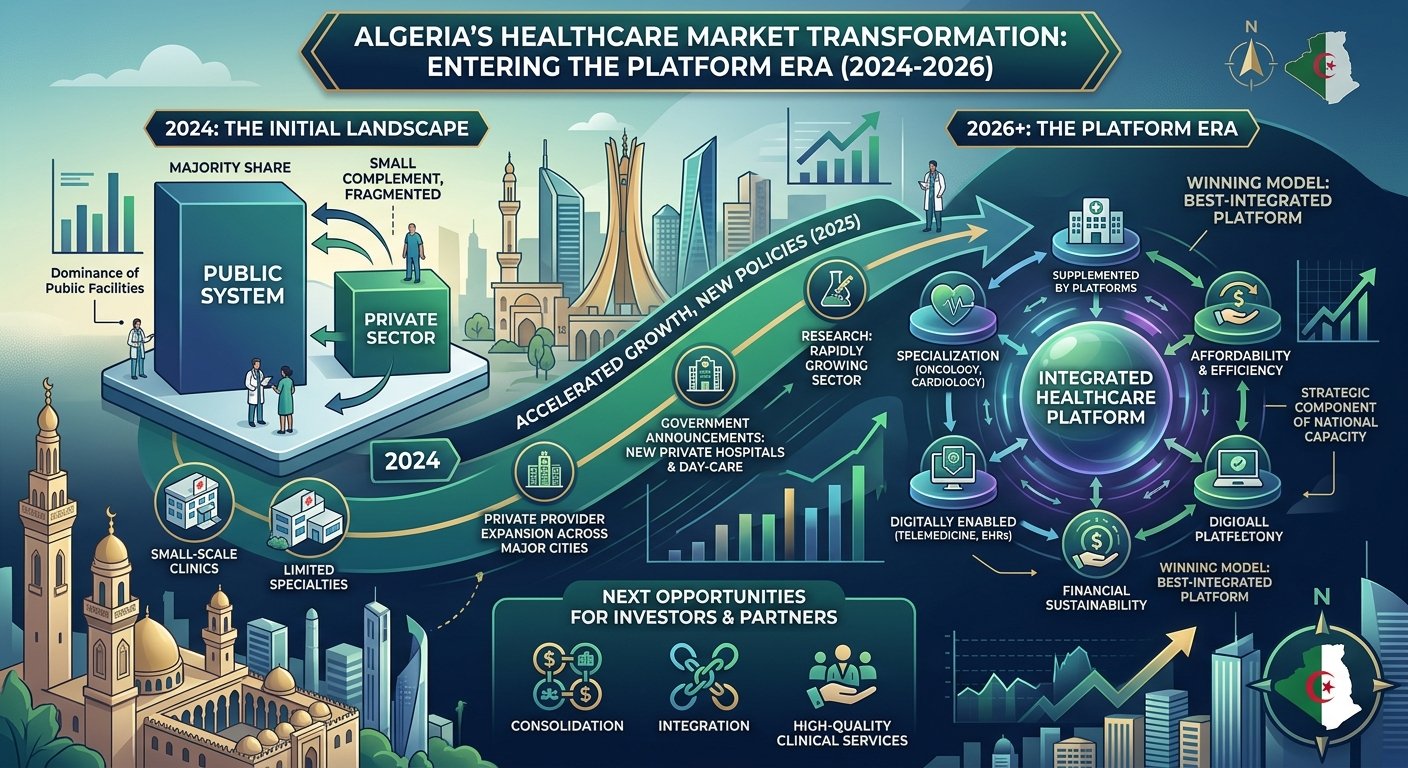
Algeria’s healthcare system is entering an important period of transformation. For decades, the country’s healthcare model has been dominated by publicly funded and publicly operated institutions. However, between 2024 and 2026, the private healthcare sector has become increasingly important as patients, employers and healthcare professionals seek greater access, shorter waiting times, specialized medical services and more modern healthcare environments.
Algeria is developing a hybrid healthcare ecosystem, combining a dominant public sector with an expanding private healthcare market. Private healthcare facilities are increasingly distributed across the country, although the strongest concentration remains in major metropolitan areas.
The private sector is also moving beyond the traditional clinic model. Hospitals, specialty centers, diagnostic networks, laboratories, day-surgery facilities, medical technology companies and professional healthcare operators are becoming increasingly important components of the healthcare value chain.
1. Understanding the Algerian Healthcare Market
Algeria has a population of more than 45 million people and one of the largest healthcare systems in North Africa. The state remains the principal healthcare provider and financier, but private providers increasingly complement public healthcare capacity.
Available industry research indicates that Algeria had approximately 602 private clinics and more than 23,000 private general and specialist medical practices in the 2021 baseline dataset. Private hospitalization capacity was estimated at approximately 7,200 beds compared with more than 77,000 public-sector beds.
These figures should not be interpreted as a definitive 2026 census. However, they provide an important baseline for understanding the scale and structure of the private healthcare market.
The Strategic Implication
The Algerian private healthcare market should no longer be viewed simply as a collection of individual clinics. It is developing into a broader healthcare industry involving:
- Private hospitals
- Multispecialty clinics
- Day-surgery centers
- Maternity hospitals
- Cardiology and cardiovascular centers
- Oncology facilities
- Dialysis centers
- Diagnostic imaging
- Medical laboratories
- Ophthalmology
- Orthopedics
- Rehabilitation
- Fertility and reproductive medicine
- Emergency and urgent care
- Corporate healthcare
- Medical tourism
- Digital health and healthcare technology
2. What Is Driving Private Healthcare Growth?
A. Growing Demand for Faster Access
One of the strongest drivers of private healthcare is the demand for faster access to medical services.
Patients who choose private healthcare may value:
- Shorter waiting periods
- Easier access to specialists
- More convenient appointments
- Greater privacy
- Improved patient experience
- Modern diagnostic equipment
- More personalized patient management
This is particularly relevant to surgery, maternity, cardiology, ophthalmology, orthopedics and diagnostic services.
B. Increasing Medical Specialization
The Algerian private market is gradually moving beyond the traditional general-clinic model.
Specialized private healthcare is becoming increasingly important in areas such as:
- Cardiology
- Oncology
- Neurosurgery
- Orthopedics
- Ophthalmology
- Obstetrics and gynecology
- Pediatrics
- Nephrology and dialysis
- Gastroenterology
- Radiology and medical imaging
This creates opportunities for specialty hospitals and centers of excellence rather than only traditional general hospitals.
C. Urban Concentration
Algiers remains the country’s principal private healthcare market, followed by major cities such as Oran, Constantine, Tizi Ouzou, Sétif, Annaba and Béjaïa.
Private healthcare is particularly concentrated in metropolitan areas where there is:
- Higher purchasing power
- Larger populations
- Greater physician concentration
- Corporate demand
- Better infrastructure
- Greater demand for specialized services
3. Healthcare Financing: A Major Market Constraint
The private healthcare sector does not operate independently of Algeria’s broader social protection system.
Healthcare financing remains strongly influenced by public social-security mechanisms, including CNAS and CASNOS. Supplementary private health insurance remains comparatively limited.
This creates an important strategic consideration for healthcare investors.
The future of private healthcare will depend not only on increasing the number of facilities, but also on developing sustainable payment mechanisms.
Potential growth areas include:
- Corporate healthcare contracts
- Employer-sponsored healthcare
- Private insurance
- Supplementary insurance
- Self-pay healthcare
- International patients
- Medical tourism
- Public-private partnerships
- Specialized high-value procedures
4. The Algerian Private Hospital Business Model
The most attractive private healthcare models are likely to be those that combine medical specialization with operational scale.
Hospitalization
Inpatient admissions remain an important component of hospital economics, particularly for surgical and complex medical cases.
Outpatient Care
Outpatient clinics can generate high patient volumes and serve as a referral engine for diagnostics, surgery and hospitalization.
Diagnostic Imaging
MRI, CT, ultrasound, mammography, radiography and other diagnostic services can create important recurring revenue streams.
Laboratory Medicine
Integrated laboratories can support hospital patients as well as external community referrals.
Surgery
Elective surgery represents an attractive private-sector opportunity because patients frequently value speed, physician choice, convenience and improved patient experience.
Specialized Centers
Cardiology, oncology, ophthalmology, orthopedics, fertility, dialysis and other specialized services can provide strong demand and clinical differentiation.
5. The Competitive Landscape: 2024–2026
There is no universally recognized official national ranking of Algeria’s private hospitals and clinics by revenue, beds, clinical outcomes or market share. Therefore, the following list should be understood as a market-oriented selection of prominent private healthcare institutions, rather than an official ranking.
10 Notable Private Healthcare Institutions in Algeria
1. Clinique Al Azhar — Algiers
Clinique Al Azhar is one of the recognizable private healthcare institutions in Algiers. Located in Dely Ibrahim, it provides a broad range of medical and surgical services.
Its broad specialty portfolio represents the multispecialty private hospital model emerging in Algeria.
2. Clinique Chifa — Hydra, Algiers
Clinique Chifa is an established private healthcare institution in the Algiers market. Its reported services include cardiology, surgery, endocrinology, gynecology, obstetrics, ophthalmology, neurology, radiology, urology and intensive care.
Its model demonstrates the value of combining multiple specialties with diagnostics and inpatient care.
3. Clinique Chahrazed — Algiers
Clinique Chahrazed is frequently cited among private healthcare institutions in Algiers. Its positioning illustrates the increasing importance of specialty-driven private healthcare, particularly in women’s health and selected surgical services.
4. Clinique Souad Laâdj — Algiers
Clinique Souad Laâdj is associated particularly with cardiology and cardiovascular care.
Its positioning reflects the emergence of specialized private centers capable of competing on complex clinical services rather than only basic medical care.
5. Clinique Ibn Sina — Algiers
Clinique Ibn Sina is another established private healthcare name in the Algerian market. Its reported services include dialysis, internal medicine and surgical care.
Its model highlights the opportunity for specialized services to operate alongside conventional hospital functions.
6. Clinique du Val — Algiers
Clinique du Val provides multiple outpatient and diagnostic specialties, including general medicine, gynecology, cardiology, endocrinology, pediatrics, dermatology, neurology, laboratory medicine and diagnostic radiology.
It represents the increasingly integrated clinic + diagnostics + specialist consultation model.
7. Clinique Les Oliviers — Tizi Ouzou
Clinique Les Oliviers is among the private institutions identified in Tizi Ouzou’s healthcare market.
Its inclusion is significant because Algeria’s private healthcare development is no longer restricted to Algiers. Regional cities are becoming increasingly important markets for private investment and specialized healthcare delivery.
8. Hôpital Chahids Mahmoudi — Tizi Ouzou
Hôpital Chahids Mahmoudi is a notable private hospital institution in Tizi Ouzou and represents the development of larger private hospital platforms outside the capital.
9. Clinique Les Jasmins — Oran
Oran is Algeria’s second major metropolitan healthcare market and has developed a substantial private healthcare ecosystem.
Clinique Les Jasmins is associated with Oran’s private healthcare market, particularly in maternity and women’s healthcare.
10. Clinique El Mokrani — Oran
Clinique El Mokrani is another private provider associated with Oran’s growing healthcare ecosystem, including surgical and orthopedic services.
Its presence reinforces Oran’s position as one of the country’s most important private healthcare markets outside Algiers.
6. Algiers vs. Oran: The Two Major Private Healthcare Markets
Algiers
Algiers represents the country’s most sophisticated private healthcare cluster, supported by:
- High concentration of specialists
- Corporate clients
- Affluent patient segments
- International connectivity
- Private diagnostic centers
- Advanced surgical services
- Pharmaceutical and medical-device companies
Oran
Oran represents a major secondary growth pole supported by:
- Large urban population
- Industrial and corporate activity
- Regional referral demand
- Medical specialists
- Growing private infrastructure
- Western Algeria’s broader catchment area
Investment Thesis: The next phase of private healthcare growth may come from regional healthcare networks rather than standalone facilities.
7. Investment Opportunities in Algeria Healthcare
7.1 Hospital Platforms
Rather than investing in individual clinics, investors can develop regional hospital platforms with centralized:
- Procurement
- Finance
- Human resources
- Marketing
- Information technology
- Quality management
- Revenue-cycle management
- Medical governance
This can create economies of scale and improve operational consistency.
7.2 Specialty Hospitals
Specialized hospitals may offer stronger differentiation than general hospitals.
Potential targets: Cardiology | Oncology | Orthopedics | Neurosurgery | Ophthalmology | Women’s Health | Pediatrics | Rehabilitation
7.3 Diagnostic Networks
Imaging and laboratory networks represent another attractive opportunity because they can serve hospitals, clinics, physicians, employers, insurance companies and self-pay patients.
7.4 Day Surgery
The development of day-hospital and ambulatory surgery models is particularly interesting. Government announcements in 2025 referenced hundreds of private hospital and day-hospital/clinic projects, demonstrating the scale of private-sector interest.
7.5 Healthcare Technology
Digital transformation is likely to become increasingly important through:
- Electronic medical records
- Digital booking
- Telemedicine
- AI-assisted diagnostics
- Digital imaging
- Hospital information systems
- Revenue-cycle platforms
- Patient engagement
- Healthcare analytics
8. Key Challenges for Private Healthcare Investors
Regulation
Private healthcare facilities operate under significant regulatory and medical oversight. Private hospitals are both investment entities and healthcare institutions providing socially important services.
Human Resources
Specialist physicians, nurses, anesthesiologists and experienced hospital managers remain critical success factors.
Pricing and Affordability
A significant portion of healthcare financing remains connected to public and social-security mechanisms, limiting the size of the purely private-pay market.
Geographic Concentration
Algiers and other major cities offer stronger demand but also greater competition.
Hospital Management
The transition from physician-owned clinic structures to professionally managed hospital companies will be an important development in the Algerian healthcare market.
9. What Will Define the 2026–2030 Algerian Healthcare Market?
The Algerian private healthcare market is moving toward a new phase. The next generation of healthcare companies is likely to be defined by five characteristics:
01. Scale
Moving from individual clinics toward networks and integrated healthcare platforms.
02. Specialization
Developing centers of excellence in cardiology, oncology, orthopedics, ophthalmology, women’s health and other high-demand specialties.
03. Integration
Connecting outpatient clinics, diagnostics, surgery, hospitalization and rehabilitation.
04. Digitalization
Using EMR, AI, telemedicine and data analytics to improve clinical and operational performance.
05. Professional Governance
Moving toward structured boards, medical governance, quality management, financial controls and professional hospital management.
10. Strategic Outlook
Algeria’s healthcare market should not be interpreted simply as a public-versus-private competition.
The more important trend is the emergence of a public-private healthcare ecosystem.
The public sector will continue to carry the principal responsibility for universal healthcare and population health, while private providers are increasingly positioned to contribute capacity, technology, specialist expertise, investment and operational innovation.
The scale of private-sector projects announced in 2025 is particularly significant. Government statements referenced 342 private hospital projects and 359 day-hospital/clinic projects, indicating substantial potential for expansion if these projects progress from authorization and development into operational facilities.
For investors, the opportunity is not merely to build another clinic. The larger opportunity is to build an integrated healthcare platform capable of combining medical excellence, technology, diagnostics, specialty care, efficient hospital operations and strong corporate governance.
Conclusion: Algeria’s Private Healthcare Market Is Entering Its Platform Era
Between 2024 and 2026, Algeria’s private healthcare sector has moved from being a relatively small complement to the public system toward becoming an increasingly strategic component of national healthcare capacity.
The market remains dominated by the public sector, but private providers are expanding across major cities and specialties. The combination of new private healthcare projects, growing demand for specialized services, technological modernization and increasing expectations around patient experience is creating a new competitive landscape.
The next opportunity is likely to be consolidation, specialization and integration.
For healthcare investors, operators and international partners, Algeria offers a market where the winning model may not necessarily be the largest hospital, but the best-integrated healthcare platform—one capable of delivering high-quality clinical services while remaining affordable, efficient, digitally enabled and financially sustainable.
Algeria Healthcare Market — Strategic Snapshot 2024–2026
| Market Dimension | 2024–2026 Outlook |
|---|---|
| Public healthcare | Dominant |
| Private healthcare | Rapidly expanding |
| Private hospital development | Strong pipeline |
| Day hospitals | High-growth opportunity |
| Diagnostics | Attractive |
| Specialty care | High potential |
| Algiers | Primary private healthcare hub |
| Oran | Major secondary growth market |
| Digital health | Emerging strategic priority |
| Private insurance | Still relatively limited |
| Healthcare investment | Increasing |
| Consolidation | Significant future opportunity |
| Hospital management | Increasingly important |
| AI & digitalization | Strategic growth area |
Editorial Note
There is currently no authoritative, government-published national ranking of Algeria’s “top 10 private hospitals” based on revenue, beds, clinical outcomes or market share. The institutions identified in this article are therefore presented as prominent private-market examples, not as an official ranking.
Historical private-sector capacity figures should likewise be treated as baseline market indicators rather than a definitive 2026 census. The most important signal for investors is the direction of the market: increasing private-sector participation, new healthcare infrastructure, specialization, digitalization and the emergence of larger healthcare platforms.
Algeria Healthcare Market | MENA & Africa Healthcare Industry Review | 2024–2026