Jamjoom Pharma: From Saudi Pharmaceutical Champion to a Regional MENA Platform
From Local Manufacturing to Regional Pharmaceutical Leadership
Among the companies shaping the next phase of the Middle East pharmaceutical industry, Jamjoom Pharma deserves particular attention.
What makes Jamjoom interesting is not simply its growth in Saudi Arabia. It is the way the company is building a regional pharmaceutical platform that combines manufacturing, commercialization, strategic partnerships and geographic expansion.
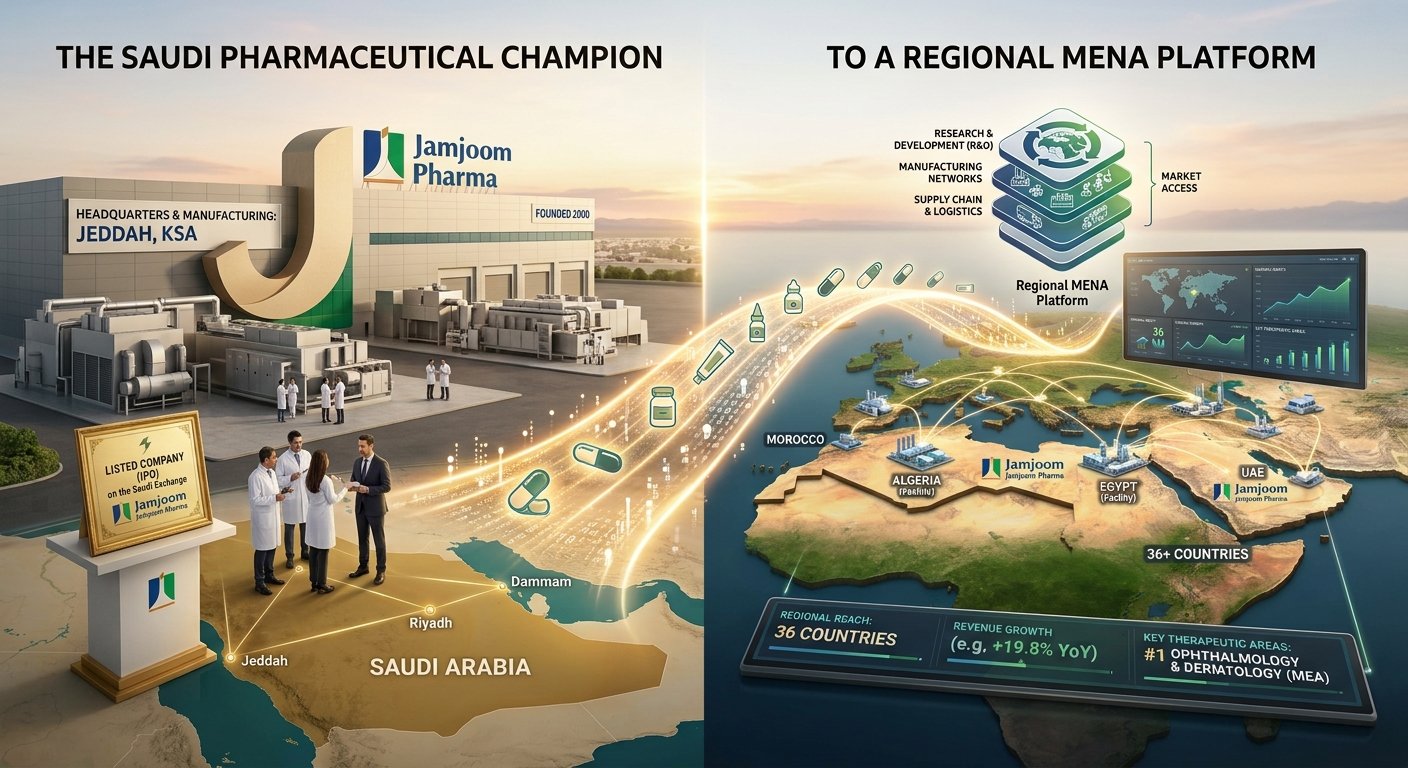
Established in Saudi Arabia, Jamjoom has evolved from a domestic pharmaceutical manufacturer into a company with operations and commercial reach across 36 countries in the Middle East and Africa, with core markets including Saudi Arabia, the UAE, Egypt, Iraq, the Levant and North Africa.
This evolution provides an important case study of how a Saudi pharmaceutical company can use the Kingdom as its industrial base while progressively developing a wider MENA footprint.
The Saudi Base: Where the Strategy Starts
Saudi Arabia remains the center of gravity for Jamjoom Pharma.
The company operates its principal manufacturing base in Jeddah, supported by specialized facilities and a growing R&D capability. Its Saudi platform has historically focused on branded generics and consumer healthcare, while the company has developed particular strengths in areas such as ophthalmology and dermatology.
The importance of Saudi Arabia to Jamjoom is therefore twofold.
First, it provides access to one of the largest pharmaceutical markets in the region.
Second, it provides the industrial and investment environment necessary to develop a more sophisticated domestic pharmaceutical manufacturing base.
Jamjoom’s strategy is increasingly aligned with Saudi Arabia’s broader ambition to strengthen pharmaceutical localization under Vision 2030.
But the more interesting story is what Jamjoom is doing beyond Saudi Arabia.
The Regional Footprint: From the Gulf to North Africa
Jamjoom’s regional presence is not based on a single model.
In some countries, the company operates directly through subsidiaries and offices. In others, it relies on distributors and strategic partnerships. This creates a flexible regional structure that allows Jamjoom to adapt its market-entry model according to the characteristics of each pharmaceutical market.
According to the company’s disclosures, Jamjoom has a presence across 36 countries, supported by manufacturing facilities in Saudi Arabia, Egypt and Algeria and commercial operations across MENA.
The company’s regional architecture can broadly be viewed through five important markets.
1. Saudi Arabia — The Manufacturing and Strategic Core
Saudi Arabia remains Jamjoom’s most important market.
The company reported strong growth in Saudi Arabia, reinforcing its position as one of the country’s leading domestic pharmaceutical companies.
This position gives Jamjoom an important domestic platform from which to expand internationally.
More importantly, the Kingdom is becoming the location where the company can build increasingly sophisticated manufacturing capabilities.
The Pfizer Transaction
One of the most significant strategic developments came in April 2026.
Jamjoom signed an agreement with Pfizer Saudi Limited Company to acquire Pfizer’s pharmaceutical manufacturing facility in King Abdullah Economic City.
The facility specializes in oral solid dosage pharmaceutical products, operates across the production chain and includes on-site quality-control laboratories.
This is important because it illustrates a new form of pharmaceutical localization.
Rather than building every new facility from the ground up, Saudi pharmaceutical companies can acquire established assets and integrate existing industrial capabilities into their own manufacturing networks.
For Jamjoom, this potentially means additional capacity, operational capabilities and a stronger industrial platform.
The strategic message is clear: Saudi localization is moving from simply attracting multinational factories toward strengthening Saudi-owned pharmaceutical manufacturing assets.
2. United Arab Emirates — The Gulf Expansion Platform
The United Arab Emirates is another important part of Jamjoom’s regional strategy.
Jamjoom has established a Dubai presence as part of its effort to strengthen its regional commercial infrastructure. The UAE represents one of its important growth markets, supported by the country’s pharmaceutical market and its role as a regional commercial and logistics hub.
The UAE also provides something strategically different from Saudi Arabia.
Saudi Arabia is increasingly becoming the manufacturing and localization engine.
The UAE can function as a regional commercial, logistics and business-development platform.
This combination gives Jamjoom the potential to connect Saudi production capabilities with broader Gulf and international markets.
3. Egypt — Manufacturing Hub and Gateway to Africa
Egypt is perhaps the most strategically important market outside Saudi Arabia for Jamjoom.
The company has an established manufacturing facility in Obour City, alongside commercial operations in Egypt.
Egypt is strategically valuable because it is not simply a market for Jamjoom products. It can also function as a manufacturing and distribution platform for neighboring markets, including Libya and Sudan.
This makes Egypt particularly valuable within the company’s regional architecture.
Saudi Arabia can provide capital, scale and manufacturing investment.
Egypt can provide manufacturing capacity, pharmaceutical talent and access to North and East African markets.
Together, the two markets can form the backbone of a broader Saudi-Egypt pharmaceutical production corridor.
4. Algeria — North African Manufacturing Presence
Jamjoom’s presence in Algeria adds another important dimension to its regional strategy.
The company has a joint-venture presence in Algeria, providing access to the country’s pharmaceutical market and local manufacturing capabilities.
Algeria is strategically significant because it is not simply another export destination. It is another example of Jamjoom’s preference for establishing local industrial and commercial relationships within important markets.
The result is a diversified manufacturing footprint across three major production countries:
Saudi Arabia → Egypt → Algeria
That gives the company a potentially powerful regional supply-chain structure.
5. Iraq and the Levant — High-Growth Commercial Markets
Jamjoom’s regional strategy also extends into Iraq and the Levant.
Iraq is particularly important because of its growing pharmaceutical demand and tender-driven market structure. Jamjoom has identified Iraq as an important market for continued regional expansion.
The Levant, meanwhile, provides Jamjoom with additional markets where branded generics and affordable pharmaceutical products can compete effectively.
This demonstrates an important characteristic of Jamjoom’s model:
The company does not need to manufacture in every country in which it operates.
Instead, it can combine local manufacturing in strategically important markets with distribution partnerships elsewhere.
The 2026 Shift: From Manufacturing Expansion to Strategic Consolidation
The Pfizer transaction is important, but it should not be viewed in isolation.
In April 2026, Jamjoom also announced a manufacturing agreement with Viatris Arabia, under which Jamjoom would manufacture several Viatris products for chronic diseases in Saudi Arabia.
This creates an interesting strategic pattern:
Acquire manufacturing assets + manufacture for multinational partners + expand regional distribution + develop local capabilities
That is a much more sophisticated model than traditional pharmaceutical localization.
It suggests that Jamjoom is increasingly positioning itself not simply as a manufacturer of its own products, but as a potential industrial pharmaceutical partner.
The Next Frontier: Biologics and Biosimilars
Perhaps the most important development for Jamjoom’s future came in July 2026.
Jamjoom announced that it had entered into a binding share subscription agreement with a Lifera-backed Biologics Company established to build, own and operate a facility in Saudi Arabia for the manufacture and commercialization of vaccines, biologics and biosimilars.
This is potentially a transformational development.
It moves the company’s strategic narrative beyond conventional branded generics and toward the higher-value end of the pharmaceutical industry.
If successfully executed, the project could position Jamjoom within an emerging Saudi ecosystem covering:
Biologics → Biosimilars → Vaccines → Advanced Manufacturing → Regional Commercialization
This is precisely the direction in which the Middle Eastern pharmaceutical industry is evolving.
A Different Kind of Regional Pharmaceutical Company
Jamjoom’s evolution illustrates an important change in the structure of the Middle Eastern pharmaceutical industry.
The traditional regional pharmaceutical model was largely:
Local factory → Local sales → Export surplus production
The emerging model is much more sophisticated:
Saudi manufacturing base → Regional subsidiaries → Local manufacturing hubs → Multinational partnerships → Technology transfer → Biologics → Regional exports
Jamjoom is increasingly moving toward this second model.
Its presence across Saudi Arabia, the UAE, Egypt, Algeria, Iraq and other MENA markets gives it the geographical platform to connect production with regional commercialization.
Why Jamjoom Matters to the Middle East Pharmaceutical Industry
Jamjoom is important not only because of the company itself.
It provides an indication of what a new generation of Middle Eastern pharmaceutical champions could look like.
- Domestic pharmaceutical manufacturing
- Regional market expansion
- Strategic acquisitions
- Manufacturing partnerships with multinational companies
- Expansion of production capacity
- R&D and product development
- Biologics and biosimilars
- Regional commercialization and exports
This combination is what makes Jamjoom strategically interesting.
It is no longer simply a Saudi pharmaceutical company selling products across the region.
It is increasingly becoming a regional pharmaceutical platform headquartered in Saudi Arabia.
Executive Takeaway
Jamjoom Pharma’s story should be viewed as part of a much larger transformation taking place in Saudi Arabia and across the Middle East.
The acquisition of Pfizer’s manufacturing facility demonstrates how industrial consolidation can accelerate pharmaceutical localization.
The Viatris manufacturing agreement demonstrates how Saudi companies can become manufacturing partners for global pharmaceutical companies.
The company’s presence in Egypt and Algeria demonstrates how Saudi pharmaceutical capital and expertise can be combined with local manufacturing platforms across MENA.
And the 2026 biologics and biosimilars initiative points toward an even more ambitious future: participation in higher-value biopharmaceutical manufacturing.
The strategic question is therefore no longer whether Jamjoom can become a larger Saudi pharmaceutical company.
The more important question is whether Jamjoom can become one of the leading Saudi-owned pharmaceutical platforms connecting the Gulf, North Africa and the wider MENA market.
The evidence from its expanding manufacturing footprint, strategic partnerships and regional presence suggests that this is precisely the direction in which the company is heading.
Jamjoom’s evolution is therefore not merely a corporate growth story. It is a case study in the transformation of the Middle Eastern pharmaceutical industry—from local manufacturing toward regional value-chain leadership.