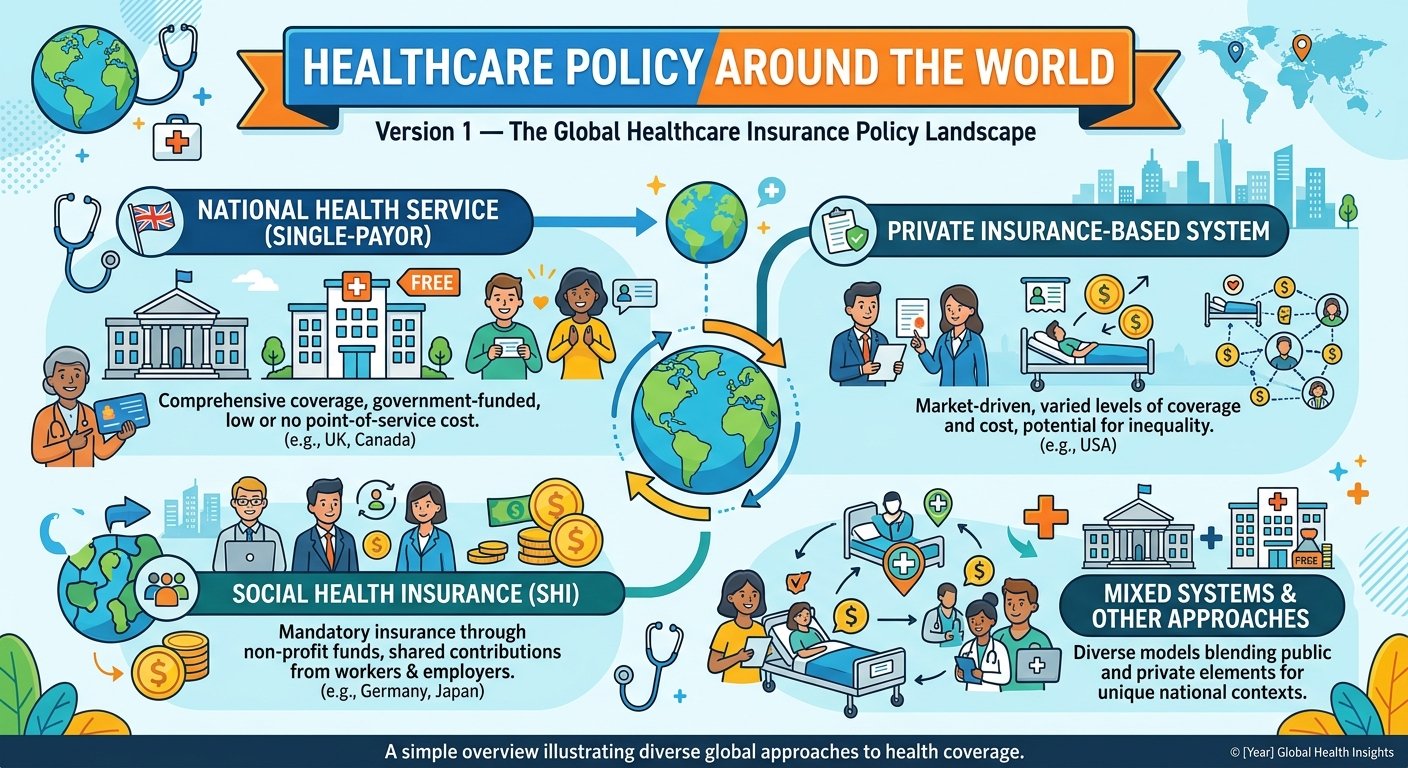
Healthcare Policy Around the World Version 1 — The Global Healthcare Insurance Policy Landscape
From Government Protection to Strategic Health Financing, Insurance, Risk Pooling and Value-Based Care
Executive Summary
Healthcare is not governed by a single policy. It is governed by a policy architecture—a connected system of laws, regulations, financing mechanisms, insurance arrangements, provider rules, clinical standards, public-health interventions, workforce policies, pharmaceutical regulations, technology frameworks and governance mechanisms that determine how healthcare is financed, delivered, accessed and regulated.
Among all of these dimensions, healthcare financing and insurance policy sit at the center of the system because they determine who pays, who is protected, what services are covered, how providers are paid, how financial risk is distributed and ultimately how healthcare markets behave.
Healthcare financing can be understood through three fundamental functions:
- Revenue raising — how money is generated for healthcare.
- Pooling — how financial risks and resources are accumulated and shared.
- Purchasing — how healthcare services are bought from providers.
The labels attached to systems—such as social health insurance, tax-funded healthcare or community insurance—can be misleading unless the underlying financing, pooling and purchasing arrangements are examined.
A country may officially describe itself as having a public healthcare system, while private insurers play a major role. Another country may use social health insurance, yet depend heavily on taxation. A third country may mandate private insurance while using substantial government subsidies and regulation to achieve universal coverage.
The modern global healthcare market is therefore not divided neatly between “public” and “private.” Instead, most countries operate some form of mixed healthcare policy architecture.
This article constitutes Version 1 of a broader healthcare policy series. It focuses specifically on the insurance and healthcare-financing dimension. Subsequent versions can expand the framework into pharmaceuticals, hospitals, medical devices, diagnostics, digital health, workforce, public health, medical education, investment, technology, quality and accreditation, and other healthcare sectors.
1. Understanding Healthcare Policy as an Architecture
Healthcare policy can be understood as the collection of government, regulatory and institutional decisions that determine:
- Who has access to healthcare.
- Which services are guaranteed.
- Who pays for healthcare.
- How much individuals pay.
- How financial risks are pooled.
- Who is eligible for insurance.
- Which insurers can operate.
- Which providers can participate.
- How providers are reimbursed.
- How medicines and medical technologies are priced.
- How quality is measured.
- How healthcare information is managed.
- How healthcare organizations are governed.
- How private-sector participation is regulated.
- How health emergencies are managed.
- How vulnerable populations are protected.
Healthcare Policy = Access + Financing + Insurance + Regulation + Delivery + Quality + Public Health + Technology + Governance
Insurance policy is therefore not an isolated financial instrument. It is one of the principal mechanisms through which a country converts healthcare policy into an operating economic system.
2. Why Insurance Policy Is So Important
Healthcare is economically different from most consumer markets. People generally do not know in advance:
- when they will become sick;
- how severe their illness will be;
- how much treatment will cost;
- which treatment will be required;
- how long treatment will continue;
- whether they will require hospitalization;
- whether they will require expensive medicines;
- whether they will require long-term rehabilitation or chronic disease management.
Insurance exists fundamentally to pool unpredictable financial risks.
Instead of an individual paying the full cost of a potentially catastrophic event, many individuals contribute to a pool from which healthcare expenditures are financed.
Healthcare insurance is not simply a payment mechanism; it is a social and economic risk-sharing mechanism.
3. The Five Fundamental Global Healthcare Financing Models
Although actual national systems are more complicated, global healthcare systems can broadly be understood through five major financing architectures.
3.1 Tax-Funded National Health Service
Under a National Health Service model, healthcare is predominantly financed through general taxation. Government becomes the principal purchaser and often the principal provider.
- General taxation
- Universal eligibility
- Government budgeting
- Public hospitals
- Government-employed healthcare professionals in some systems
- Relatively limited direct payment at the point of service
- Government purchasing and regulation
The United Kingdom’s NHS is the most internationally recognized example of this model. However, even tax-funded systems increasingly purchase services from private providers and use private insurance for supplementary access.
Public financing does not necessarily mean public delivery.
4. National Health Insurance
National Health Insurance uses a public insurance mechanism to finance healthcare. The government may operate a national insurance fund or a highly centralized purchasing system while healthcare delivery may involve both public and private providers.
Population → Mandatory Contributions/Taxes → National Pool → Healthcare Purchasers → Providers
This model attempts to separate financing, purchasing, regulation and service delivery. That separation can create greater flexibility in contracting providers.
5. Social Health Insurance
Social Health Insurance, or SHI, generally involves compulsory contributions to statutory insurance funds.
Contributions may be linked to:
- Salaries
- Employers
- Employees
- Government contributions
- Taxation
- Other public revenues
Countries using variants of social insurance include Germany, France, Belgium, Austria and several other European and Asian systems.
The important principle is:
Insurance becomes part of the social protection architecture rather than simply a commercial financial product.
6. Mandatory Private Health Insurance
A fourth model uses private insurance as the primary mechanism of coverage, while government establishes mandatory participation, subsidies, minimum benefit requirements and extensive regulation.
The Netherlands and Switzerland demonstrate important examples of compulsory private health insurance arrangements.
Private insurance does not necessarily mean an unregulated healthcare market.
In highly regulated systems, private insurers can function as regulated risk-bearing purchasers within a universal social policy framework.
7. Predominantly Private and Mixed Insurance Systems
The United States provides the most prominent example of a healthcare system in which employer-sponsored and individual private insurance coexist with public programs such as Medicare and Medicaid.
- Employer insurance
- Individual insurance
- Government insurance
- Public subsidies
- Direct patient payments
- Supplemental coverage
- Specialized programs
A country can therefore have extensive insurance coverage without having one single national insurance model.
8. The Global Insurance Policy Spectrum
| Model | Core Characteristics |
|---|---|
| No or Limited Insurance | Government budgets, household payments, charities and external assistance |
| Voluntary Private Insurance | Individuals or employers voluntarily purchase coverage |
| Employer-Based Insurance | Employers provide health insurance as part of compensation |
| Mandatory Social Insurance | Workers and employers contribute to statutory insurance funds |
| National Health Insurance | A government-controlled or publicly mandated insurance mechanism |
| Universal Tax-Funded Healthcare | General taxation finances the majority of healthcare |
| Mandatory Private Insurance | Private insurers provide primary coverage under government-defined rules |
| Hybrid Universal Systems | Public financing, statutory insurance, private insurance and direct payments operate simultaneously |
Most sophisticated healthcare systems ultimately fall somewhere between these models.
9. The Three Core Insurance Questions
Question 1: Who Pays?
- General taxation
- Payroll contributions
- Employer contributions
- Employee contributions
- Individual premiums
- Government subsidies
- Insurance premiums
- Investment income
- Special health taxes
- External funding
Question 2: Who Is Protected?
- Citizens
- Legal residents
- Workers
- Employers
- Families
- Children
- Elderly people
- Low-income households
- People with disabilities
- Refugees
- Expatriates
- Tourists
- Undocumented populations
Coverage eligibility is therefore both a financial policy and a social policy.
Question 3: What Is Covered?
- Primary care
- Emergency care
- Inpatient care
- Outpatient care
- Surgery
- Maternity
- Mental healthcare
- Medicines
- Diagnostics
- Rehabilitation
- Dental care
- Optical care
- Home healthcare
- Long-term care
- Preventive services
- Palliative care
- Advanced therapies
Universal coverage does not necessarily mean that every possible healthcare service is automatically covered.
Insurance Coverage ≠ Effective Healthcare Access
Insurance Enrollment ≠ Financial Protection
10. Benefit Package Policy
A sophisticated insurance system requires a clearly defined Essential Health Benefits Package.
| Dimension | Policy Question |
|---|---|
| Covered Services | What is included? |
| Coverage Limits | How much is covered? |
| Frequency | How often can a service be accessed? |
| Clinical Eligibility | Under what clinical circumstances is it covered? |
| Provider Eligibility | Which providers may deliver it? |
| Geographic Coverage | Where can the patient receive care? |
| Financial Participation | What deductible, copayment or coinsurance applies? |
| Prior Authorization | Which services require insurer approval? |
| Referral Requirements | Does the patient require primary-care referral? |
11. Insurance Cost-Sharing Policies
Deductible
The patient pays an initial amount before insurance begins paying.
Copayment
The patient pays a fixed amount for a service.
Coinsurance
The patient pays a percentage of the cost.
Annual Maximum
The insurer defines a maximum amount payable under a benefit.
Out-of-Pocket Maximum
The patient’s financial liability is capped after reaching a defined threshold.
Exclusions
Certain services are excluded from the policy.
Waiting Periods
Certain benefits become available only after a defined period.
The policy challenge is to control unnecessary utilization without making necessary healthcare financially inaccessible.
12. Insurance and Financial Protection
The fundamental purpose of healthcare insurance should not simply be to pay medical bills. It should provide financial protection.
- Catastrophic household expenditure
- Medical bankruptcy
- Delayed treatment
- Untreated chronic disease
- Avoidance of preventive care
- Impoverishment caused by serious illness
A successful insurance system should therefore be evaluated not only by “How many people are insured?” but also by “How effectively does insurance protect people from financial hardship?”
13. Universal Coverage vs Universal Protection
A country may report very high insurance enrollment while patients still experience:
- High deductibles
- Large copayments
- Uncovered medicines
- Restricted provider networks
- Long waiting times
- Limited geographic access
- Exclusions
- Underinsurance
A mature policy framework should measure:
Population Coverage + Service Coverage + Financial Protection + Quality + Timeliness
14. Insurance Pooling Policy
Pooling is one of the most important concepts in healthcare economics.
A properly designed insurance pool allows the financial burden of expensive treatment to be distributed across the broader insured population.
Risk Sharing
Low-risk individuals subsidize high-risk individuals.
Income Redistribution
Higher-income groups can subsidize lower-income groups.
Intergenerational Redistribution
Working populations can help finance elderly populations.
Population Stability
The system becomes less dependent on the financial capacity of individual households.
15. Fragmented vs Consolidated Insurance Pools
One National Pool
- Greater risk diversification
- Stronger purchasing power
- Reduced fragmentation
- Greater cross-subsidization
Multiple Insurance Pools
- Competition
- Consumer choice
- Innovation
- Differentiated purchasing strategies
The policy debate is therefore not simply one insurer vs many insurers. It is:
How can a country achieve adequate risk pooling while maintaining efficiency, choice and accountability?
16. Insurance Regulation
A comprehensive health-insurance regulatory framework should address:
- Licensing
- Solvency
- Capital requirements
- Reinsurance
- Premium regulation
- Underwriting
- Claims management
- Consumer protection
- Disclosure
- Exclusions
- Provider contracting
- Network adequacy
- Complaints
- Fraud
- Medical necessity
- Data protection
- Conflict of interest
- Financial reporting
17. Risk Selection and Adverse Selection
People who anticipate high healthcare expenditure may be more likely to purchase insurance. If healthier people remain outside the pool, premiums can increase.
Higher Risk → Higher Premiums → Healthy People Exit → Even Higher Risk → Higher Premiums
Mandatory participation or strong incentives can therefore stabilize insurance pools.
18. Moral Hazard
Moral hazard occurs when insurance changes behavior because the individual does not bear the full cost of healthcare.
Insurance policy must therefore address both:
- Patient-side incentives
- Provider-side incentives
This is why healthcare purchasing policy is as important as insurance coverage policy.
19. Strategic Purchasing
The insurer or public purchaser should not simply reimburse every healthcare bill submitted by a provider. It should strategically purchase healthcare.
Strategic purchasing means asking:
- Which providers should be contracted?
- At what price?
- For which services?
- Based on what quality?
- With what outcomes?
- Under which payment model?
- What utilization controls are appropriate?
20. Provider Payment Policies
Fee-for-Service
Providers receive payment for each service.
Advantages:
- Simple
- Encourages service availability
- Familiar to providers
Risks:
- Overutilization
- Fragmented care
- Volume over value
Capitation
Providers receive a fixed payment per enrolled patient.
Advantages:
- Encourages prevention
- Encourages cost control
- Supports population management
Risks:
- Potential under-provision
- Risk selection
- Quality concerns if poorly regulated
Diagnosis-Related Groups
Hospitals receive a predetermined payment based on diagnosis and case characteristics.
This can encourage efficiency, predictable expenditure and hospital productivity, but requires accurate coding, clinical classification and quality monitoring.
21. Value-Based Healthcare Payment
Paying for Outcomes Instead of Paying Only for Activities
This can include:
- Quality bonuses
- Bundled payments
- Outcome-based contracts
- Shared savings
- Risk-sharing agreements
- Population-based payments
- Readmission penalties
- Performance incentives
The objective is to move healthcare from Volume → Value and from Treatment → Outcomes.
22. Private Health Insurance: The Three Major Roles
22.1 Substitutive Insurance
Private insurance substitutes for public/statutory coverage for certain groups.
22.2 Complementary Insurance
Private insurance covers services or cost-sharing not covered by the public system.
22.3 Supplementary Insurance
Private insurance provides additional benefits such as broader provider choice, faster access, enhanced accommodation and additional services.
23. Employer-Sponsored Health Insurance
Employer-based insurance is an important component of healthcare policy in many countries.
The employer may:
- Pay the full premium
- Share the premium with employees
- Provide multiple plans
- Negotiate provider networks
- Contract through a broker or insurer
This creates an important policy question:
Should access to healthcare depend on employment?
24. Government Subsidies
Government subsidies are frequently used to make insurance affordable.
- Low-income households
- Children
- Elderly populations
- People with disabilities
- Unemployed individuals
- Informal workers
- Rural communities
Ability to Pay should be separated from Need for Healthcare.
25. Community-Based Health Insurance
Community-based insurance can operate in populations where formal insurance markets or government schemes are limited.
Potential advantages include:
- Local ownership
- Community participation
- Increased access
However, small pools may suffer from limited risk diversification, insufficient financial capacity, administrative costs and high-risk concentration.
26. Reinsurance Policy
Reinsurance allows insurers to transfer part of their risk to another entity.
This is particularly important for:
- Catastrophic claims
- Rare diseases
- High-cost oncology
- Transplant
- Advanced surgery
- Neonatal intensive care
- Gene therapies
- High-cost medicines
Patient Risk Pool → Insurer → Reinsurer → Global Risk Market
27. Catastrophic Health Insurance
Catastrophic insurance focuses primarily on protecting households from very large healthcare expenditures.
This model can reduce catastrophic financial exposure but may create barriers to routine and preventive care if not combined with broader coverage.
28. Long-Term Care Insurance
Aging populations create increasing demand for nursing care, home care, rehabilitation, assisted living, chronic disease support, dementia care and long-term disability support.
Health Insurance + Social Care + Long-Term Care
29. Prescription Drug Insurance
A national drug-insurance policy must address:
- Formularies
- Generic substitution
- Reference pricing
- Reimbursement
- Prior authorization
- Specialty drugs
- Orphan drugs
- Biosimilars
- Pharmacy networks
- Drug utilization review
30. Mental Health Insurance Policy
Modern policy increasingly seeks parity between mental and physical healthcare, including benefit coverage, reimbursement, provider access and continuity of care.
31. Maternity and Reproductive Healthcare
Insurance policy must define coverage for:
- Antenatal care
- Childbirth
- Cesarean section
- Neonatal care
- Fertility services
- High-risk pregnancy
- Maternal complications
32. Emergency Healthcare Policy
Emergency healthcare raises a fundamental policy question:
Can a patient be denied emergency care because they cannot pay?
Emergency-care policy generally creates special rules regarding access, stabilization, reimbursement, insurer authorization and emergency provider payments.
33. Fraud, Waste and Abuse
Insurance systems can be exposed to:
- Fraudulent claims
- Phantom patients
- Unnecessary procedures
- Upcoding
- Duplicate billing
- Unnecessary admissions
- Prescription fraud
- Provider collusion
- Identity fraud
Healthcare Fraud Management + Data Analytics + Clinical Audit + Claims Intelligence
34. Prior Authorization Policy
Prior authorization allows insurers to review certain services before they are delivered.
- High-cost medicines
- Advanced imaging
- Elective surgery
- Hospitalization
- Specialty treatment
- Biologics
- Advanced therapies
The policy challenge is to create:
Clinical Protection Without Administrative Overload.
35. Provider Networks
Networks may be:
- Open
- Closed
- Preferred
- Tiered
- Regional
- National
- International
Network design influences insurer cost, provider bargaining power, patient choice, healthcare quality and geographic access.
The insurance company is not simply financing healthcare. It is helping to shape the healthcare delivery market.
36. Insurance and Hospital Strategy
Hospital management must increasingly understand:
- Payer mix
- Reimbursement rates
- Claims rejection
- Authorization
- Coding
- Contract negotiations
- Length of stay
- Case mix
- Utilization
- Quality indicators
- Readmissions
- Patient acquisition
Population → Insurer/Purchaser → Network → Provider → Outcome → Payment
This represents a major structural transformation in healthcare economics.
37. Insurance and Primary Healthcare
A well-designed insurance model can incentivize prevention, vaccination, screening, chronic disease management, family medicine, early diagnosis and referral coordination.
This can reduce unnecessary use of emergency departments, hospitals and expensive specialists.
38. Insurance and Prevention
Prevent → Detect → Manage → Treat → Rehabilitate
Insurance can finance screening, vaccination, health-risk assessment, smoking cessation, obesity programs, diabetes management and cardiovascular prevention.
This transforms insurers from claims payers into population-health managers.
39. Insurance and Digital Health
- Electronic claims
- Electronic medical records
- Digital eligibility verification
- E-prescriptions
- Telemedicine
- AI claims review
- Fraud detection
- Predictive analytics
- Digital prior authorization
- Patient portals
This requires new policies around cybersecurity, privacy, consent, interoperability, data ownership and algorithmic accountability.
40. AI and Insurance Policy
| Area | AI Application |
|---|---|
| Underwriting | Risk assessment and pricing |
| Claims | Automated review and fraud detection |
| Utilization Management | Identifying potentially inappropriate services |
| Population Health | Predicting high-risk patients |
| Provider Performance | Analyzing outcomes and costs |
| Disease Management | Predicting deterioration |
AI also introduces major policy questions concerning bias, transparency, discrimination, explainability, patient consent and data governance.
The future insurance regulator will increasingly need to regulate not only insurers, but also insurance algorithms.
41. Cross-Border Health Insurance
Global mobility creates demand for:
- Expatriate insurance
- International private medical insurance
- Medical tourism coverage
- Cross-border treatment
- Emergency evacuation
- Multinational employer plans
42. Medical Tourism and Insurance
Potential insured treatments include cardiac surgery, oncology, orthopedics, fertility, transplantation, dental care and cosmetic surgery.
Insurance + Accreditation + International Pricing + Provider Networks + Patient Safety
43. Insurance and Private Healthcare Investment
Investors evaluating hospitals, clinics, laboratories, radiology, pharmacies, home healthcare, rehabilitation and digital health must understand the payer system.
Healthcare Investment Strategy = Clinical Strategy + Market Strategy + Payer Strategy
44. Insurance and Provider Consolidation
Insurance purchasing power can influence provider consolidation. Large insurers may negotiate with hospital groups, diagnostic networks, pharmacy chains and physician groups. Conversely, large provider groups can develop greater negotiating power with insurers.
Insurer Consolidation ↔ Provider Consolidation
Regulators therefore need to monitor market concentration, pricing power, anti-competitive behavior, network access and patient choice.
45. Insurance Policy and Health Equity
A healthcare insurance system should be evaluated through an equity lens.
- Do rural citizens receive equivalent access?
- Do low-income households receive adequate protection?
- Are elderly people adequately covered?
- Are chronic diseases covered?
- Are vulnerable populations protected?
- Are women able to access essential services?
- Are people with disabilities appropriately supported?
46. The Role of Government
| Government Function | Purpose |
|---|---|
| The Rules | Licensing and regulation |
| Minimum Coverage | Essential benefits |
| Safety Net | Protection for vulnerable populations |
| Financial Architecture | Taxes, subsidies and insurance rules |
| Quality Framework | Clinical and organizational standards |
| Competition Framework | Prevention of anti-competitive behavior |
| Data Framework | Privacy, security and interoperability |
| Public Health Function | Population-level prevention and health security |
47. The Role of the Private Sector
The private sector can participate as:
- Insurer
- Hospital
- Clinic
- Pharmacy
- Laboratory
- Technology company
- Pharmaceutical company
- Medical-device manufacturer
- Healthcare investor
- Third-party administrator
- Reinsurer
- Healthcare manager
The modern healthcare system is therefore better understood as an ecosystem rather than a public-versus-private binary.
48. The Role of the Regulator
A modern healthcare regulator should protect five major interests:
| Stakeholder | Primary Protection |
|---|---|
| Patient | Access, quality and financial protection |
| Insurer | Solvency and sustainable risk management |
| Provider | Fair reimbursement and predictable contracting |
| Government | Fiscal sustainability and population health |
| Market | Competition, innovation and transparency |
Patient Protection + Market Sustainability + Fiscal Sustainability + Innovation
49. Insurance Policy as a Strategic Purchasing System
The future insurer should not be viewed simply as a claims-paying organization.
Risk Manager + Purchaser + Population Health Manager + Data Organization + Quality Partner
Traditional Model
Premium → Claim → Payment
Modern Model
Population → Risk Pool → Prevention → Network → Care Management → Outcome → Payment
The second model is much closer to value-based healthcare.
50. Global Comparison: A Simplified Policy Map
| Model | Main Funding | Main Risk Pool | Main Purchaser | Private Providers | Private Insurance |
|---|---|---|---|---|---|
| NHS | Taxation | Government/public | Government | Often significant | Usually supplementary |
| National Health Insurance | Taxes/contributions | National fund | Public insurer | Significant | Complementary/supplementary |
| Social Health Insurance | Payroll + taxes | Statutory funds | Insurance funds | Significant | Supplemental |
| Mandatory Private Insurance | Premiums + subsidies | Private insurers | Private insurers | Major | Primary |
| Employer-Based | Employer/employee premiums | Employer/insurer pools | Insurers/employers | Major | Primary |
| Mixed System | Multiple sources | Multiple pools | Public + private | Major | Major |
| Predominantly Cash | Household payments | Limited pooling | Patients | Major | Limited |
The table should be viewed as a conceptual framework rather than a classification of entire national systems. Most countries combine multiple mechanisms.
51. The Most Important Global Policy Trend
The global healthcare system is moving away from the simple question:
“Who owns the hospital?”
toward the more important questions:
“Who finances healthcare, who bears the risk, who purchases care and who is accountable for outcomes?”
Ownership remains important. But financing and purchasing increasingly determine market behavior.
52. From Insurance to Healthcare Ecosystem Management
The next generation of healthcare systems will increasingly integrate:
Insurance → Healthcare Providers → Pharmaceuticals → Diagnostics → Digital Health → Public Health → AI → Population Health → Data → Investment
This creates a healthcare ecosystem in which financial and clinical decisions become increasingly interconnected.
53. A Proposed Global Healthcare Policy Architecture
| Layer | Core Question |
|---|---|
| 1 — Population | Who needs healthcare? |
| 2 — Eligibility | Who is entitled to coverage? |
| 3 — Revenue | Where does the money come from? |
| 4 — Pooling | Who bears the financial risk? |
| 5 — Benefits | What services are covered? |
| 6 — Purchasing | Who buys healthcare? |
| 7 — Providers | Who delivers healthcare? |
| 8 — Payment | How are providers paid? |
| 9 — Quality | How is performance measured? |
| 10 — Regulation | Who supervises the system? |
| 11 — Data | Who owns and governs healthcare information? |
| 12 — Outcomes | What health outcomes are achieved? |
This 12-layer model provides a useful foundation for comparing healthcare systems across countries.
54. The Healthcare Insurance Policy Scorecard
| Dimension | Core Question |
|---|---|
| Population Coverage | Who is insured? |
| Financial Protection | Are households protected? |
| Benefit Depth | What services are covered? |
| Affordability | Can people afford premiums/cost sharing? |
| Risk Pooling | How effectively is risk shared? |
| Provider Access | Can patients access appropriate providers? |
| Purchasing | Does the payer purchase strategically? |
| Quality | Are outcomes measured? |
| Sustainability | Can the system remain financially viable? |
| Equity | Are vulnerable populations protected? |
An advanced assessment can then add innovation, digital maturity, AI governance, fraud control, pharmaceutical access, medical technology, workforce capacity and emergency preparedness.
55. What Makes an Insurance System Sustainable?
A sustainable healthcare insurance system must balance four competing objectives:
People must receive needed healthcare.
Healthcare must achieve appropriate outcomes.
Individuals and governments must be able to finance the system.
The system must remain financially viable over time.
A system that maximizes access without financial sustainability can collapse. A system that maximizes financial control without access can become socially unacceptable. A system that maximizes access without quality can produce inefficient healthcare.
Sustainable Healthcare = Access + Quality + Affordability + Financial Sustainability
56. The Future of Insurance Policy
- From Volume to Value: Payment increasingly linked to outcomes.
- From Treatment to Prevention: Insurance increasingly finances population health.
- From Claims Management to Risk Management: Insurers increasingly manage patient risk before claims occur.
- From Fragmented Care to Integrated Care: Primary care, specialists, hospitals and post-acute care become interconnected.
- From Manual Claims to AI-Assisted Claims: Automation becomes increasingly important.
- From Annual Contracts to Dynamic Risk Management: Data allows more continuous monitoring.
- From Individual Risk to Population Risk: Population health becomes a central payer responsibility.
- From Insurance Companies to Healthcare Platforms: Insurers increasingly connect patients, providers, pharmacies, laboratories and digital services.
57. The Strategic Question for Governments
Governments should not ask only:
“How much should we spend on healthcare?”
They should ask:
- How much should society collectively finance?
- Which risks should be pooled?
- Which services should be guaranteed?
- Which services should remain optional?
- Who should purchase healthcare?
- How should providers be paid?
- How should private insurance participate?
- How should private providers participate?
- How should quality be measured?
- How should vulnerable groups be protected?
- How should technology change the system?
- How can the system remain financially sustainable?
58. The Strategic Question for Insurers
Insurers should move beyond:
“How do we reduce claims?”
toward:
“How do we improve health outcomes while managing total cost of care?”
This means insurers should increasingly measure:
- Disease incidence
- Preventable admissions
- Emergency utilization
- Readmissions
- Medication adherence
- Chronic disease control
- Patient outcomes
- Provider performance
- Total cost of care
The insurer of the future should be a health-value organization, not simply a claims organization.
59. The Strategic Question for Healthcare Providers
Hospitals and healthcare providers should increasingly ask:
“What value do we create for the payer and the patient?”
This changes hospital strategy from:
Beds + Doctors + Equipment
to:
Capacity + Clinical Excellence + Patient Experience + Outcomes + Cost Efficiency + Payer Relationships
Insurance policy therefore becomes an essential component of hospital strategy.
60. The Strategic Question for Investors
Healthcare investors should analyze:
- Payer penetration
- Insurance density
- Public insurance reforms
- Reimbursement models
- Premium growth
- Provider pricing
- Population demographics
- Chronic disease burden
- Healthcare utilization
- Regulatory risk
- Consolidation
- Government healthcare expenditure
A hospital market with rapidly expanding insurance coverage can behave very differently from a predominantly cash-pay market.
61. The Global Direction: From Fragmentation to Integration
Government
↓
Regulation & Social Protection
↓
Insurance / Public Purchasing
↓
Strategic Purchasing
↓
Integrated Provider Networks
↓
Primary Care → Specialist Care → Hospital → Rehabilitation → Long-Term Care
↓
Digital Health + Data + AI
↓
Population Health Outcomes
This is the direction in which healthcare financing, insurance and service delivery increasingly converge.
62. A New Definition of Insurance
Traditional definition: Insurance protects an individual against financial loss.
Healthcare definition: Health insurance protects individuals and populations against healthcare-related financial risk while organizing the financing and purchasing of healthcare services.
Next-generation health insurance is a regulated mechanism for pooling health risks, purchasing healthcare, protecting households financially, improving population health and creating incentives for measurable healthcare value.
63. Conclusion
There is no single “global healthcare system.” There are multiple policy architectures, each shaped by history, economics, demographics, politics, culture, government capacity, labor markets, private-sector development and population health needs.
Nevertheless, almost every healthcare system must solve the same fundamental problems:
- Who pays?
- Who is covered?
- What is covered?
- Who bears the risk?
- Who purchases healthcare?
- Who delivers it?
- How are providers paid?
- How is quality measured?
- How is the system regulated?
- How is financial sustainability achieved?
Insurance sits directly at the intersection of these questions.
For this reason, understanding healthcare insurance policy is essential not only for insurers but also for governments, regulators, hospitals, physicians, investors, pharmaceutical companies, diagnostic providers, medical-device companies, digital-health organizations and healthcare consultants.
Healthcare policy is no longer simply about building hospitals or financing medical treatment. It is about designing an integrated economic and social architecture capable of converting financial resources into equitable access, quality care, measurable outcomes and sustainable population health.
Version 1 — The Beginning of a Global Healthcare Policy Series
This Version 1 establishes the Insurance & Healthcare Financing Policy Framework.
| Version | Healthcare Policy Sector | Core Focus |
|---|---|---|
| Version 1 | Insurance & Healthcare Financing | Financing, pooling, purchasing, insurance and financial protection |
| Version 2 | Hospital Policy | Regulation, licensing, ownership, governance, accreditation, financing, capacity and PPPs |
| Version 3 | Pharmaceutical Policy | Registration, pricing, reimbursement, intellectual property, localization and access |
| Version 4 | Medical Devices Policy | Registration, procurement, reimbursement, safety and technology assessment |
| Version 5 | Diagnostic Policy | Laboratories, pathology, radiology, imaging, molecular diagnostics and reimbursement |
| Version 6 | Healthcare Workforce Policy | Education, licensing, workforce planning, compensation and migration |
| Version 7 | Primary Healthcare Policy | Family medicine, prevention, screening and chronic disease management |
| Version 8 | Digital Health & AI Policy | Telemedicine, EMR, interoperability, cybersecurity, data and AI governance |
| Version 9 | Public Health Policy | Prevention, vaccination, epidemiology and health security |
| Version 10 | Healthcare Investment Policy | Private equity, healthcare funds, PPPs, M&A and healthcare capital markets |
| Version 11 | Quality & Accreditation Policy | Clinical governance, patient safety and accreditation |
| Version 12 | Healthcare Governance Policy | Boards, executive management, compliance, risk, ethics and accountability |
| Version 13 | Healthcare Technology Policy | Technology assessment, AI, robotics, precision medicine and innovation |
| Version 14 | Long-Term Care & Rehabilitation Policy | Aging, chronic care, rehabilitation, home healthcare and social care |
| Version 15 | Global Healthcare Policy Framework | Integrated global comparison across the healthcare ecosystem |
Final Strategic Perspective
The future healthcare industry should not be viewed as a collection of disconnected sectors. It should be understood as a single interconnected healthcare economy.
Government / Employers / Individuals / Insurers / Investors
↓
Pooling & Risk Management
↓
Strategic Purchasing
↓
Healthcare Providers
↓
Medicines + Diagnostics + Devices + Technology + Workforce
↓
Patient Care
↓
Outcomes
↓
Population Health
The countries that successfully integrate these components will be better positioned to achieve the three objectives that increasingly define modern healthcare policy:
ACCESS
Healthcare that people can reach.
VALUE
Healthcare that produces measurable outcomes.
SUSTAINABILITY
Healthcare that society can continue to finance.
That is the foundation upon which the next generations of global healthcare policy should be built.
“`