A Landmark Regulatory Milestone for ESRM in Egypt’s Banking Sector A situation and impact overview for Egypt health sector
A Landmark Regulatory Milestone for ESRM in Egypt’s Banking Sector
A Situation and Impact Overview for Egypt’s Health Sector
On June 30, 2026, the Central Bank of Egypt (CBE) issued a transformative circular mandating all domestic banks to implement a comprehensive Environmental and Social Risk Management System (ESRMS) and a framework for managing climate-related financial risks. This move transitions Environmental, Social, and Governance (ESG) factors from voluntary corporate social responsibility into binding credit risk, governance, and capital allocation requirements, with a hard implementation deadline of January 2028. This regulation fulfills critical reform measures agreed upon with international bodies, including the IMF’s Resilience and Sustainability Facility (RSF), which requires financial institutions to monitor and report climate-related transition and physical risks.
Alignment of International Standards with Egyptian Legislation
The CBE’s guidelines are anchored in global best practices, ensuring that Egyptian credit assessments align with international benchmarks. The framework explicitly draws upon:
- The World Bank Environmental and Social Framework (ESF) and IFC Performance Standards.
- The Equator Principles (EP) for project-related financing.
- The International Sustainability Standards Board (ISSB) and the Task Force on Climate-related Financial Disclosures (TCFD) for climate risk transparency.
- National Statutory Baselines: These requirements reinforce Waste Management Law No. 202 of 2020, making any regulatory violation a direct financial risk that can halt credit approvals.
CIB: Risk Categorization and Social Due Diligence
Commercial International Bank (CIB) adopted the Equator Principles in April 2021 to ensure financed projects reflect sound environmental and social (E&S) management.
Risk Categorization Model
CIB utilizes a tiered system based on the magnitude of impact, filtered by factors like project size, activity type, and irreversibility:
- Category A: Activities with significant, diverse, irreversible, or unprecedented adverse E&S risks.
- Category B: Activities with limited, site-specific, largely reversible risks readily addressed through mitigation.
- Category C: Activities with minimal or no adverse E&S impacts.
The E&S Concurrence Due Diligence Checklist
CIB has established a mandatory checklist for its Environmental and Social Due Diligence (ESDD). This list is composed of the eight IFC Performance Standards, which assess the following impacts:
- PS 1: Assessment and Management of Environmental and Social Risks and Impacts
- PS 2: Labor and Working Conditions (Social)
- PS 3: Resource Efficiency and Pollution Prevention
- PS 4: Community Health, Safety, and Security (Social)
- PS 5: Land Acquisition and Involuntary Resettlement (Social)
- PS 6: Biodiversity Conservation and Sustainable Management of Living Natural Resources
- PS 7: Indigenous Peoples (Social)
- PS 8: Cultural Heritage (Social)
CIB views these E&S risks as direct components of credit risk, as they can have material financial implications for borrowers and the bank alike.
NBK-Egypt: Risk Categorization and Social Due Diligence
NBK-Egypt has integrated its Environmental and Social Management System (ESMS) into its Corporate Credit Policy, overseen by the Chief Risk Officer (CRO).
Risk Categorization Model
NBK-Egypt aligns with the Egyptian Environmental Affairs Agency (EEAA) categorization system, classifying all corporate transactions into four categories: A, B, C, and Excluded.
- As of 2024, 34.57% of its corporate portfolio is classified as High E&S Risk (primarily mining and energy) and 43.65% as Medium Risk (mostly construction).
- For projects exceeding EGP 200 million, the bank engages external environmental consultants to ensure comprehensive risk addressing.
Attention to Social Aspects
NBK-Egypt pays significant attention to social due diligence through:
- Human Rights and Labor: Incorporating a Sustainable Supplier Code of Conduct that requires vendors to protect labor rights and provide grievance mechanisms.
- Client Profiling: ESG-specific assessments are embedded in Know Your Customer (KYC) procedures.
- Inclusion: The bank evaluates “Social Projects” (e.g., healthcare and education), which constituted a major part of its sustainable finance efforts in 2024.
Impact on the Health Sector: Affected Organizations, Requirements, and Benefits
The health sector is highly impacted due to its status as a significant resource consumer and generator of hazardous waste.
Affected Organizations
- The Egypt Healthcare Authority (EHA): Currently driving the “Green Transformation” of public hospitals.
- Pharmaceutical Manufacturers: Companies like Rameda Pharmaceuticals must now undergo resource-efficiency audits to secure or maintain financing.
- Private and Specialized Health Facilities: Large general hospitals and diagnostic labs.
Requirements for Health Sector Compliance
- Waste Management Hierarchy: Facilities must prioritize autoclaving and shredding over incineration to comply with Law 202/2020.
- Climate Resilience: Facilities must conduct carbon footprint assessments and vulnerability and adaptation (V&A) assessments.
- Occupational Health: Rigorous infection control and mental health support for workers to mitigate psychosocial hazards and burnout.
Benefits of Compliance
1. Operational Cost Savings
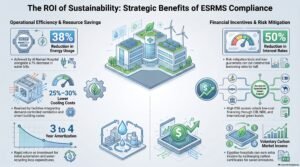
- Al-Ramad Hospital: Achieved an average 38% reduction in energy usage, alongside a 7% decrease in water bills.
- National Energy Services Company (Tarshid) – KSA: Spearheads retrofitting projects across Saudi healthcare facilities.
- Project: Comprehensive retrofitting of HVAC systems, chiller replacements, and smart lighting at Prince Abdulaziz Bin Musaed Hospital in Arar.
- Financial Impact: Thermal and electrical retrofits yield an estimated 14% baseline energy savings per facility.
- United Arab Emirates (Buroppan and Cleveland Clinic Abu Dhabi):
- Project: Integration of demand-controlled ventilation, automated lighting, and water-recycling loops for cooling towers.
- Financial Impact: Reduced annualized cooling expenditures by 25% to 30%, with rapid amortization on initial automation investments within 3 to 4 years.
- South Africa (Bongani Regional Hospital):
- Project: Phased out hazardous pesticides/chemicals via a strict Integrated Pest Management (IPM) system.
- Financial Impact: Eliminated hazardous waste disposal fees and secondary chemical procurement costs.
- Sub-Saharan Africa (The EU-backed SophiA Project):
- Project: Deployed mobile, solar-powered containerized systems in Malawi, Uganda, Burkina Faso, and Cameroon.
- Financial Impact: Near 100% reduction in power-generation fuel costs and significantly reduced losses from compromised vaccine inventories.
2. Favorable Financing
- High ESG scores allow operators to access lower-cost specialized financing, such as CIB’s green project funds or NBK’s sustainable portfolio.
- International Green Bonds & Financing Options:
- Sovereign & Private Green Bonds: Egypt’s Sovereign Sustainable Financing Framework enables sovereign allocations ($750M debut, $3B–$5B expansion) for green public hospital infrastructure and treatment. Private entities leverage IFC-backed initiatives.
- Multi-Lateral Concessional Facilities:
- IFC-Banque Misr Facility: $150M committed to scale sub-loans for healthcare renewable energy and green buildings.
- Development Bank Loans: EIB and AFD structure combined low-interest financing with technical grants offering up to 100% financing with extended 7-year repayment terms.
- Integrated Risk Mitigation Tools: Guarantees tied to green structures cut commercial interest rates by more than half and ease collateral requirements.
3. Legal Protection
Adhering to ESRMS guidelines proactively lowers exposure to regulatory penalties and potential loan acceleration clauses triggered by non-compliance.
4. Extra Income
Opportunities in the voluntary carbon market established by the Financial Regulatory Authority (FRA) in Egypt allow hospitals to monetize saved carbon emissions.
A Practice Case for Financial Feasibility
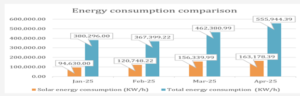
Case Study: Shefaa Al-Orman in Egypt
References
- Al-Ramad Hospital. (2024). Al-Ramad Hospital Green Transformation. Global Green and Healthy Hospitals.
- Central Bank of Egypt. (2026). Circulars: Mandating the Implementation of Environmental and Social Risk Management Systems. Central Bank of Egypt.
- Climate Change Laws of the World. (2022). Egypt’s sovereign sustainable financing framework. Grantham Research Institute on Climate Change and the Environment.
- Commercial International Bank. (2021). Equator Principles CIB Implementation Report 2021. CIB.
- Daily News Egypt. (2026). CBE mandates banks to implement Environmental, Social Risk Management System by January 2028.
- Egypt Healthcare Authority [@ehaegypt]. (2025, August 26). Egypt Healthcare Authority achieves green and healthy hospitals accreditation [Post]. LinkedIn.
- Egyptian Healthcare Authority. (2024). Egypt: Advancing climate and health through digital resilience, leadership, and governance. ATACH Community of Practice.
- International Finance Corporation. (2025). Building Climate Resilient Health Systems. IFC/World Bank Group.
- National Bank of Kuwait-Egypt. (2024). GRI Report 2024: Building on our ESG Foundation. NBK Group.
- National Energy Services Company [Tarshid]. (2025, October 14). #Tarshid reduces energy consumption by 68 million kWh at King Faisal Hospital in Riyadh [Post]. LinkedIn.
- ScienceDirect. (2026). Advancing solar energy financing in Sub-Saharan Africa. Energy Economics & Policy, 12(1), Article 26000094.
- SophiA 4 Africa. (2026, July 8). Sustainable off-grid solutions for pharmacies and hospitals in Africa. European Union Horizon Europe Project.
- United Nations Development Programme [UNDP]. (2025, March 16). Egypt’s integrated national financing strategy: Key messages.
- World Bank Group. (2025). WBG Environmental, Health, and Safety Guidelines – Summary of Updates – Health Care Facilities 2025. World Bank Group.