Sudan’s Post-War Healthcare Reconstruction: Rebuilding a Health System, Not Simply Replacing Hospitals
Executive Summary
Sudan’s post-war healthcare challenge will be one of the largest reconstruction and health-system transformation opportunities in Africa. The conflict that began in April 2023 has not simply damaged hospitals; it has disrupted the entire healthcare value chain—from primary care and emergency medicine to laboratories, pharmaceuticals, medical education, health insurance, supply chains, water and sanitation, and the health workforce.
By 2026, the scale of the crisis is extraordinary. The World Health Organization has estimated that approximately 21 million people in Sudan require health assistance, while a significant proportion of health facilities remain non-functional. WHO has also documented hundreds of attacks affecting healthcare since the beginning of the conflict.
The World Bank has reported massive displacement, severe economic contraction and extensive destruction of productive capacity and essential services.
The strategic conclusion is clear: Sudan does not need a conventional hospital-rebuilding programme. It needs a national healthcare reconstruction and transformation programme.
Based on the scale of infrastructure damage, population need, healthcare gaps and the requirement to rebuild both public and private healthcare capacity, a reasonable indicative healthcare reconstruction and investment envelope for 2026–2033 is approximately US$12–20 billion, with a central planning scenario of approximately US$15–16 billion.
This is an analytical investment estimate rather than an official Sudanese Government, World Bank or WHO reconstruction figure. The final requirement will depend on security conditions, the geographic extent of destruction, inflation, exchange rates, construction costs, donor commitments and the eventual political and economic settlement.
1. Sudan’s Healthcare Crisis Is Larger Than Physical Destruction
The destruction of healthcare infrastructure is only the visible component of the crisis.
A functioning healthcare system requires:
- Hospitals
- Primary healthcare centres
- Emergency departments
- Ambulances
- Laboratories
- Pharmacies
- Blood banks
- Diagnostic imaging
- Medical oxygen
- Water and sanitation
- Reliable electricity
- Digital health infrastructure
- Trained physicians and nurses
- Medical universities and training institutions
- Health financing and insurance
- Regulatory institutions
- Medical equipment maintenance
- Reliable pharmaceutical and medical supply chains
- Integrated referral networks
The conflict has disrupted many of these components simultaneously.
The WHO health-system assessment has demonstrated the enormous scale of the infrastructure requiring assessment, rehabilitation or reconstruction. This means Sudan’s recovery cannot be measured simply by counting damaged hospitals.
2. The First Post-War Priority: Restore Access Before Building Luxury Capacity
The first stage of reconstruction should not focus primarily on large tertiary hospitals. Sudan needs to restore the healthcare pyramid.
Tier 1 — Community and Primary Healthcare
The country will require a major expansion and rehabilitation programme covering:
- Family medicine
- Maternal and child health
- Vaccination
- Nutrition
- Infectious disease control
- Chronic disease management
- Mental health
- Community pharmacies
- Basic laboratories
- Emergency stabilisation
Primary healthcare should become the foundation of the post-war system.
Tier 2 — District Hospitals
District hospitals should provide:
- Emergency medicine
- General surgery
- Obstetrics
- Paediatrics
- Internal medicine
- Anaesthesia
- Blood transfusion
- Basic imaging
- Laboratory services
- Neonatal care
Tier 3 — Regional Referral Hospitals
Regional hospitals should provide:
- Advanced surgery
- Trauma care
- Oncology
- Cardiology
- Neurosurgery
- Nephrology
- Intensive care
- Interventional radiology
- Advanced laboratory medicine
- Maternal-fetal medicine
- Neonatal intensive care
Tier 4 — National Centres of Excellence
A smaller number of national institutions should become centres of excellence for:
- Cancer
- Cardiovascular disease
- Transplantation
- Advanced surgery
- Neurosciences
- Burns
- Trauma
- Infectious diseases
- Genomic and molecular diagnostics
- Medical research
This model is more economically sustainable than attempting to establish high-cost tertiary hospitals in every major city.
3. Indicative Healthcare Investment Requirement: 2026–2033
There is currently no single authoritative figure that should be treated as Sudan’s final post-war healthcare reconstruction bill. A strategic investment model therefore needs to be constructed from the major components required to restore and transform the health system.
| Investment Area | Indicative 2026–2033 Allocation |
|---|---|
| Hospital rehabilitation and reconstruction | US$4.0–5.5 billion |
| Primary healthcare network | US$1.5–2.0 billion |
| Medical equipment and diagnostics | US$1.2–1.8 billion |
| Pharmaceuticals and medical supply chains | US$0.8–1.2 billion |
| Ambulance and emergency medical services | US$0.4–0.7 billion |
| Maternal, neonatal and paediatric healthcare | US$0.5–0.8 billion |
| Laboratories, blood banks and public health | US$0.4–0.7 billion |
| Health workforce recovery and education | US$0.7–1.0 billion |
| Digital health and health information systems | US$0.2–0.4 billion |
| WASH, medical oxygen, power and hospital utilities | US$0.8–1.2 billion |
| Healthcare financing and system strengthening | US$0.5–0.8 billion |
| Contingency, security and reconstruction inflation | US$1.0–1.5 billion |
| Indicative Total | US$12–20 billion |
Central Planning Estimate
For strategic investment planning, a US$15–16 billion healthcare reconstruction envelope can be used as a reasonable base case.
4. Three Investment Scenarios
Scenario A — Minimum Recovery
Estimated investment: US$8–12 billion
This scenario would focus on:
- Reopening damaged hospitals
- Restoring primary healthcare
- Emergency medicine
- Essential pharmaceuticals
- Maternal and child healthcare
- Disease surveillance
- Basic diagnostics
- Essential workforce recovery
This approach could restore basic functionality but would not fundamentally transform Sudan’s healthcare system.
Scenario B — National Healthcare Reconstruction
Estimated investment: US$12–20 billion
This should be considered the most realistic strategic scenario.
It would include:
- Hospital reconstruction
- Primary healthcare expansion
- Regional referral networks
- Modern diagnostic capacity
- Laboratory strengthening
- Pharmaceutical supply-chain development
- Medical education
- Digital health
- Private-sector participation
- Health insurance reform
- Public-private partnerships
- National emergency medical services
Scenario C — Healthcare Transformation
Estimated investment: US$20–30+ billion
This scenario would move beyond reconstruction and create:
- Medical cities
- Specialised centres of excellence
- Modern private hospitals
- Healthcare investment zones
- Pharmaceutical manufacturing
- Medical-device manufacturing
- Medical universities
- Research centres
- Digital-health infrastructure
- Advanced diagnostic networks
- Regional medical tourism capacity
This model could position Sudan as a future healthcare hub for the Horn of Africa and selected East and Central African markets.
5. The Hospital Opportunity
The hospital sector is likely to absorb the largest share of reconstruction capital.
However, Sudan should avoid simply replacing every destroyed facility with an identical building.
Hospitals should instead be redesigned according to:
Population → Catchment Area → Disease Burden → Referral Network → Bed Requirement → Clinical Services → Financial Model.
A new generation of Sudanese hospitals could incorporate:
- Modular construction
- Solar energy
- Water recycling
- Medical oxygen systems
- Digital medical records
- Integrated laboratory networks
- Centralised procurement
- Telemedicine
- Electronic pharmacy systems
- AI-assisted diagnostics
- Infection prevention and control
- Disaster-resilient infrastructure
This creates an opportunity to build Healthcare 2.0 rather than restore Healthcare 1.0.
6. Private Healthcare Will Be Critical
The reconstruction of Sudan cannot realistically depend exclusively on government financing.
The private sector can play a major role in:
- Hospitals
- Diagnostic centres
- Laboratories
- Pharmacies
- Pharmaceutical manufacturing
- Medical equipment
- Ambulance services
- Healthcare logistics
- Health insurance
- Digital health
- Medical education
- Rehabilitation
- Dialysis
- Oncology
- Fertility services
- Specialised surgery
The preferred model should therefore be a Public–Private–Development Partnership rather than a purely government-funded reconstruction programme.
Potential Structures
PPP Hospitals
Government can provide land, guarantees, infrastructure and regulatory support, while private investors provide capital, equipment, management and clinical operations.
Build–Operate–Transfer
An investor develops and operates a hospital for a defined period before transferring ownership to the public sector.
Joint-Venture Healthcare Cities
Government, sovereign institutions, development finance institutions and private healthcare operators can jointly develop integrated medical cities.
Diagnostic Networks
International operators could establish regional networks covering laboratories, imaging, pathology and molecular diagnostics.
7. Pharmaceutical Manufacturing Is a Strategic Reconstruction Opportunity
Sudan should not reconstruct a healthcare system that remains heavily dependent on imported medicines.
The post-war programme should therefore include a Sudanese Pharmaceutical and Medical Supply Strategy.
Priority areas could include:
- Generic medicines
- IV fluids
- Antibiotics
- Analgesics
- Vaccines
- Oncology medicines
- Insulin
- Dialysis consumables
- Medical oxygen
- Surgical consumables
- Laboratory reagents
- Personal protective equipment
- Selected medical devices
Regional pharmaceutical manufacturing could reduce foreign-exchange pressure, supply interruptions and dependency on humanitarian procurement while creating an export platform for neighbouring African markets.
8. Medical Education and Workforce Recovery
Infrastructure without healthcare professionals will not create a functioning health system.
The reconstruction programme should therefore include a National Health Workforce Recovery Programme.
Priority investments should include:
- Medical schools
- Nursing schools
- Allied health education
- Residency programmes
- Specialist training
- Simulation centres
- Continuing professional development
- International fellowships
- Diaspora return programmes
- Tele-education
Sudan could establish international partnerships with universities and healthcare systems across Africa, the Middle East, Europe and Asia.
The objective should be to transform the Sudanese diaspora from a lost workforce into a strategic reconstruction asset.
9. Emergency Medicine Should Become a National Priority
After years of conflict, Sudan’s health system will continue to experience a high burden of:
- Trauma
- Orthopaedic injuries
- Burns
- Disability
- Maternal emergencies
- Infectious diseases
- Malnutrition
- Mental health conditions
Therefore, the post-war healthcare strategy should establish a national emergency network.
National Emergency Number → Ambulance → Stabilisation Centre → District Hospital → Regional Trauma Centre → National Centre of Excellence
Such a system would improve survival while reducing unnecessary transfers and pressure on tertiary hospitals.
10. Maternal and Child Health Cannot Be Delayed
The reconstruction programme must give special attention to:
- Antenatal care
- Safe delivery
- Emergency obstetrics
- Neonatal intensive care
- Paediatric emergency care
- Vaccination
- Nutrition
- Reproductive health
- Childhood infectious diseases
Maternal and child healthcare should be treated not simply as a humanitarian programme, but as a national human-capital investment.
11. Disease Control and Public Health
Sudan’s post-war reconstruction will face a dangerous combination of:
- Population displacement
- Damaged water systems
- Poor sanitation
- Overcrowding
- Weak vaccination coverage
- Malaria
- Dengue
- Cholera
- Measles
- Meningitis
- Polio
- Hepatitis E
- Diphtheria
Consequently, reconstruction funding should include a national public-health infrastructure covering:
- Epidemiological surveillance
- Public-health laboratories
- Vaccination
- Vector control
- Water, sanitation and hygiene
- Environmental health
- Food safety
- Outbreak response
12. Digital Health Could Accelerate Reconstruction
Sudan has an opportunity to avoid rebuilding healthcare around fragmented paper-based systems.
One Patient → One Digital Health Identity → One Medical Record → One Referral Network
Priority platforms should include:
- Electronic medical records
- Electronic prescriptions
- Digital laboratory results
- PACS and digital imaging
- Telemedicine
- Digital insurance claims
- National provider registry
- National facility registry
- Healthcare workforce registry
- Pharmaceutical traceability
Digital health could help Sudan overcome geographical barriers created by its enormous territory and fragmented healthcare infrastructure.
13. Health Insurance Will Be Essential
Healthcare reconstruction cannot depend indefinitely on humanitarian financing.
Sudan will ultimately need a sustainable healthcare financing mechanism combining:
- Government health expenditure
- Social health insurance
- Private insurance
- Employer-sponsored coverage
- Donor funding
- Development finance
- Reduced out-of-pocket expenditure
- Strategic healthcare purchasing
The strategic transition should be:
Humanitarian Financing → Reconstruction Financing → Social Health Financing → Sustainable Universal Health Coverage
14. A Potential US$15–16 Billion Investment Architecture
Phase I — Stabilisation: 2026–2027
Estimated investment: US$2–3 billion
Priority areas:
- Emergency healthcare
- Reopening critical hospitals
- Medicines
- Medical supplies
- Ambulances
- Water, sanitation and hygiene
- Disease control
- Workforce retention
- Essential diagnostics
Phase II — Reconstruction: 2027–2030
Estimated investment: US$6–8 billion
Priority areas:
- Hospital reconstruction
- Primary-care networks
- Regional hospitals
- Laboratories
- Pharmaceutical supply chains
- Medical education
- Digital infrastructure
- Private healthcare investment
Phase III — Transformation: 2030–2033
Estimated investment: US$5–6 billion
Priority areas:
- Centres of excellence
- Medical cities
- Advanced diagnostics
- Pharmaceutical manufacturing
- Healthcare technology
- Medical research
- Insurance expansion
- Medical tourism
- Regional healthcare services
15. Potential Sources of Capital
| Capital Source | Potential Role |
|---|---|
| Sudanese Government | Policy, land and public infrastructure |
| World Bank / IDA | Reconstruction and health-system financing |
| African Development Bank | Infrastructure and private-sector financing |
| Islamic Development Bank | Healthcare infrastructure and investment |
| Arab development funds | Hospitals, medical cities and infrastructure |
| Gulf investors | Private hospitals and healthcare platforms |
| European DFIs | Healthcare infrastructure and systems |
| International NGOs | Humanitarian and early-recovery healthcare |
| Sudanese diaspora | Private equity, hospitals and specialist services |
| International healthcare operators | Management and PPPs |
| Pharmaceutical companies | Manufacturing and distribution |
| Private equity | Hospitals, diagnostics and healthcare platforms |
| Commercial banks | Working capital and project finance |
16. The Sudanese Diaspora Could Become a Major Investor
One of the most underestimated assets in Sudan’s reconstruction is the Sudanese professional diaspora.
Sudanese doctors, pharmacists, engineers, healthcare executives and academics working outside the country can become strategic partners in rebuilding the healthcare system.
A structured Sudan Healthcare Diaspora Investment Programme could allow professionals to participate through:
- Hospital ownership
- Medical centres
- Specialist clinics
- Laboratories
- Pharmacies
- Medical education
- Healthcare technology
- Healthcare funds
- Equipment financing
This would combine capital + expertise + trust + international networks.
17. Investment Opportunities by Healthcare Segment
| Healthcare Segment | Investment Opportunity |
|---|---|
| Hospitals | Large capital requirement and high social impact |
| Primary Healthcare | Large population coverage and lower capital intensity |
| Diagnostics | Attractive early-stage investment opportunity |
| Pharmaceuticals | Import substitution and regional exports |
| Medical Logistics | Warehousing, cold chain and distribution |
| Emergency Medical Services | Ambulances, trauma centres and emergency networks |
| Digital Health | High scalability with relatively low physical infrastructure requirements |
| Medical Education | Large long-term workforce deficit |
| Rehabilitation | Major post-conflict demand |
| Mental Health | Severely underserved strategic sector |
18. What Investors Should Avoid
Post-war healthcare investment must not become an uncontrolled race to build hospitals.
The following risks should be carefully managed:
- Politically connected projects
- Hospitals without sustainable catchment populations
- Excessive tertiary capacity
- Imported equipment without maintenance contracts
- Projects dependent entirely on donor funding
- Weak procurement governance
- Foreign-exchange exposure
- Unclear land ownership
- Inadequate medical workforce
- Poor referral networks
- Absence of health insurance
- Corruption and procurement leakage
The most successful projects will likely be those combining health impact with operational and financial sustainability.
19. A New Healthcare Investment Map for Sudan
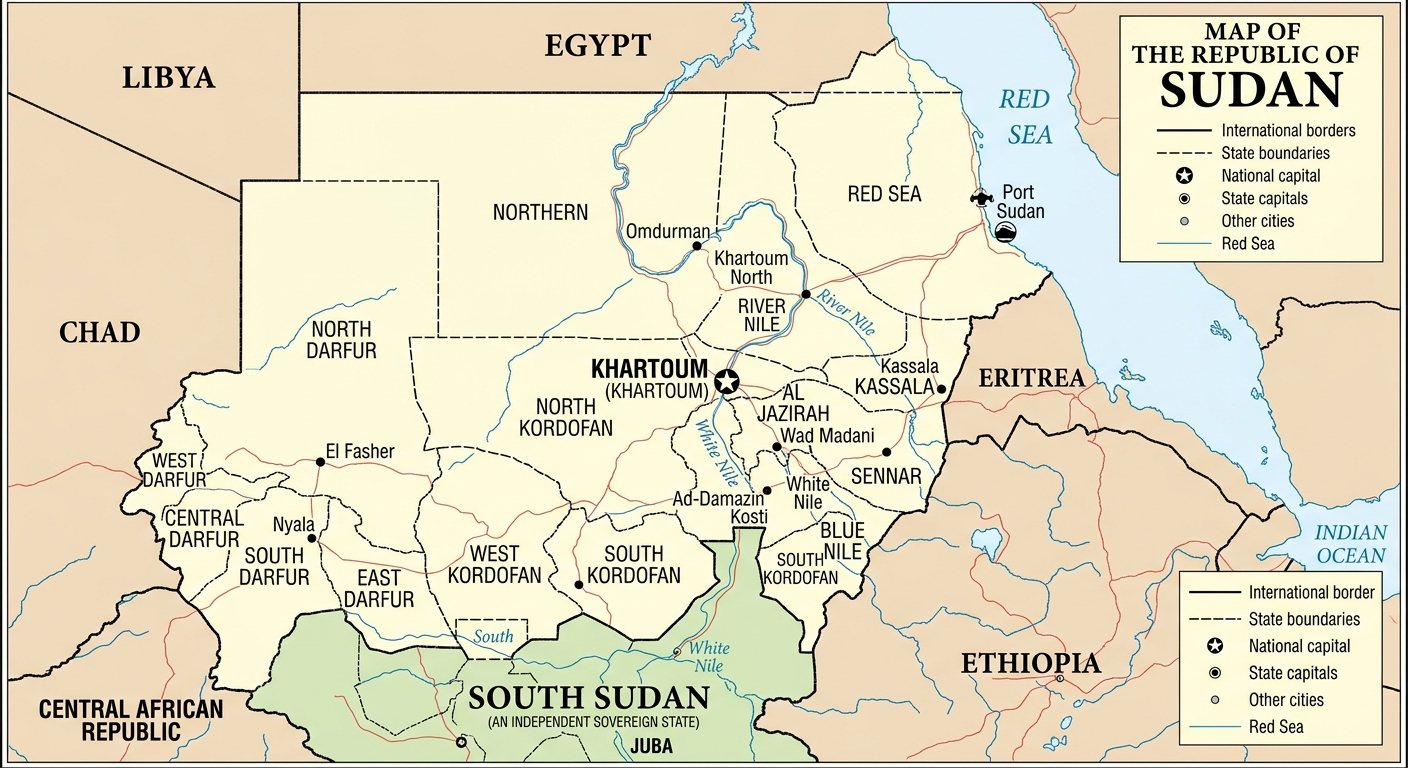
Khartoum Corridor
Potential focus areas include:
- Tertiary hospitals
- Specialist medicine
- Medical universities
- Advanced diagnostics
- Private healthcare
Port Sudan Corridor
Potential focus areas include:
- Healthcare logistics
- Pharmaceutical supply chains
- Medical distribution
- International healthcare services
- Regional referral capacity
Gezira Corridor
Potential focus areas include:
- Secondary hospitals
- Primary healthcare
- Pharmaceutical manufacturing
- Occupational health
Darfur Corridor
Potential focus areas include:
- Humanitarian healthcare
- District hospitals
- Trauma care
- Maternal and child health
- Mobile healthcare
Kordofan Corridor
Potential focus areas include:
- Regional hospitals
- Emergency medicine
- Primary healthcare
- Laboratories
20. From Humanitarian Crisis to Healthcare Economy
The most important strategic question is not simply:
“How much will it cost to rebuild Sudan’s hospitals?”
The more important question is:
“How can Sudan use reconstruction to create a sustainable healthcare economy?”
A US$15–16 billion healthcare reconstruction programme should therefore be viewed not simply as expenditure.
It could become the foundation for:
- Thousands of healthcare jobs
- Pharmaceutical production
- Medical education
- Digital-health companies
- Private hospitals
- Diagnostic networks
- Medical logistics
- Healthcare insurance
- Research
- Healthcare technology
Healthcare can therefore become one of the engines of Sudan’s broader economic recovery.
21. Strategic Conclusion
Sudan’s healthcare system has reached a point where simply returning to the pre-war model would be insufficient.
The post-war period should be treated as an opportunity for system redesign.
The objective should be to create a healthcare system that is:
- More resilient
- More decentralised
- Digitally enabled
- Financially sustainable
- Privately investable
- Clinically integrated
- Accessible to the population
Strategic Investment Outlook
Indicative 2026–2033 Healthcare Investment Opportunity:
US$12–20 billion
Recommended Central Planning Scenario:
US$15–16 billion
Transformation Scenario:
US$20–30+ billion
Strategic Formula:
Rebuild → Stabilise → Modernise → Finance → Localise → Transform
The ultimate measure of success will not be the number of hospitals reconstructed.
It will be whether Sudan can move from a humanitarian healthcare model to a self-sustaining national healthcare economy capable of delivering universal access, attracting investment and supporting the country’s long-term economic recovery.
Investment Outlook at a Glance
| Indicator | Strategic Assessment |
|---|---|
| Conflict Start | April 2023 |
| Population Requiring Health Assistance | Approximately 21 million in 2026 |
| Non-Functional Health Facilities | Approximately 37% |
| Health Service Units Monitored | Approximately 4,809 |
| Indicative Reconstruction Period | 2026–2033 |
| Minimum Recovery Scenario | US$8–12 billion |
| Recommended Planning Range | US$12–20 billion |
| Central Investment Scenario | US$15–16 billion |
| Transformation Scenario | US$20–30+ billion |
| Priority Investment Model | PPP + Development Finance + Government + Private Capital |
| Long-Term Objective | Universal, sustainable and investable healthcare system |
Editorial Note
The US$12–20 billion investment range presented in this article is an analytical strategic estimate and should not be interpreted as an officially published Sudan healthcare reconstruction bill. It should be refined through a post-conflict physical asset assessment, facility-by-facility damage assessment, population projections, hospital-bed capacity modelling, construction-cost benchmarking, healthcare workforce analysis and a national health expenditure and revenue model.