Africa’s Investment Powerhouses: Leading Angel Investors, Venture Capital & Private Equity Firms Shaping the Continent
From Capital Scarcity to an Emerging Investment Destination
Africa is rapidly becoming one of the world’s most important emerging investment markets.
The continent’s investment opportunity is being driven by demographic growth, urbanisation,
digital adoption, financial inclusion, healthcare demand, infrastructure deficits, renewable
energy requirements, consumer expansion and the emergence of a new generation of
technology-enabled businesses.
For investors, however, Africa is not a single market. It is a collection of highly diverse
economies, regulatory systems, currencies, consumer markets and investment ecosystems.
Successful investors increasingly combine local market knowledge, regional platforms,
sector expertise and patient capital.
The African private-capital ecosystem now includes:
- Angel investors and business-angel networks
- Seed and pre-seed investors
- Venture capital firms
- Growth-capital investors
- Private equity firms
- Infrastructure funds
- Impact investors
- Family offices
- Development-finance institutions
- Corporate venture capital
- Sovereign and strategic investors
This article provides a practical overview of some of the
most prominent investment firms and investment platforms active across Africa,
together with examples of their previous and recent activities.
Important: The firms below should not be interpreted as a formal ranking
by assets under management or investment performance. “Leading” and “popular” refer broadly
to visibility, track record, African footprint, sector relevance, investment activity and
influence within the African investment ecosystem.
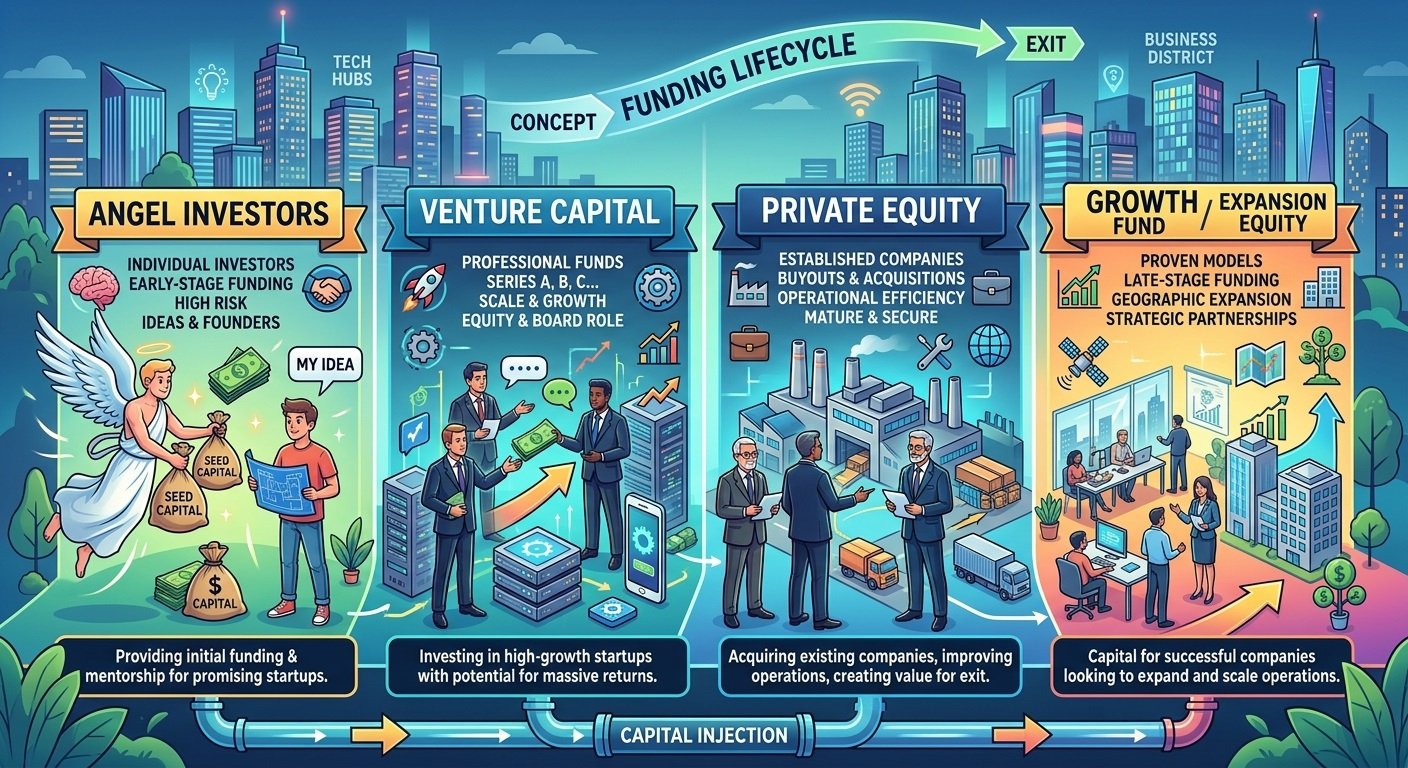
1. Understanding the African Investment Capital Stack
Before looking at individual investors, it is important to understand how different forms
of capital participate in the African market.
Angel Investors
Angel investors normally invest their own money into early-stage companies, often before
institutional venture capital becomes available.
They can provide:
- Seed capital
- Industry expertise
- Founder mentoring
- Strategic introductions
- Corporate relationships
- Follow-on investor access
Venture Capital
Venture capital firms generally invest in companies with high growth potential,
particularly technology-enabled businesses.
Common sectors include:
- Fintech
- Healthtech
- E-commerce
- Logistics
- SaaS
- Edtech
- Insurtech
- Agritech
- Climate technology
- Digital infrastructure
Growth Capital
Growth investors generally enter businesses that have already demonstrated product-market
fit and are seeking expansion into additional markets.
Private Equity
Private equity firms typically invest larger amounts into established businesses and may
acquire minority or majority positions.
Their strategies can include:
- Buyouts
- Growth capital
- Platform creation
- Consolidation
- Regional expansion
- Operational transformation
- Recapitalisation
- Strategic exits
Infrastructure and Impact Capital
Africa’s infrastructure gap has created substantial opportunities for specialist funds
investing in energy, telecommunications, data centres, transport, logistics, water,
healthcare, housing and digital infrastructure.
2. AfricInvest — One of Africa’s Most Established Private-Capital Platforms
AfricInvest is one of the most established African private-equity and
investment platforms, with roots going back to the early 1990s.
The firm has raised approximately US$2 billion across 21 funds and reports
more than 200 investments and 90+ exits, with investment activity spanning
approximately 35 African countries.
Its strategy has historically focused strongly on small and mid-sized African businesses
with potential to become regional champions.
Selected Investment Activities
AfricInvest has invested across:
- Financial services
- Healthcare
- Education
- Consumer businesses
- Agribusiness
- Technology
- Insurance
- Manufacturing
- Digital payments
Its portfolio has included companies such as
MFS Africa, PalmPay, Boomplay, Instadeep, Fidelity Bank Ghana,
I&M Rwanda, Britam, Blue Health and Africa Healthcare Network.
Recent activities have included investment in fintech, healthcare and growth businesses,
demonstrating the evolution of African private capital toward technology, healthcare and
financial inclusion.
Why AfricInvest Matters
AfricInvest is particularly important for investors studying Africa because it represents
the transition from traditional country-focused private equity toward
Pan-African multi-asset investing.
3. Helios Investment Partners — A Pan-African Private-Equity Giant
Helios Investment Partners is one of the most prominent Africa-focused
private investment firms.
Founded in 2004, Helios reports more than US$3 billion in capital raised,
with an investment footprint spanning more than 35 African countries and more than two
decades of African investment experience.
Helios invests across several strategies, including:
- Private equity
- Climate
- Digital ventures
- Technology-enabled businesses
Selected Investments
Helios has invested in or supported businesses including:
- ARM Pension Managers
- Acorn Group
- Solevo
- Starsight
- Paymob
- SeamlessHR
- M2P Fintech
- Maroc Data Centre
- Thunes
For example, Helios invested in Egyptian fintech
Paymob and in Nigerian HR and payroll technology company
SeamlessHR.
Strategic Significance
Helios is particularly relevant for investors looking at the intersection of
technology, demographics, infrastructure and financial inclusion.
Its history also includes the creation of major telecom-tower platforms, illustrating how
private equity can build entirely new infrastructure categories rather than simply acquire
existing companies.
4. LeapFrog Investments — Profit With Purpose
LeapFrog Investments occupies a distinctive position in African investment
because of its focus on commercially scalable businesses delivering essential services to
emerging consumers.
Its principal areas include:
- Financial services
- Healthcare
- Climate solutions
- Insurance
- Digital financial services
LeapFrog has reported that its portfolio of almost 50 companies reaches hundreds of millions
of people, while portfolio companies generate substantial combined revenues.
African Investment Examples
- Enterprise Group Ghana
- ICEA LION Group Kenya
- Moniepoint
- Sun King
- Fidelity Bank
- Alexforbes
- miLife
Why LeapFrog Is Important
For healthcare investors, LeapFrog is especially relevant because it demonstrates how
healthcare, insurance, financial inclusion and impact investing can be combined
into a scalable investment thesis.
5. Partech Africa — A Major Technology Venture-Capital Platform
Partech is one of the best-known venture-capital investors in Africa and
globally.
Its investment model covers multiple stages, from seed and venture capital to growth,
with a dedicated Africa strategy.
Partech’s annual Africa technology reports have become an important reference for
understanding the African venture-capital ecosystem.
Leading Technology Investment Markets
| Market | 2025 Total Funding |
|---|---|
| Kenya | US$1.04 billion |
| South Africa | US$715 million |
| Egypt | US$604 million |
| Nigeria | US$572 million |
These markets remain particularly important because of their large populations,
entrepreneurial ecosystems, technology talent, financial systems and international
connectivity.
6. TLcom Capital — Backing African Technology at Scale
TLcom Capital is a prominent Africa-focused venture-capital firm investing
in technology companies from seed through growth stages.
Its portfolio includes:
- Pula
- FairMoney
- SeamlessHR
- uLesson
- Flextock
- HoneyCoin
- HUB2
- Educatly
- Zone
Its portfolio demonstrates the geographic diversity of African technology investing.
Flextock, for example, is headquartered in Egypt and focuses on warehousing
and fulfilment infrastructure for e-commerce, while Educatly operates in
education technology.
TLcom is particularly relevant to investors interested in the
Egypt–West Africa–East Africa technology corridor.
7. Novastar Ventures — Technology, Healthcare and Essential Services
Novastar Ventures is another highly visible African venture-capital investor.
Its investment thesis focuses on entrepreneurs building businesses capable of transforming
African markets.
Its portfolio includes:
- mPharma
- Turaco
- Moniepoint
- TradeDepot
- NewGlobe
- KOKO Networks
- BasiGo
- Breadfast
- Chowdeck
- Penda Health
- SolarNow
- MoKo
- MAX
Healthcare is particularly important within Novastar’s portfolio. Companies such as
mPharma, Turaco and Penda Health illustrate the intersection between
technology, healthcare access, financing and service delivery.
8. Amethis — Growth Capital Across Africa
Amethis is a major investment platform focused on long-term growth
businesses in Africa and emerging markets.
Its portfolio has included companies across:
- Financial services
- Healthcare
- Pharmaceuticals
- Agribusiness
- Distribution
- Manufacturing
- Consumer goods
- Logistics
Examples of African investment activities have included
Naivas in Kenya, Avacare Health in South Africa, GlobalCorp in Egypt,
NMA in Senegal, Fidelity Bank in Ghana and CFG Bank in Morocco.
Amethis is particularly interesting for investors seeking businesses positioned between
traditional private equity and growth capital.
9. Development Partners International — Investing in African Champions
Development Partners International (DPI) is a major Africa-focused
private-equity investor.
Its investment philosophy focuses on identifying African companies with the potential
to become regional or continental champions.
DPI’s investment universe includes:
- Financial services
- Consumer goods
- Healthcare
- Education
- Technology
- Industrial sectors
- Business services
10. Actis — Infrastructure, Energy and Sustainable Growth
Actis is a major global investment firm with significant African activity.
Its African investment themes have historically included:
- Renewable energy
- Power
- Infrastructure
- Real estate
- Digital infrastructure
- Healthcare
- Consumer businesses
Actis is particularly important because Africa’s investment opportunity is not limited to
startups. The continent requires enormous amounts of capital for
power, energy, infrastructure, digital connectivity and urbanisation.
11. Investisseurs & Partenaires — Investing in African SMEs
Investisseurs & Partenaires (I&P) is one of the major investment
platforms dedicated to African SMEs and entrepreneurs.
Its investment focus has included:
- Healthcare
- Agriculture
- Energy
- Food
- Education
- Financial services
- Manufacturing
- Services
Its model demonstrates how investment capital can support locally owned African businesses
while strengthening management, governance and operational capacity.
12. Goodwell Investments — Financial Inclusion and Inclusive Growth
Goodwell Investments has built a strong reputation around financial
inclusion and inclusive business models.
Its investment themes include:
- Financial services
- Fintech
- Consumer businesses
- Healthcare
- Essential services
This investment philosophy is particularly relevant to Africa because millions of consumers
remain underserved by traditional financial and healthcare systems.
13. Mediterrania Capital Partners
Mediterrania Capital Partners is a private-equity firm with a strong focus
on Africa and the Mediterranean region.
Its investment model generally targets established businesses capable of scaling,
professionalisation, regional expansion, consolidation and operational improvement.
Its geographical positioning makes it particularly relevant to businesses operating between
North Africa, Europe and Sub-Saharan Africa.
14. SPE Capital Partners
SPE Capital Partners is a prominent private-equity manager with a strong
African footprint, particularly in North Africa.
Its investment activities have included:
- Healthcare
- Education
- Consumer
- Manufacturing
- Financial services
- Business services
SPE is particularly relevant to companies seeking institutional capital for expansion,
professionalisation and regional growth.
15. Vantage Capital
Vantage Capital is one of Africa’s established alternative investment
managers.
Unlike traditional venture capital, Vantage has been particularly active in
mezzanine finance and growth capital, providing an important alternative
to pure equity financing.
This is significant for African businesses because many established companies need expansion
capital but do not necessarily want to surrender a large equity stake.
16. Phatisa — Food, Agriculture and Healthcare
Phatisa is a specialist African private-equity platform with a particular
history in food, agriculture, agribusiness, healthcare and consumer sectors.
Its investment model reflects one of Africa’s most fundamental structural opportunities:
feeding, housing, employing and serving a rapidly growing population.
17. Sahel Capital
Sahel Capital is an investment-management firm with a strong focus on
West Africa.
Its investment themes include:
- Agriculture
- Food
- Manufacturing
- Consumer businesses
- SMEs
Its activities demonstrate an important characteristic of African private capital:
regional specialisation can be more valuable than attempting to cover the entire
continent from one location.
18. Alitheia Capital
Alitheia Capital is a notable African investment platform with a strong
focus on growth businesses and gender-inclusive investment.
Its investment approach has included:
- Consumer goods
- Financial services
- Agriculture
- Manufacturing
- Healthcare-related opportunities
It is particularly significant within the development of
female-led and gender-smart investment strategies in Africa.
19. Janngo Capital — Technology and Female Entrepreneurship
Janngo Capital has developed a distinctive investment strategy focused on
African technology and businesses that can generate meaningful economic and social impact.
The firm has placed particular emphasis on:
- Digital businesses
- Financial inclusion
- Healthcare
- Education
- Women-led businesses
20. Seedstars Africa Ventures
Seedstars Africa Ventures is a venture-capital platform supporting African
technology companies.
Its investment focus includes:
- Fintech
- SaaS
- E-commerce
- Logistics
- Digital services
- Technology-enabled SMEs
21. Launch Africa Ventures
Launch Africa Ventures has emerged as an important early-stage investor
targeting African technology businesses.
Its strategy focuses on startups capable of expanding across multiple African markets.
This model is particularly important because Africa’s fragmented markets mean that a
startup’s ability to move from
one country → multiple countries → Pan-African platform
can be as important as the size of its initial domestic market.
22. Founders Factory Africa
Founders Factory Africa represents a different investment model, combining
venture capital + venture building + operational support.
Venture-building platforms can help entrepreneurs with:
- Product development
- Technology
- Recruitment
- Marketing
- Fundraising
- Strategy
- Corporate partnerships
This model is increasingly attractive in Africa because access to management and technical
talent can be as important as access to capital.
23. Future Africa — Supporting African Founders
Future Africa has become associated with early-stage investment in African
technology companies.
Its model has focused on supporting founders building solutions around:
- Financial services
- Healthcare
- Mobility
- Agriculture
- Commerce
- Digital infrastructure
The broader importance of platforms such as Future Africa is the development of a local
African investor ecosystem rather than relying exclusively on foreign capital.
24. Angel Investors and Angel Networks
Venture capital and private equity receive considerable attention, but angel investors
play an equally important role.
Many African businesses initially require relatively small amounts of capital:
US$25,000 → US$100,000 → US$500,000
before becoming suitable for institutional venture capital.
Angel investors can therefore act as the bridge between:
Founder Capital → Angel Capital → Venture Capital → Growth Capital → Private Equity
African Business Angel Network
The African Business Angel Network (ABAN) has played an important role in
developing the angel-investment ecosystem.
Angel networks can help investors:
- Identify founders
- Conduct initial due diligence
- Syndicate investments
- Share risk
- Provide mentoring
- Connect startups to institutional investors
25. The Role of African Family Offices
Family offices are becoming increasingly important in Africa.
Unlike traditional funds, family offices can potentially provide:
- Patient capital
- Strategic capital
- Long-term ownership
- Follow-on funding
- Corporate relationships
- Cross-border expansion support
Family offices are particularly relevant for healthcare, education, real estate,
infrastructure, consumer businesses, technology and financial services.
A major trend is the movement from
passive wealth preservation toward direct investment in operating businesses.
26. Development Finance Institutions: The Hidden Engine Behind African Private Capital
No serious analysis of African investment can ignore Development Finance Institutions.
Important institutional investors include:
- British International Investment
- International Finance Corporation
- European Investment Bank
- FMO
- Proparco
- DEG
- Africa Finance Corporation
- African Development Bank
These institutions frequently invest in private-equity and venture-capital funds as
Limited Partners.
DFI Capital → Investment Fund → African Company → Jobs / Infrastructure / Services / Economic Growth
Their role creates a multiplier effect by helping institutional investment platforms raise
larger pools of capital for African businesses.
27. Where Is African Investment Concentrated?
Although investment is becoming more geographically diversified, several markets remain
dominant.
The Four Major Technology Investment Markets
| Market | 2025 Total Funding |
|---|---|
| Kenya | US$1.04 billion |
| South Africa | US$715 million |
| Egypt | US$604 million |
| Nigeria | US$572 million |
These markets remain particularly important because of their populations, entrepreneurial
ecosystems, technology talent, financial systems and international connectivity.
Morocco, Ghana, Côte d’Ivoire, Senegal, Rwanda, Tanzania, Uganda, Tunisia and Mauritius
are also becoming increasingly important in sector-specific investment strategies.
28. Africa’s Healthcare Investment Opportunity
For healthcare investors, Africa presents an unusually broad investment opportunity.
The opportunity extends far beyond hospitals.
Healthcare Delivery
- Hospitals
- Clinics
- Polyclinics
- Primary care
- Specialist centres
- Home healthcare
- Long-term care
Diagnostics
- Laboratories
- Imaging
- Pathology
- Molecular diagnostics
- Digital diagnostics
Pharmaceuticals
- Pharmaceutical manufacturing
- Distribution
- Generic medicines
- Specialty pharmaceuticals
- Contract manufacturing
Medical Technology
- Medical devices
- Digital health
- Artificial intelligence
- Remote monitoring
- Clinical decision-support systems
Healthcare Financing
- Health insurance
- Microinsurance
- Healthcare payment platforms
- Claims management
- Revenue-cycle management
Healthcare Infrastructure
- Medical cities
- Diagnostic networks
- Laboratories
- Cold-chain infrastructure
- Medical logistics
- Healthcare data infrastructure
Healthcare Workforce
- Medical education
- Nursing
- Allied health
- Telemedicine
- Healthcare workforce platforms
The investment thesis is not simply that Africa needs more hospitals.
Africa needs scalable healthcare infrastructure, financing, technology,
supply chains and service-delivery platforms.
This creates opportunities for venture capital, private equity, infrastructure funds,
impact investors and strategic healthcare investors simultaneously.
29. What Are Investors Looking for in African Companies?
1. Large Addressable Market
Investors increasingly want companies capable of serving millions of customers.
2. Regional Scalability
A company dependent on one small market may face a valuation ceiling. Businesses capable
of expanding across several African countries can be more attractive.
3. Strong Management
Capital alone cannot compensate for weak leadership.
4. Technology Leverage
Technology can enable companies to overcome infrastructure and distribution limitations.
5. Recurring Revenue
Investors increasingly value predictable and recurring revenue models.
6. Strong Governance
Corporate governance is becoming a central investment consideration.
7. Regulatory Readiness
Investors need businesses capable of operating within complex regulatory environments.
8. Path to Exit
The ultimate question for institutional investors is:
Who will buy the company later?
Potential exits include:
- Strategic acquisition
- Secondary sale
- Larger private-equity fund
- Corporate acquisition
- IPO
- Founder buyback
30. The Emerging Investment Map of Africa
North Africa
Egypt – Morocco – Tunisia
Strong in:
- Healthcare
- Manufacturing
- Fintech
- Consumer businesses
- Education
- Logistics
- Pharmaceuticals
West Africa
Nigeria – Ghana – Côte d’Ivoire – Senegal
Strong in:
- Fintech
- Financial services
- Consumer businesses
- Agriculture
- Logistics
- Digital commerce
East Africa
Kenya – Rwanda – Tanzania – Uganda
Strong in:
- Fintech
- Climate technology
- Agriculture
- Mobility
- Digital services
- Financial inclusion
Southern Africa
South Africa
Strong in:
- Technology
- Financial services
- Healthcare
- Mining
- Infrastructure
- Private equity
- Institutional capital
31. What Is Changing in African Private Capital?
The investment market is evolving rapidly.
Old Model:
Foreign Capital → African Company
Emerging Model:
African Founders + African Capital + International Capital + Regional Expansion
This is an important structural change. African entrepreneurs are increasingly building
companies designed from inception to operate across several countries.
At the same time, international investors are becoming more sophisticated about Africa.
The question is no longer simply: “Is Africa investable?”
The question increasingly becomes: “Which African markets, sectors, founders
and business models offer the strongest risk-adjusted returns?”
32. The Next Generation of African Investment Themes
Artificial Intelligence
AI is likely to influence:
- Healthcare
- Financial services
- Agriculture
- Education
- Customer service
- Cybersecurity
- Logistics
Digital Infrastructure
Africa’s digital economy will require:
- Data centres
- Fibre networks
- Telecom towers
- Cloud infrastructure
- Digital payments
- Cybersecurity
Healthcare
Healthcare is likely to become one of the most important private-capital sectors as demand
increases for quality, affordability and access.
Climate and Energy
Investment opportunities include:
- Solar energy
- Battery storage
- Distributed energy
- Electric mobility
- Climate-smart agriculture
- Water infrastructure
Financial Inclusion
Africa remains one of the world’s most important markets for:
- Mobile money
- Digital banking
- Insurance
- SME finance
- Embedded finance
Food and Agriculture
Population growth, urbanisation and food-import dependence create opportunities throughout
the agricultural value chain.
Logistics
The development of intra-African trade creates opportunities for warehousing, freight,
last-mile delivery, cold-chain infrastructure and cross-border logistics.
33. Practical Shortlist of African Investment Firms
| Investor / Platform | Primary Category | Key Areas |
|---|---|---|
| AfricInvest | Private Equity / Multi-Asset | Financial services, healthcare, technology, SMEs |
| Helios Investment Partners | Private Equity / Growth | Technology, financial services, infrastructure |
| LeapFrog Investments | Impact PE / Growth | Healthcare, insurance, financial inclusion |
| Partech | Venture Capital | Technology, fintech, growth |
| TLcom Capital | Venture Capital | Technology, fintech, SaaS |
| Novastar Ventures | Venture Capital | Healthcare, climate, fintech, essential services |
| Amethis | Growth / Private Equity | Healthcare, finance, consumer, agribusiness |
| DPI | Private Equity | Consumer, healthcare, financial services |
| Actis | Infrastructure / PE | Energy, infrastructure, digital |
| Investisseurs & Partenaires | SME / Growth Capital | Healthcare, agriculture, energy |
| Goodwell Investments | Impact / Growth | Financial inclusion, essential services |
| Mediterrania Capital Partners | Private Equity | North Africa, Sub-Saharan Africa |
| SPE Capital | Private Equity | North Africa, healthcare, consumer |
| Vantage Capital | Mezzanine / Growth | Established African businesses |
| Phatisa | Private Equity | Food, agriculture, healthcare |
| Sahel Capital | Private Equity / Growth | Agriculture, food, West Africa |
| Alitheia Capital | Growth / PE | Consumer, agriculture, financial services |
| Janngo Capital | Venture Capital | Technology, women-led businesses |
| Seedstars Africa Ventures | Venture Capital | Technology, fintech, digital |
| Launch Africa Ventures | Venture Capital | Early-stage technology |
| Future Africa | Venture Capital | Technology, fintech, healthcare |
| Founders Factory Africa | Venture Building / VC | Technology, digital businesses |
34. The Investment Opportunity Is Becoming More Sophisticated
Africa’s investment story should no longer be presented simply as a story of
high population growth and untapped markets. That narrative is incomplete.
The more sophisticated investment thesis is based on:
Demographics + Urbanisation + Technology + Infrastructure +
Financial Inclusion + Healthcare + Regional Trade + Local Entrepreneurship
The emergence of sophisticated investors such as AfricInvest, Helios, LeapFrog, Partech,
Novastar, TLcom and Amethis demonstrates that African investment is becoming an institutional
asset class rather than merely an emerging-market opportunity.
Recent transaction activity also confirms the breadth of the market, with private-equity
and venture-capital investors active across multiple sectors and countries.
Conclusion: Africa Is Moving From Capital Destination to Investment Platform
The next phase of African investment will not be defined only by the amount of capital
entering the continent.
It will be defined by what that capital builds.
The strongest investment platforms are increasingly moving beyond financial engineering toward:
- Building regional champions
- Professionalising management
- Improving corporate governance
- Creating infrastructure
- Expanding healthcare access
- Digitising traditional industries
- Building financial inclusion
- Supporting African entrepreneurs
- Creating scalable technology platforms
- Preparing companies for international expansion
The most attractive opportunities may therefore sit at the intersection of
capital, technology and essential services.
For Africa, the strategic objective is not simply to attract foreign investors.
It is to create a sustainable investment ecosystem in which:
African entrepreneurs create the businesses →
African and international investors provide capital →
professional management creates scale →
regional markets create growth →
strategic buyers provide exits →
capital is recycled into the next generation of African companies.
That cycle could become one of the most important engines of African economic transformation
over the coming decade.
Investment Takeaway
Africa is no longer simply a market waiting for capital. It is becoming a platform for
building companies, infrastructure and investment franchises capable of competing across
emerging markets and, increasingly, globally.