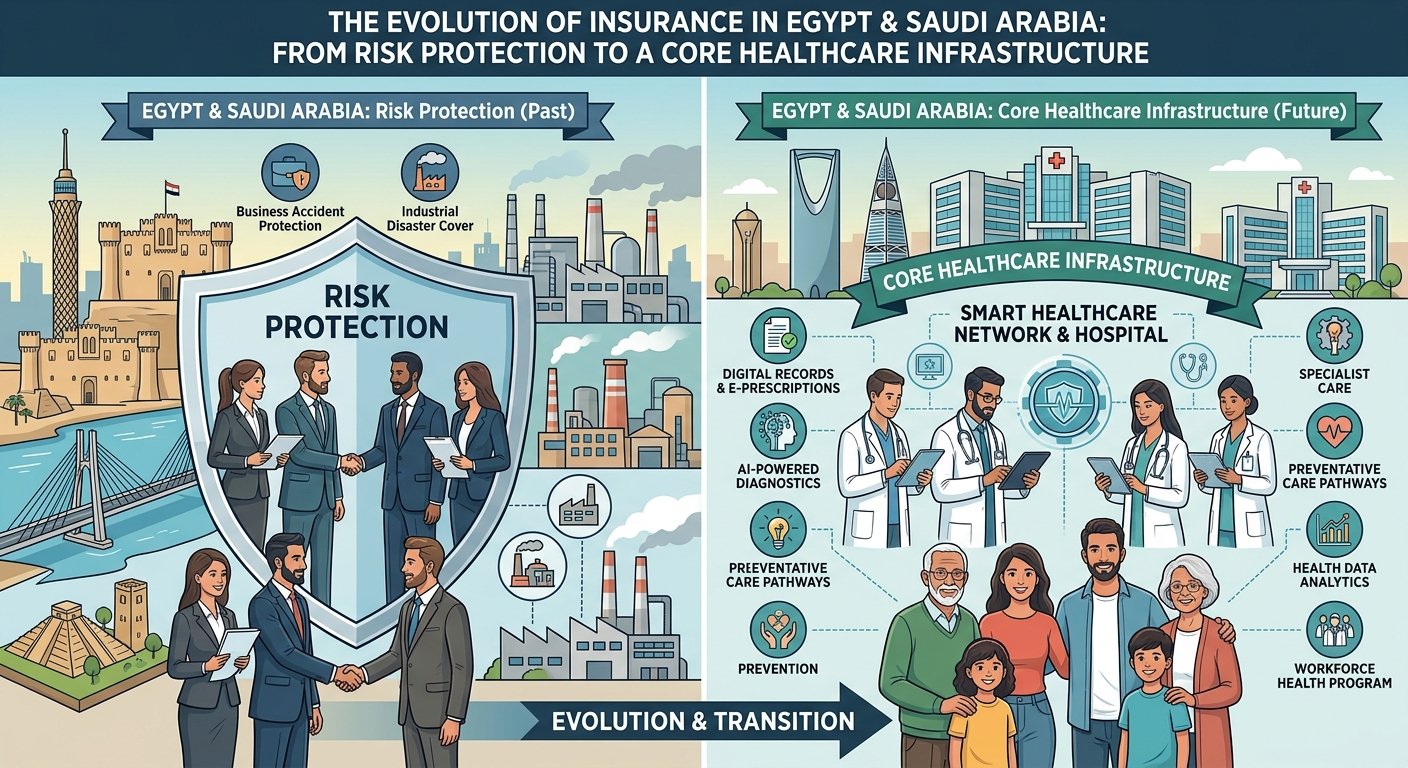
Insurance in Egypt and Saudi Arabia: From Risk Protection to a Core Healthcare Infrastructure
Industry Review | MENA & Africa Healthcare Magazine | August 2026
Insurance is no longer simply a financial mechanism for transferring risk. In Egypt and Saudi Arabia, insurance is becoming an increasingly important part of the architecture of healthcare financing, corporate risk management, financial inclusion, investment and economic development.
The two markets are particularly interesting because they represent two different stages of insurance-market development. Egypt has a large, diversified and increasingly regulated insurance ecosystem with substantial room for penetration and product expansion. Saudi Arabia has developed a much more compulsory and technology-enabled insurance environment, particularly in health insurance, where insurance is deeply integrated into employment, residency, healthcare access and the wider transformation of the healthcare system.
For healthcare investors, hospital operators, medical groups, laboratories, pharmacies, diagnostic companies, healthcare funds and technology companies, understanding insurance is therefore essential.
1. The Insurance Industry: What Does an Insurance Company Actually Do?
An insurance company performs several functions simultaneously. At the simplest level, it collects premiums from a pool of customers and assumes specified risks in return for contractual obligations to compensate policyholders when insured events occur.
However, a modern insurance company is effectively a combination of:
- Risk-management institution
- Financial institution
- Underwriting organization
- Investment manager
- Claims-management organization
- Data and analytics company
- Healthcare purchasing organization in medical insurance
- Customer-service organization
- Regulated financial institution
- Counterparty to healthcare providers
2. The Main Functions of the Insurance Market
2.1 Risk Identification
The insurance cycle starts with identifying the risks faced by an individual, company, asset, employee population or healthcare organization.
Examples include death, disability, illness, hospitalization, accidents, fire, property damage, professional liability, motor accidents, cyber risk, marine risk, engineering risk and business interruption.
2.2 Risk Assessment
Insurers assess the probability and financial impact of an insured event. This is where actuarial science, underwriting, medical underwriting, engineering assessment, historical claims data and artificial intelligence increasingly become important.
2.3 Underwriting
Underwriting determines whether an insurer will accept a risk and, if accepted, under what conditions and at what price.
In health insurance, underwriting may consider demographic characteristics, benefit design, utilization patterns, historical claims, medical inflation, provider prices and population risk.
2.4 Pricing
The insurer converts risk into a premium. Pricing normally incorporates expected claims, administrative expenses, commissions, capital requirements, reinsurance costs, profit margins and risk adjustments.
2.5 Policy Administration
Insurance companies issue policies, maintain customer records, manage endorsements, collect premiums, renew contracts and administer changes in coverage.
2.6 Claims Management
Claims management is one of the most important functions of an insurer. It includes notification, validation, assessment, adjudication, fraud detection, medical review where applicable, settlement and payment.
In healthcare, claims management can become a sophisticated clinical and financial process involving pre-authorizations, medical necessity, coding, utilization review, provider contracts, network management and fraud analytics.
2.7 Risk Management and Reinsurance
Insurers do not necessarily retain all risks themselves. Reinsurance allows insurers to transfer part of their exposure to specialized reinsurance companies.
Egypt introduced a new regulatory framework for registered reinsurers in 2025, requiring Egyptian insurers to place reinsurance with entities registered with the Financial Regulatory Authority.
2.8 Investment Management
Insurance companies collect premiums before claims are necessarily paid. The resulting funds can be invested subject to regulatory requirements, creating an important link between insurance and capital markets.
2.9 Customer Protection
Insurance regulation aims to ensure that insurers maintain sufficient capital, technical provisions and liquidity to meet future obligations.
2.10 Data and Analytics
The future insurance company will increasingly be a data company. Claims databases, electronic health records, utilization data, provider performance, customer behavior and artificial intelligence can transform underwriting and claims management.
3. The Insurance Value Chain
| Participant | Primary Function | Healthcare Relevance |
|---|---|---|
| Insurance Company | Risk underwriting and policy issuance | Finances healthcare claims |
| Broker | Advisory and placement | Designs and negotiates corporate medical programs |
| TPA / Claims Administrator | Claims and network administration | Controls utilization and provider interaction |
| Healthcare Provider | Clinical services | Generates the underlying healthcare cost |
| Reinsurer | Risk transfer | Supports catastrophic and portfolio capacity |
| Actuary | Risk and financial modelling | Prices medical risk and reserves |
| Regulator | Market supervision | Protects policyholders and market stability |
4. Egypt Insurance Market
Egypt’s insurance industry is entering a significant transition following the Unified Insurance Law No. 155 of 2024. The Financial Regulatory Authority has been developing implementing regulations covering insurance companies, products, solvency, reinsurance, Takaful and digital transformation.
At the end of 2025, Egypt’s insurance sector recorded approximately EGP 130.8 billion in total premiums, up 22.5% from EGP 106.7 billion in 2024. Claims paid reached approximately EGP 64.4 billion, an increase of 38.2%. The sector comprised 169 active entities including insurers, brokers, loss-adjustment and insurance-consulting businesses, in addition to six insurance pools.
The market also had approximately 15 million policyholders at the end of 2025, demonstrating both the scale of the sector and the significant potential for further penetration.
Egypt’s Major Insurance Companies
The following list provides a practical industry-reference view of the principal insurance companies operating in Egypt, covering life, non-life and Takaful businesses. Because the regulatory register is continuously updated, investors should verify current licensing directly through the FRA before entering into a transaction. The FRA explicitly advises customers to verify that insurers and brokers are licensed.
Life and Personal Insurance
- Misr Life Insurance Company
- Allianz Life Egypt
- MetLife Egypt
- AXA Life Egypt
- QNB Alahli Life Insurance
- GIG Life Egypt
- Sarwa Life Insurance
- Suez Canal Life Insurance
- Chubb Life Egypt
- Delta Life Assurance
- Libano-Suisse Takaful
- KAF Life Takaful Insurance
- Wafa Life Insurance
- Mohandes Life Insurance
- Misr Emirates Takaful Life Insurance
- Arope Life Insurance
- Misr Life Takaful
The 2024 market data show a highly concentrated life-insurance segment, led by Allianz Life Egypt, Misr Life Insurance, MetLife Egypt and AXA Life Egypt.
Property, Casualty, Medical and General Insurance
- Misr Insurance
- Orient Takaful Insurance
- GIG Egypt Insurance
- Allianz Insurance Egypt
- Bupa Egypt Insurance
- Egyptian Takaful Insurance
- AXA Insurance Egypt
- Royal Insurance
- Suez Canal Insurance
- Delta Insurance
- Mohandes Insurance
- Al Wataniya Insurance
- Chubb Insurance Egypt
In 2024, Misr Insurance remained by far the largest non-life insurer, followed by Orient Takaful, GIG Egypt, Allianz Insurance Egypt and Bupa Egypt.
5. Egypt’s Insurance Functions in Healthcare
The healthcare insurance value chain in Egypt can be divided into several major functions.
- Corporate medical insurance: Employers purchase coverage for employees and dependents.
- Individual medical insurance: Individuals purchase private health protection.
- Medical network management: Insurers and administrators contract hospitals, clinics, laboratories, pharmacies and diagnostic centers.
- Pre-authorization: Selected services require prior approval.
- Claims adjudication: Medical bills are reviewed before payment.
- Utilization management: Insurers monitor the appropriateness and frequency of healthcare utilization.
- Fraud detection: Claims analytics identify abnormal provider or patient behavior.
- Medical underwriting: Risk characteristics influence product design and pricing where permitted.
- Reimbursement: The insurer settles eligible claims with providers or beneficiaries.
- Provider contracting: Insurers negotiate tariffs, discounts, payment terms and service conditions.
6. Takaful in Egypt
Takaful is becoming an increasingly important component of the Egyptian insurance market. In May 2026, the FRA issued a new regulatory framework for Takaful companies, including provisions concerning policyholder funds, shareholder funds, Sharia supervisory committees, Sharia auditing and the treatment of surpluses and deficits.
The development of Takaful provides Egypt with an additional product architecture capable of attracting customers who prefer Sharia-compliant risk-sharing structures.
7. Saudi Arabia Insurance Market
Saudi Arabia represents one of the most advanced insurance markets in the GCC, particularly in healthcare. The establishment of the Insurance Authority has further consolidated regulatory responsibility for the sector.
The Insurance Authority’s current licensing framework covers insurance and reinsurance companies, foreign insurance and reinsurance branches, brokers and agents, aggregation, insurance consulting, loss adjustment, claims settlement and actuarial services.
The Authority’s official licensed-company register was updated on 17 August 2026, making it the appropriate reference point for the current legal status of Saudi insurers.
Principal Saudi Insurance Companies
The Saudi market includes a broad group of cooperative insurers and specialist insurance businesses. The following provides a practical market map of the principal companies relevant to healthcare, corporate insurance and general insurance:
- Bupa Arabia for Cooperative Insurance
- The Company for Cooperative Insurance – Tawuniya
- Gulf Insurance Group – GIG Saudi
- MedGulf – The Mediterranean and Gulf Insurance and Reinsurance Company
- Walaa Cooperative Insurance
- Al Rajhi Takaful
- Arabian Shield Cooperative Insurance
- Al Etihad Cooperative Insurance
- Al Sagr Cooperative Insurance
- Buruj Cooperative Insurance
- Saudi Arabian Cooperative Insurance – SAICO
- Saudi Enaya Cooperative Insurance
- Malath Cooperative Insurance and Reinsurance
- Saudi United Cooperative Insurance / UCA
- United Cooperative Insurance
- Amana Cooperative Insurance
- Salama Cooperative Insurance
- Allied Cooperative Insurance Group – ACIG
- Gulf Union Cooperative Insurance
- Gulf General Cooperative Insurance
- Alinma Tokio Marine
- Al Jazira Takaful Ta’awuni
- Alinma Tokio Marine
- Wataniya Insurance
- Mutakamela Insurance
- Liva Insurance
- Saudi Re
- Riyadh Re
This list should be read as a market map rather than a definitive legal register because corporate names, mergers, licenses and permitted activities change. The Insurance Authority’s current licensed-company PDF should be used for transaction-level verification.
8. Saudi Arabia: Why Health Insurance Is Different
Healthcare is the defining engine of the Saudi insurance market. Health insurance is closely connected with employment, residency, private healthcare utilization and the transformation of healthcare financing under Vision 2030.
The Saudi insurance market’s medical gross written premium reached approximately SAR 15.37 billion in Q1 2025, up around 10% from Q1 2024. Bupa Arabia and Tawuniya were the largest contributors, with MedGulf also representing a major medical insurer.
One industry analysis described the Saudi medical market as highly concentrated, with the two largest players controlling approximately 79% of medical premiums. The same analysis cited the National Insurance Sector Strategy 2030 target of approximately 23 million beneficiaries and SAR 83 billion in premiums by 2030.
9. The Saudi Healthcare Insurance Ecosystem
Saudi healthcare insurance has evolved beyond the traditional insurer-provider relationship.
The ecosystem increasingly includes:
- Insurance companies
- Health insurance administrators
- Third-party administrators
- Medical claims-management companies
- Hospitals
- Medical centers
- Laboratories
- Pharmacies
- Diagnostic centers
- Home healthcare providers
- Digital health companies
- Insurance brokers
- Reinsurance companies
- Actuarial firms
- Healthcare consultants
The Saudi Insurance Authority itself provides digital services for health insurance verification and allows users to identify the insurance company associated with their coverage.
10. The TPA Function
Third-party administrators are particularly important in healthcare insurance because they operate between the insurer, employer, patient and healthcare provider.
A TPA may perform:
- Member eligibility verification
- Provider network administration
- Pre-authorization
- Medical claims processing
- Medical coding review
- Utilization management
- Fraud detection
- Customer service
- Provider payment administration
- Claims analytics
Saudi Arabia’s healthcare ecosystem includes dedicated medical claims-settlement businesses, and the Insurance Authority regulates licensing and qualification of relevant entities.
11. Insurance and Hospitals: The Most Important Commercial Relationship
For hospitals, insurance companies are not simply customers. They are increasingly strategic counterparties.
The relationship covers:
- Contracted tariffs
- Discounts
- Payment cycles
- Medical authorization
- Length-of-stay management
- Case-mix management
- Clinical pathways
- Readmission management
- Quality indicators
- Claims rejection rates
- Denial management
- Fraud prevention
- Patient experience
This creates a major strategic opportunity for healthcare operators. A hospital that understands insurance economics can improve both revenue and clinical efficiency.
12. The Economics of Medical Insurance
The basic economics of medical insurance can be simplified into:
For healthcare providers, the corresponding equation is different:
The strategic objective of both sides should therefore not be to maximize the number of claims. It should be to maximize the value of each healthcare intervention.
13. From Fee-for-Service to Value-Based Healthcare
The traditional insurance model often pays providers according to the quantity of services delivered.
The emerging model focuses increasingly on:
- Clinical outcomes
- Patient safety
- Appropriate utilization
- Reduced avoidable admissions
- Reduced readmissions
- Chronic disease management
- Preventive care
- Population health
- Cost per episode
- Patient experience
This shift creates opportunities for hospitals and insurance companies to establish bundled payments, case rates, capitation, shared savings and other alternative payment models.
14. Insurance Brokers: An Underestimated Part of the Market
Brokers represent another critical component of the insurance ecosystem.
For corporate healthcare programs, brokers can:
- Assess employee demographics
- Analyze historical claims
- Prepare tender documents
- Obtain competing quotations
- Negotiate premiums
- Design benefit structures
- Compare insurer networks
- Support renewal negotiations
- Advise on risk management
- Assist with claims escalation
In Saudi Arabia, the Insurance Authority explicitly recognizes insurance brokers, reinsurance brokers, insurance agents and other intermediary activities within its licensing framework.
15. Reinsurance: The Invisible Infrastructure
Reinsurance is rarely visible to patients but is fundamental to insurance-market stability.
A primary insurer may transfer part of a large risk to a reinsurer through:
- Treaty reinsurance
- Facultative reinsurance
- Quota share
- Surplus arrangements
- Excess-of-loss protection
- Catastrophe protection
For healthcare, reinsurance can be particularly relevant to catastrophic medical risks, high-cost treatments, international medical coverage and portfolio volatility.
16. Digital Transformation of Insurance
Both Egypt and Saudi Arabia are moving toward digital insurance ecosystems.
Important technologies include:
- Artificial intelligence
- Machine learning
- Automated underwriting
- Digital claims processing
- Electronic medical claims
- Fraud analytics
- Predictive healthcare analytics
- Digital identity
- Electronic policy issuance
- Insurance comparison platforms
- API-based healthcare integration
- Cloud insurance platforms
Egypt has mandated electronic linking and real-time/historical insurance data registration, creating the foundation for a more data-driven supervisory environment.
Saudi Arabia is similarly promoting digital insurance, including electronic brokerage, automated processes and digital comparison of insurance products.
17. Key Differences Between Egypt and Saudi Arabia
| Dimension | Egypt | Saudi Arabia |
|---|---|---|
| Market maturity | Developing with significant penetration opportunity | More mature, particularly in medical insurance |
| Regulator | Financial Regulatory Authority | Insurance Authority |
| Major growth driver | Penetration, financial inclusion and product development | Compulsory medical coverage, Vision 2030 and private healthcare |
| Health insurance | Significant growth opportunity | Core market segment |
| Takaful | Growing under new regulatory framework | Established cooperative/Takaful-oriented market |
| Digitalization | Rapidly accelerating | Highly developed and strategically prioritized |
| Healthcare opportunity | Large underserved population and private-market opportunity | Large insured population and transformation toward private-sector participation |
18. Major Risks Facing Both Markets
- Medical inflation
- Provider price inflation
- Claims leakage
- Fraud and abuse
- Adverse selection
- Underpricing
- Cybersecurity
- Data privacy
- Regulatory change
- Low insurance awareness in some population segments
- Concentration risk
- Reinsurance capacity
- Investment-market volatility
- Climate and catastrophe risks
- Geopolitical risk
19. The Healthcare Opportunity
For the healthcare industry, the most important opportunity is the transformation of insurance from a payment mechanism into a healthcare-management platform.
The future insurance-healthcare relationship can be built around four layers:
- Coverage: Who is insured?
- Access: Which providers can the patient use?
- Utilization: Which services are medically necessary?
- Outcome: Did the intervention create measurable value?
This creates a strategic opportunity for healthcare management companies to operate between insurers and providers, using analytics, clinical governance and operational management to reduce unnecessary cost while improving outcomes.
20. Investment Themes for 2026–2030
Several insurance-related investment themes deserve particular attention across Egypt, Saudi Arabia and the wider MENA region:
- Health insurance platforms
- TPA and claims-management companies
- Insurance technology
- AI-based claims analytics
- Fraud detection
- Medical cost-management companies
- Digital brokers
- Healthcare provider networks
- Population-health management
- Chronic disease management
- Home healthcare insurance models
- Telemedicine-linked insurance
- Value-based healthcare contracts
- Specialty insurance products
- Reinsurance and risk-capital platforms
21. What Healthcare Investors Should Monitor
When evaluating an insurance company or insurance-linked healthcare business, investors should examine:
- Gross written premium
- Net written premium
- Loss ratio
- Expense ratio
- Combined ratio
- Medical loss ratio
- Retention ratio
- Solvency position
- Claims reserves
- Average claims cost
- Claims settlement time
- Provider concentration
- Customer concentration
- Reinsurance dependence
- Digital claims penetration
- Fraud and leakage levels
- Investment income
- Customer acquisition cost
- Renewal rate
- Complaint ratio
22. The Strategic Outlook
Egypt and Saudi Arabia are moving in different but complementary directions.
Egypt’s opportunity is penetration. A large population, expanding private healthcare sector, rising financial awareness and regulatory modernization create substantial room for insurance expansion.
Saudi Arabia’s opportunity is integration. The market is increasingly moving toward a digitally connected insurance and healthcare ecosystem in which insurers, providers, employers, regulators and technology companies exchange data and manage healthcare utilization more systematically.
The result is a major strategic transformation.
The winning model will not be the insurer that simply pays the cheapest claim. It will be the organization capable of understanding risk, managing utilization, improving outcomes, controlling medical inflation and creating a better experience for patients, employers and healthcare providers.
23. Conclusion: From Insurance Companies to Health-Risk Platforms
The insurance industry in Egypt and Saudi Arabia is entering a new phase.
The traditional model was simple: collect premiums, insure risks and pay claims.
The emerging model is much more sophisticated:
Identify risk → price risk → insure risk → manage utilization → manage providers → analyze data → prevent avoidable events → improve outcomes → reduce total cost of care.
This transformation makes insurance one of the most important sectors for healthcare investors and operators to understand.
For MENA and Africa, Egypt and Saudi Arabia can increasingly serve as two different laboratories for the development of the next generation of healthcare-financing models: Egypt as a large, underpenetrated and rapidly modernizing market, and Saudi Arabia as a highly structured market moving toward digital, integrated and increasingly outcome-oriented healthcare financing.
Regulatory and Market References
- Financial Regulatory Authority – Egypt: Insurance Companies and Funds Registries. [FRA Insurance Registries](https://fra.gov.eg/en/سجلات-في-مجال-التأمين/?utm_source=chatgpt.com)
- Financial Regulatory Authority – Egypt: Insurance sector information and consumer guidance. [FRA Insurance Sector](https://fra.gov.eg/en/قطاع-التأمين/?utm_source=chatgpt.com)
- Insurance Authority – Saudi Arabia: Licensed Companies and licensing information. [Saudi Insurance Authority – Licensed Companies](https://www.ia.gov.sa/en/regulations-and-licenses/licenses?utm_source=chatgpt.com)
- Insurance Authority – Saudi Arabia: Insurance eServices and health insurance verification. [Saudi Insurance Authority eServices](https://www.ia.gov.sa/en/eservices/?utm_source=chatgpt.com)
Editorial note: Company names and licensing status can change because of mergers, acquisitions, license amendments, withdrawals and regulatory decisions. This article is intended as an industry-review and educational reference for the MENA & Africa Healthcare Magazine and should not be treated as a legal confirmation that a particular company is licensed for a particular insurance class. Current licensing should always be verified through the relevant regulator.