Energy Shocks, Healthcare Resilience and the Next Investment Cycle
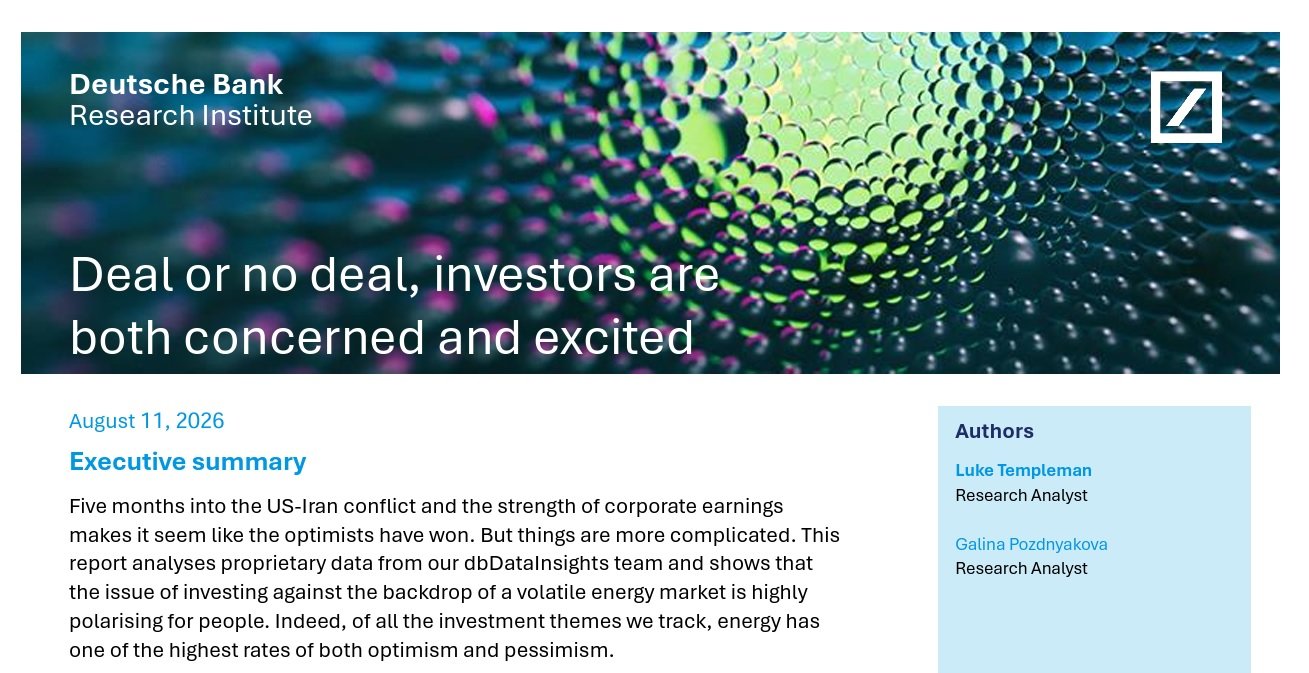
Deutsche Bank’s August 2026 Perspective: From Energy Shock to Structural Transformation — Operator for Health Care Commentary
1. Energy Has Become a Polarizing Investment Theme
Energy is increasingly viewed through two opposing lenses. On one side, higher energy prices represent a major economic risk, increasing costs for consumers, manufacturers and businesses. On the other, the disruption creates significant investment opportunities across energy production, infrastructure, technology and alternative energy sources.
This polarization means that investors are no longer looking at energy simply as a commodity sector. They are increasingly considering energy security, diversification, infrastructure resilience and energy efficiency as long-term investment themes.
In this respect, energy is beginning to resemble artificial intelligence in its influence on capital allocation: both are structural forces capable of reshaping entire industries.
2. Short-Term Pain, Long-Term Gain
Energy shocks are typically painful in the short term. Higher energy prices increase operating costs, reduce household purchasing power and place pressure on economic growth. However, Deutsche Bank’s longer-term megatrend analysis suggests that energy shocks can ultimately become catalysts for structural economic improvement.
When energy becomes expensive or unreliable, economies are forced to respond. They diversify their sources of supply, invest in new technologies, improve infrastructure and reduce energy consumption.
The result is a gradual improvement in energy productivity — generating more economic output from each unit of energy consumed.
This creates an important investment principle:
Energy disruption can create short-term economic pain while accelerating long-term efficiency and diversification.
3. The 1970s Parallel
One of the strongest historical parallels is the energy crisis of the 1970s. The oil shocks created inflation, economic disruption and significant pressure on consumers and businesses.
Yet the longer-term consequence was transformative. Economies diversified energy supplies, invested in alternative technologies and dramatically improved energy efficiency.
The structural decline in the energy intensity of GDP that followed demonstrates how an external shock can permanently change economic behavior.
The current environment could produce a similar outcome. The immediate disruption associated with the Strait of Hormuz and geopolitical instability may accelerate investments that otherwise would have taken years to materialize.
4. Where Capital Could Flow
If the historical pattern continues, the medium-term beneficiaries are likely to extend well beyond traditional oil and gas producers.
- LNG infrastructure and alternative gas supply routes.
- Non-Gulf energy production capable of reducing geographic concentration.
- Renewable energy and decentralized generation.
- Electricity grids and grid-resilience infrastructure.
- Battery storage and distributed energy systems.
- Energy-efficiency technologies capable of reducing consumption without reducing economic output.
The key investment opportunity therefore may not simply be higher energy prices. It may be the infrastructure required to build a more diversified, decentralized and resilient global energy system.
Operator for Health Care Commentary: Why Energy Resilience Is Becoming a Healthcare Issue
While the Deutsche Bank analysis is primarily focused on macroeconomics and investment markets, its implications for healthcare are profound.
Healthcare systems are among the most energy-dependent sectors of the economy. Hospitals operate continuously and require reliable electricity for intensive care units, operating rooms, imaging equipment, laboratories, pharmacies, refrigeration, sterilization, HVAC systems, information technology and life-support systems.
Consequently, energy security should no longer be considered merely an environmental or facilities-management issue. It is becoming a core healthcare business-continuity and investment issue.
1. Immediate Operational Costs and Margin Pressure
The first impact of energy volatility is financial.
Hospitals and healthcare providers already operate under pressure from labor costs, medical inflation, technology investment, insurance reimbursement constraints and rising pharmaceutical and medical-device costs. A significant increase in energy expenditure can further compress operating margins.
Margin Squeeze
Higher electricity, fuel and transportation costs can reduce the cash available for recruitment, technology upgrades, clinical expansion and infrastructure investment.
For healthcare operators, this creates a difficult strategic equation: the organization must invest more in resilience precisely when operating costs are already increasing.
Supply Chain Disruption
Energy volatility also affects the healthcare supply chain. Pharmaceuticals, medical devices, laboratory supplies, oxygen systems, packaging materials and other critical products often depend on energy-intensive manufacturing and international transportation.
Disruptions in shipping routes or energy markets can therefore translate into longer lead times, higher procurement costs and potential shortages.
Healthcare providers will increasingly need to move from a procurement model based primarily on lowest cost toward one that also considers security of supply, geographic diversification and business continuity.
2. Energy Resilience Will Become Part of Hospital Strategy
The concept of grid resilience highlighted by the Deutsche Bank analysis has a direct healthcare equivalent.
A hospital cannot afford to treat electricity as an ordinary utility. A power interruption can immediately become a clinical safety event.
This is likely to accelerate investment in:
- On-site solar generation.
- Battery energy storage.
- High-efficiency backup generation.
- Microgrids.
- Smart energy-management systems.
- Energy monitoring and predictive maintenance.
- Redundant power systems for critical clinical areas.
The strategic objective is not simply to reduce carbon emissions. It is to ensure that the hospital can maintain essential services during an external energy or infrastructure shock.
A hospital capable of operating independently during a major power disruption possesses a genuine competitive and clinical advantage.
3. Healthcare’s Own Energy-Transition Opportunity
The energy crisis could also accelerate the transformation of healthcare facilities themselves.
Hospitals consume significant amounts of energy because of their 24/7 operating model. Cooling, heating, ventilation, sterilization, imaging, operating rooms, laboratories and critical-care infrastructure all require continuous energy.
The opportunity is therefore to reduce the energy intensity of healthcare without compromising clinical quality.
Hospitals can achieve this through:
- LED and high-efficiency lighting.
- Smart HVAC and building-management systems.
- Energy-efficient imaging and laboratory equipment.
- Intelligent operating-room utilization.
- Optimized sterilization systems.
- Energy-efficient refrigeration and pharmacy systems.
- Digital monitoring of energy consumption.
- Predictive maintenance of major equipment.
The objective should be measured in terms of energy consumed per patient, per procedure, per occupied bed and per unit of revenue.
4. A New Opportunity for Health-Tech
Energy disruption may also accelerate healthcare innovation.
Telehealth and Distributed Care
Healthcare delivery does not necessarily need to remain concentrated inside large physical facilities.
Telemedicine, remote patient monitoring, digital diagnostics and decentralized outpatient services can reduce unnecessary patient travel and potentially reduce the physical and energy footprint associated with traditional healthcare delivery.
The future healthcare model may therefore become increasingly distributed: large hospitals for complex care, supported by digitally connected outpatient and community-based services.
Pharmaceutical and Biomanufacturing Innovation
Energy volatility may also encourage pharmaceutical companies to reconsider manufacturing models.
Technologies such as continuous manufacturing, precision fermentation and other advanced biomanufacturing approaches could help create more flexible and potentially more resource-efficient production systems.
The broader lesson is the same as in the energy sector: when resources become expensive or uncertain, innovation becomes economically attractive.
5. The Public Health Dimension
Perhaps the most important healthcare implication is not inside the hospital at all.
Energy prices influence the social determinants of health.
When household energy costs increase, disposable income declines. Families may subsequently face greater pressure from food costs, housing expenses, transportation and other essential needs.
Prolonged economic stress can contribute to poorer nutrition, housing insecurity, psychological stress and reduced access to preventive healthcare.
This creates a paradox: the same energy shock that increases healthcare operating costs can simultaneously increase healthcare demand.
For governments and healthcare investors, this makes energy policy an important component of long-term health-system planning.
6. What This Means for Healthcare Investors
From an investment perspective, energy resilience should increasingly be incorporated into healthcare due diligence.
Investors evaluating hospitals, laboratories, medical centers and healthcare platforms should consider questions such as:
- How dependent is the facility on the national electricity grid?
- What percentage of operating expenditure is energy-related?
- Does the facility have redundant power infrastructure?
- Can critical services operate during prolonged power disruption?
- How diversified are pharmaceutical and medical-device suppliers?
- What is the facility’s energy consumption per bed or patient?
- What investments are required to improve energy efficiency?
- Can renewable generation or battery storage improve the business case?
These questions are increasingly relevant to valuation, operational risk and long-term competitiveness.
7. The MENA Healthcare Opportunity
The implications may be particularly significant across the Middle East and North Africa.
The region combines rapidly expanding healthcare demand with significant energy infrastructure, geopolitical exposure and ambitious healthcare transformation programs.
This creates an opportunity to design the next generation of hospitals differently from legacy facilities.
Future healthcare developments can be designed around energy efficiency, decentralized generation, smart buildings, digital health, resilient supply chains and integrated business-continuity systems from the beginning rather than retrofitted later.
For healthcare developers and operators, this represents more than an ESG opportunity. It is a potential source of lower operating costs, improved resilience, stronger asset value and greater continuity of patient care.
Operator for Health Care Services: Strategic View
The central lesson from the Deutsche Bank analysis is highly relevant to healthcare:
Crises do not simply destroy value; they redistribute capital toward systems that are more efficient, diversified and resilient.
The healthcare industry should therefore not view energy volatility solely as an external macroeconomic problem. It should be treated as a strategic transformation opportunity.
The hospital of the future will not be judged only by its number of beds, clinical specialties or technology portfolio. It will increasingly be judged by its ability to maintain high-quality care under stress.
That means resilient power, diversified supply chains, efficient infrastructure, digital healthcare delivery and intelligent resource management will become increasingly important components of healthcare competitiveness.
Conclusion: From Energy Security to Healthcare Security
The current energy shock may create significant short-term economic pain. Healthcare providers are likely to face higher operating costs, supply-chain pressure and increased demand from populations affected by economic stress.
But the longer-term outcome could be very different.
Just as previous energy crises accelerated diversification and energy efficiency across the global economy, today’s disruption could accelerate the development of a more resilient healthcare infrastructure.
The winners will likely be healthcare organizations that recognize the shift early and invest accordingly.
Energy security is becoming healthcare security. Energy efficiency is becoming healthcare productivity. And resilience is becoming an increasingly important component of healthcare value.
For investors, operators and healthcare policymakers, the opportunity is to move beyond reacting to the current crisis and begin designing the healthcare infrastructure required for the next decade.
“`