Comment on the BNP Paribas Economic Outlook for Egypt July 2026
Comment on the BNP Paribas Economic Outlook for Egypt
July 2026
The report correctly acknowledges the resilience demonstrated by Egypt through strengthened fiscal reforms, enhanced exchange rate flexibility, and continued international support. Together, these measures have contributed to improving investor confidence and supporting the country’s economic recovery.
Economic stabilization should be viewed not as the destination, but as the foundation for Egypt’s next stage of development.
From Stabilization to Productivity-Led Growth
From a strategic perspective, economic stabilization should be viewed as only the first stage of Egypt’s development journey. The country’s next priority must be accelerating productivity-led growth through investment in high-value sectors, particularly:
- Healthcare
- Education and human capital
- Digital transformation
- Advanced manufacturing
- Logistics and transportation
- Knowledge-based and professional services
Sustainable economic growth exceeding 6% will require structural reforms that expand private-sector participation, stimulate innovation, improve productivity, and create higher-value employment opportunities.
Reducing External Vulnerability
The report’s emphasis on external vulnerability and energy dependency is particularly significant. Egypt’s long-term competitiveness will depend not only on maintaining macroeconomic discipline, but also on transforming the country into a regional hub for energy, healthcare, logistics, and professional services.
Diversifying foreign-currency earnings beyond traditional sources remains essential to reducing dependence on volatile capital flows and strengthening Egypt’s external resilience.
Regional energy hub
Medical and health services hub
Trade and logistics gateway
Knowledge-based economy
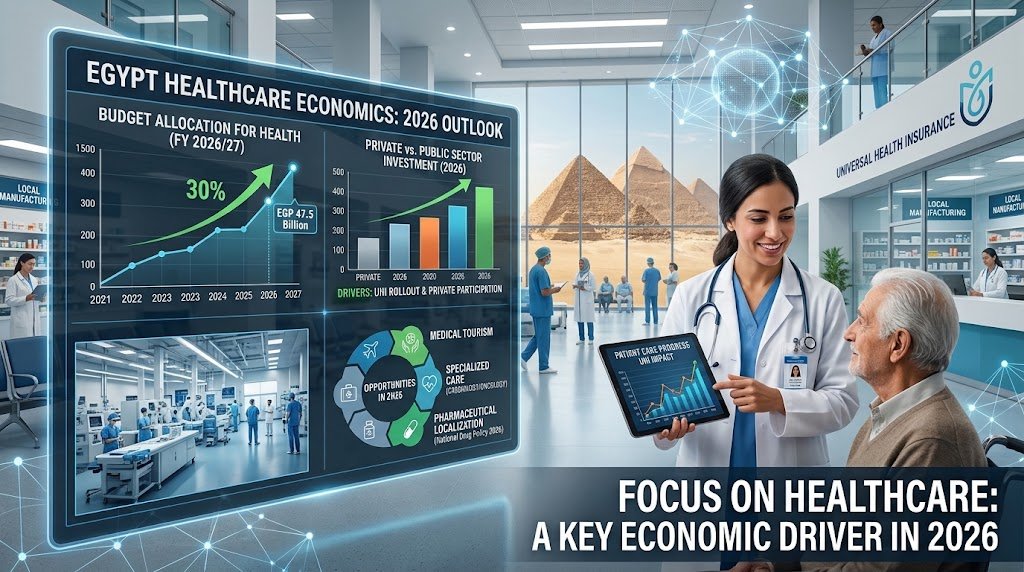
Healthcare as an Economic Driver
Equally important, healthcare should be recognized as a strategic economic driver rather than merely a social expenditure.
The ongoing implementation of Universal Health Insurance, combined with increasing private investment, medical tourism, pharmaceutical manufacturing, biotechnology, and digital health, provides Egypt with a unique opportunity to position healthcare as a major contributor to:
- GDP growth
- Employment creation
- Foreign direct investment
- Foreign-currency earnings
- Innovation and technology transfer
- Regional economic competitiveness
Egypt has the potential to move beyond viewing healthcare primarily as a cost center and instead develop it as an integrated economic ecosystem connecting healthcare delivery, education, research, pharmaceuticals, medical technology, insurance, digital health, and medical tourism.
Healthcare Can Become One of Egypt’s Engines of Growth
Investment in healthcare is investment in human capital, productivity, employment, innovation, and economic competitiveness.
The Next Economic Challenge
Overall, the BNP Paribas report reinforces the view that Egypt has successfully navigated a difficult period of macroeconomic adjustment. The challenge now is to convert stabilization into sustainable, inclusive, and innovation-driven economic growth.
Achieving this objective will require continued policy consistency, institutional reform, human capital development, stronger private-sector participation, and strategic investment in sectors capable of generating long-term value for both the Egyptian economy and its citizens.
Prof. Dr. Khaled Samir
Chairman, Operator for Health Care Services
“`