THE PHYSINEER ERA
The Rise of the Physineer
What Happens When a Physician Starts Thinking Like an Engineer?
For generations, healthcare has been organized around professional boundaries.
Physicians diagnose and treat.
Engineers design and build.
Technologists develop systems.
Financial professionals manage resources.
Each profession has developed its own knowledge, language, education, and professional identity.
But healthcare is changing faster than these boundaries.
The healthcare system of the future is no longer simply a place where physicians treat patients.
It is a complex ecosystem of clinical services, artificial intelligence, data, medical devices,
digital platforms, robotics, infrastructure, finance, regulation, cybersecurity, and human behavior.
And this creates a new question:
Who will connect all of these worlds?
Perhaps the answer is a new kind of professional.
The Physineer
PHYSICIAN + ENGINEER
A New Word for a New Healthcare Era
The word Physineer combines two worlds:
PHYSICIAN
Clinical knowledge, patient care, medical judgment and human understanding.
ENGINEER
Systems thinking, process design, optimization, technology and problem solving.
But the concept is much bigger than the combination of two professions.
A Physineer is a professional who understands healthcare through the mindset of
systems, engineering, technology, data, and continuous improvement
while remaining deeply connected to the human and clinical realities of medicine.
The goal is not to replace disciplines.
The goal is to connect them.
From Treating Problems to Designing Systems
The traditional physician is trained to identify a clinical problem:
“What is wrong with this patient?”
The engineer approaches a problem differently:
“Why is the system producing this outcome?”
The Physineer asks both questions.
Consider a Simple Example: Patient Waiting Time
A patient experiences a long waiting time.
The traditional response might be:
“We need more staff.”
The Physineer asks:
- Where exactly is the bottleneck?
- Is registration causing the delay?
- Is physician scheduling poorly designed?
- Are appointments clustered at certain times?
- Is diagnostic capacity insufficient?
- Is the electronic medical record slowing the process?
- Could automation eliminate unnecessary steps?
- Could predictive analytics improve scheduling?
The problem is no longer simply “waiting.”
It becomes a system-design problem.
Healthcare Is Becoming a Systems Industry
Healthcare used to be largely centered on:
Today, it increasingly involves:
Every component is connected.
A new AI diagnostic tool may improve accuracy but increase workflow complexity.
A new medical device may improve clinical outcomes but create additional operating costs.
A digital platform may increase access but create cybersecurity and data-governance risks.
The challenge is not simply acquiring technology.
The challenge is integrating technology into a functioning healthcare system.
The End of the “Either Medicine or Engineering” Mindset
For a long time, professional education encouraged specialization.
You became a physician.
Or an engineer.
Or an IT specialist.
Or a financial expert.
But today’s healthcare challenges rarely stay inside one discipline.
Consider Cancer Care
Modern cancer care requires the integration of:
- Clinical medicine
- Pathology
- Medical imaging
- Genomics
- Pharmaceuticals
- Medical devices
- Data science
- Artificial intelligence
- Radiation physics
- Nursing
- Patient navigation
- Hospital operations
- Financial planning
- Quality management
Who owns the entire system?
Usually, nobody.
This is one of the greatest opportunities for the Physineer.
The Physineer as the Bridge
The value of the Physineer is not necessarily that they know everything.
It is that they can connect the people who do.
In a complex healthcare environment, translation becomes a strategic capability.
Why AI Makes the Physineer More Important
Artificial intelligence is accelerating the convergence between medicine, engineering,
technology and data.
- AI can analyze enormous quantities of data.
- It can recognize patterns.
- It can support diagnosis.
- It can predict patient deterioration.
- It can optimize scheduling.
- It can automate documentation.
- It can support drug discovery.
- It can improve imaging interpretation.
But AI does not independently redesign a healthcare organization.
Someone still has to ask:
- Where should AI be introduced?
- What clinical problem are we actually solving?
- What data are required?
- How will the workflow change?
- Who remains accountable?
- What happens when the algorithm is wrong?
- How will clinicians adopt it?
- How will patients experience it?
- What is the economic return?
- How do we scale it safely?
The algorithm may be intelligent.
But the system around the algorithm must also be intelligently designed.
The Physineer Does Not Replace the Physician
This distinction is critical.
The emergence of the Physineer does not mean that clinical expertise is becoming less important.
Quite the opposite.
The more technology enters healthcare, the more important it becomes to understand the clinical
context in which technology operates.
The Physineer helps the physician work within a better-designed system.
The Physineer Does Not Replace the Engineer Either
A physician learning systems engineering will not suddenly become a structural engineer,
biomedical engineer, electrical engineer, or software architect.
Nor should they.
The objective is not professional replacement.
It is professional integration.
From Multidisciplinary to Integrated Thinking
A hospital may employ physicians, engineers, IT specialists, architects, financial professionals,
quality specialists, pharmacists, nurses and data scientists.
That is a multidisciplinary organization.
But if every department optimizes only its own objectives, the organization may still perform poorly.
The Physineer asks:
“How do all these parts work together to optimize the patient’s outcome?”
Multidisciplinary → Interdisciplinary → Integrated Healthcare Design
The New Healthcare Professional
The Physineer is not necessarily a new job description.
It is a new professional identity.
A Physineer may begin as a physician who learns engineering and systems thinking.
Or an engineer who becomes deeply educated in healthcare.
Or a healthcare leader who develops strong capabilities in clinical systems,
technology, finance, data and innovation.
The starting profession may differ.
The destination is similar:
The ability to design better healthcare systems.
The Physineer Mindset
At its core, the Physineer mindset can be summarized in five questions:
Understand the patient and the clinical need.
Understand why the existing process produces the current outcome.
Identify where AI, automation, data, devices or digital platforms can create value.
A solution that cannot survive financially cannot transform healthcare at scale.
Healthcare transformation is an ongoing process of measurement, learning and adaptation.
From Healthcare Provider to Healthcare Designer
Perhaps this is the biggest shift of all.
The healthcare professional of the past was primarily trained to deliver care.
The healthcare professional of the future will increasingly be expected to
design care.
- Patient journeys
- Clinical pathways
- Operating models
- Digital workflows
- AI-enabled services
- Smart hospitals
- Remote-care models
- Population-health systems
- Financial models
- Quality systems
- New healthcare businesses
From treating within the system
→ TO IMPROVING THE SYSTEM
A New Question for Healthcare Education
If this transformation is real, healthcare education must change.
- Should medical students learn basic systems engineering?
- Should engineers studying healthcare learn clinical workflows?
- Should physicians learn data science?
- Should healthcare executives understand AI architecture?
- Should engineers understand patient safety?
- Should future healthcare leaders learn financial modeling?
The objective is not to create people who know everything.
It is to create people who can connect everything.
The Future Belongs to the Connectors
History often celebrates specialists.
But the complexity of modern healthcare is creating another category of professional:
THE CONNECTOR
The person who understands enough medicine to appreciate the problem.
Enough engineering to redesign the system.
Enough technology to recognize the opportunity.
Enough finance to understand sustainability.
Enough governance to manage accountability.
And enough humanity to remember why the system exists in the first place.
THE PHYSINEER ERA
PHYSINEER
The word may be new.
The need is not.
Medicine + Engineering
Humanity + Technology
Clinical Excellence + Systems Excellence
Innovation + Sustainability
The future of healthcare will not be built by physicians alone.
It will not be built by engineers alone.
It will be built by those who can connect them.
Welcome to the Physineer Era.
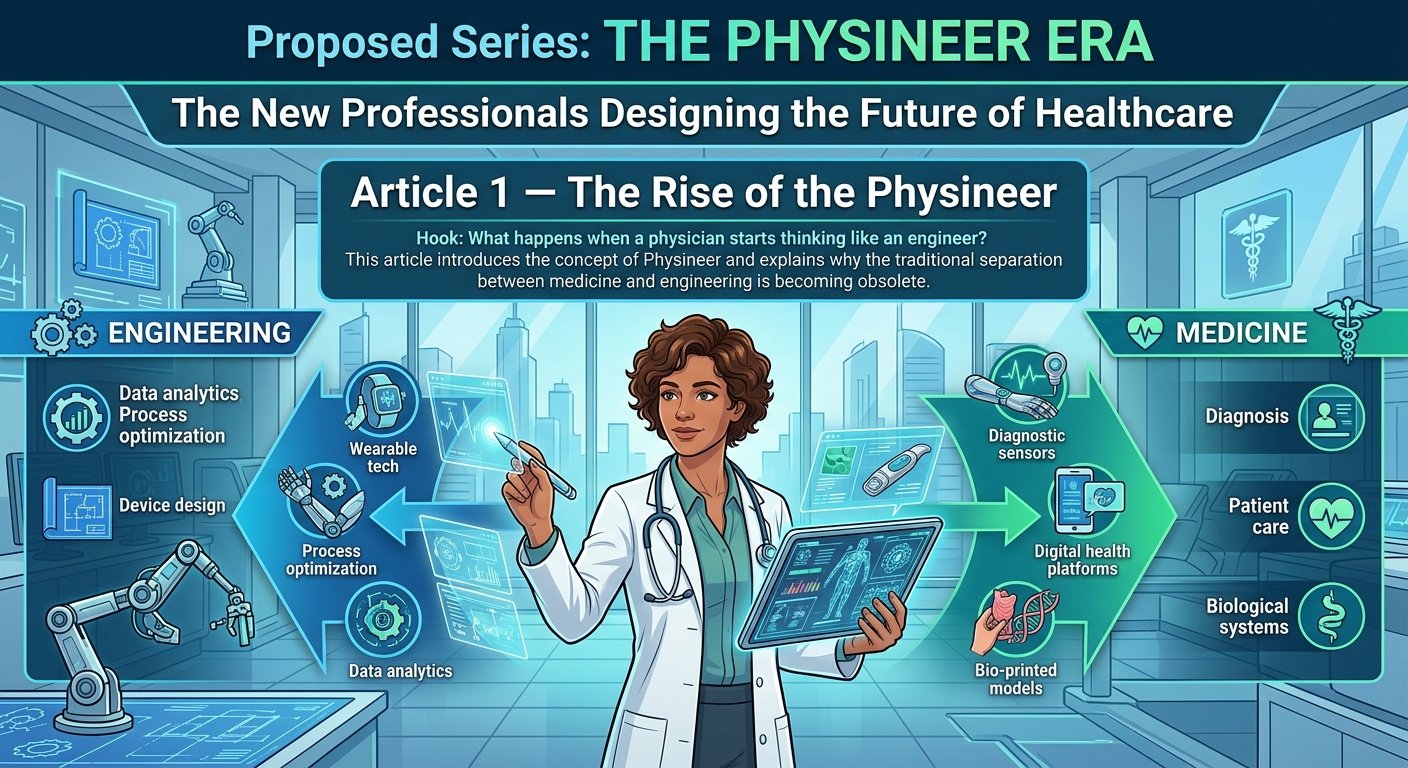
THE PHYSINEER ERA
Article 01 — The Rise of the Physineer
The New Professionals Designing the Future of Healthcare