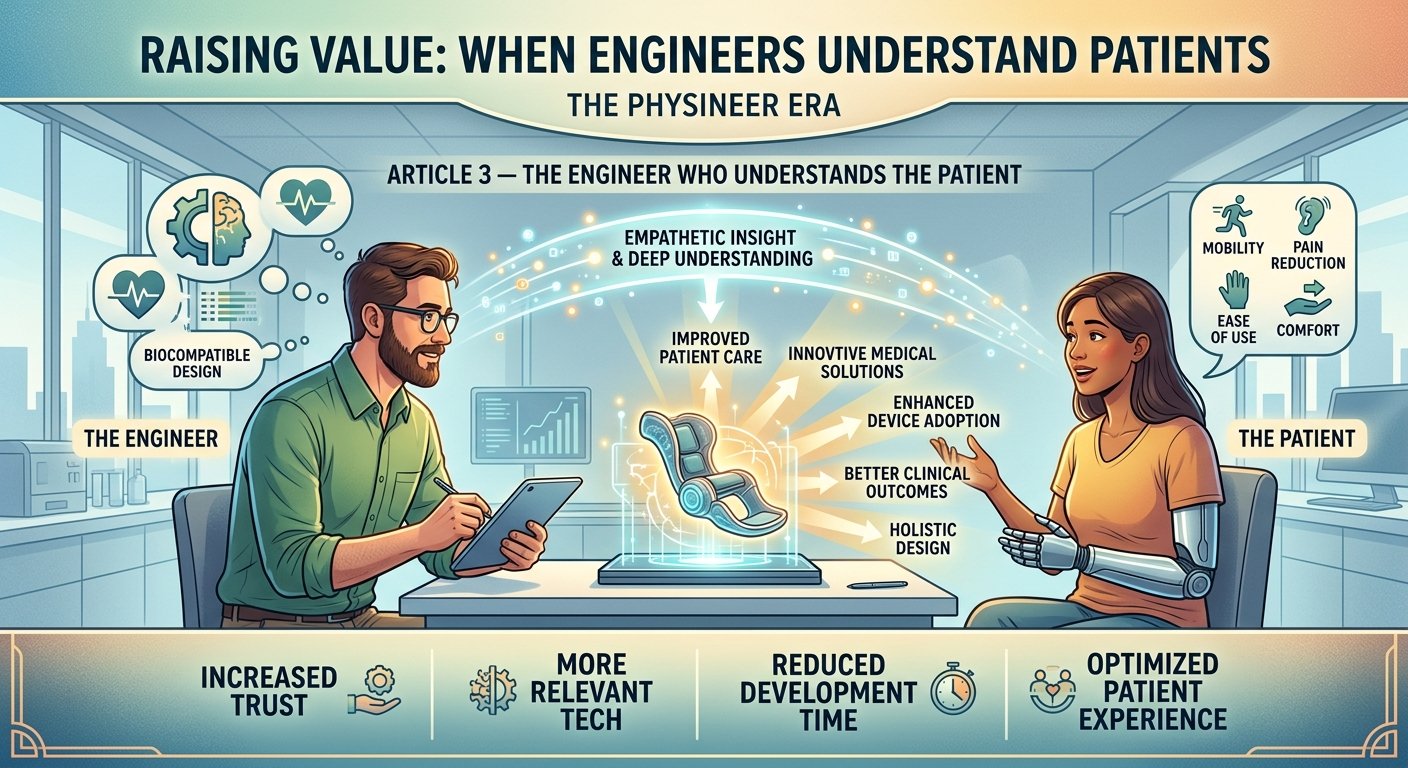
The Physineer Era Article 3 — The Engineer Who Understands the Patient
Hook: Technology can be technically perfect—and still fail healthcare.
This article examines why engineers entering healthcare must understand the patient journey, clinical workflows, medical ethics, patient safety, and the realities of healthcare delivery.
Here’s what I found on healthcare technology integration and human factors engineering (HFE):
I found that technically functional medical devices and IT systems frequently fail in clinical practice when they are designed in isolation from the physical, cognitive, and social realities of the healthcare system.
Key themes I noticed:
1. The Shift from “User Error” to “System Design”
Modern patient safety research, such as findings shared by PMC and Alcimed, shifts the blame away from frontline clinicians. Instead of accusing a tired nurse of “user error,” engineers must design systems that mitigate “use errors” by accounting for cognitive fatigue, long shifts, and high-stress clinical environments.
2. The “Pre-Market vs. Post-Market” Disconnect
As highlighted by the Medical Safety Board, devices like infusion pumps often pass perfect laboratory-based testing but fail spectacularly in the ICU. Real-world conditions bring unexpected challenges like “key bounce” (where a single keystroke registers twice, converting 10 mL/hr to 100 mL/hr as documented by the FDA) or poor contrast displays that require clinicians to stand at awkward physical angles to read screens.
3. Rigid Systems Force Dangerous Workarounds
A systematic review on Health IT problems shows that when dropdown menus or predefined order entry sentences are too rigid, clinicians develop informal workarounds (such as entering critical dosing details in free-text fields or ignoring alerts entirely). While workarounds solve the immediate patient need, they bypass digital safety nets.
4. Technology Impacts Physical and Cognitive Ergonomics
Designing for healthcare is not just about the code or the UI. Human-centered design must account for the physical environment (such as room glare on barcodes, alarm fatigue in noisy pediatric wards, or unreadable keys due to routine chemical cleaning).
Real‑world cases: the evidence we need
These real-world cases provide the exact evidence we need to write Article 3 — The Engineer Who Understands the Patient. We can structure the article around how the transport monitor failure, the FDA’s “key bounce” dosing cases, and the “barcode‑scanner‑glare” scenario prove that healthcare engineering is not engineering applied to a building, but engineering applied to a living human system.
🚑 Transport monitor failure
A device that works perfectly in the lab fails during patient transport due to vibration, battery drain, and poor screen readability in ambulance lighting. The engineer must design for chaos, not the bench.
⌨️ FDA “key bounce” dosing
A single keystroke registers twice — 10 mL/hr becomes 100 mL/hr. This is not a clinician error; it’s a hardware‑software interface failure that human factors engineering can eliminate.
🔦 Barcode‑scanner‑glare
Room lighting, reflective wristbands, and chemical cleaning residue make barcodes unreadable. Nurses waste time, bypass scanning, and medication errors rise. The solution is environmental design, not more training.
📌 The “key bounce” case in detail:
FDA documentation shows that infusion pump key bounce can convert a safe 10 mL/hr infusion to 100 mL/hr. This is not a training issue — it’s a hardware debounce algorithm failure. Engineers must simulate real‑world keystroke dynamics, including partial presses and rapid sequences, to prevent lethal dosing errors.
📝 Article structure suggestion:
- Introduction: The perfect device that fails in practice.
- The transport monitor: why vibration, light, and battery matter.
- The key bounce crisis: from 10 mL/hr to 100 mL/hr.
- The barcode glare: when the environment defeats the scanner.
- Workarounds: how rigid IT systems force unsafe shortcuts.
- Human factors engineering: the bridge between tech and care.
- Conclusion: engineering the human system, not just the device.
🧠 Human Factors Engineering (HFE) is not optional
It is the discipline that translates clinical reality into technical requirements. HFE considers cognitive load, physical environment, workflow interruptions, and the emotional state of caregivers. The engineer who understands the patient — and the clinician — designs technology that fits the system, not the other way around.
“Healthcare engineering is not engineering applied to a building. It is engineering applied to a living human system.”
The Engineer Who Understands the Patient
To succeed in healthcare, engineers must step out of the lab and into the ICU, the ward, the ambulance, and the patient’s room. They must observe the chaos, listen to the nurses, and watch how clinicians actually work — not how they are supposed to work.
Only then can they build technology that is not just technically perfect, but clinically safe, cognitively supportive, and environmentally robust.
This is the heart of the Physineer philosophy: blending engineering excellence with deep human understanding.
THE PHYSINEER ERA
From Clinical Excellence to System Excellence
Clinical Judgment + Systems Thinking
Patient Care + Process Design
Quality + Economics
AI + Human Intelligence
The future physician won’t just practice medicine.
They will help design the future of healthcare.
The Physineer Era — Article 3