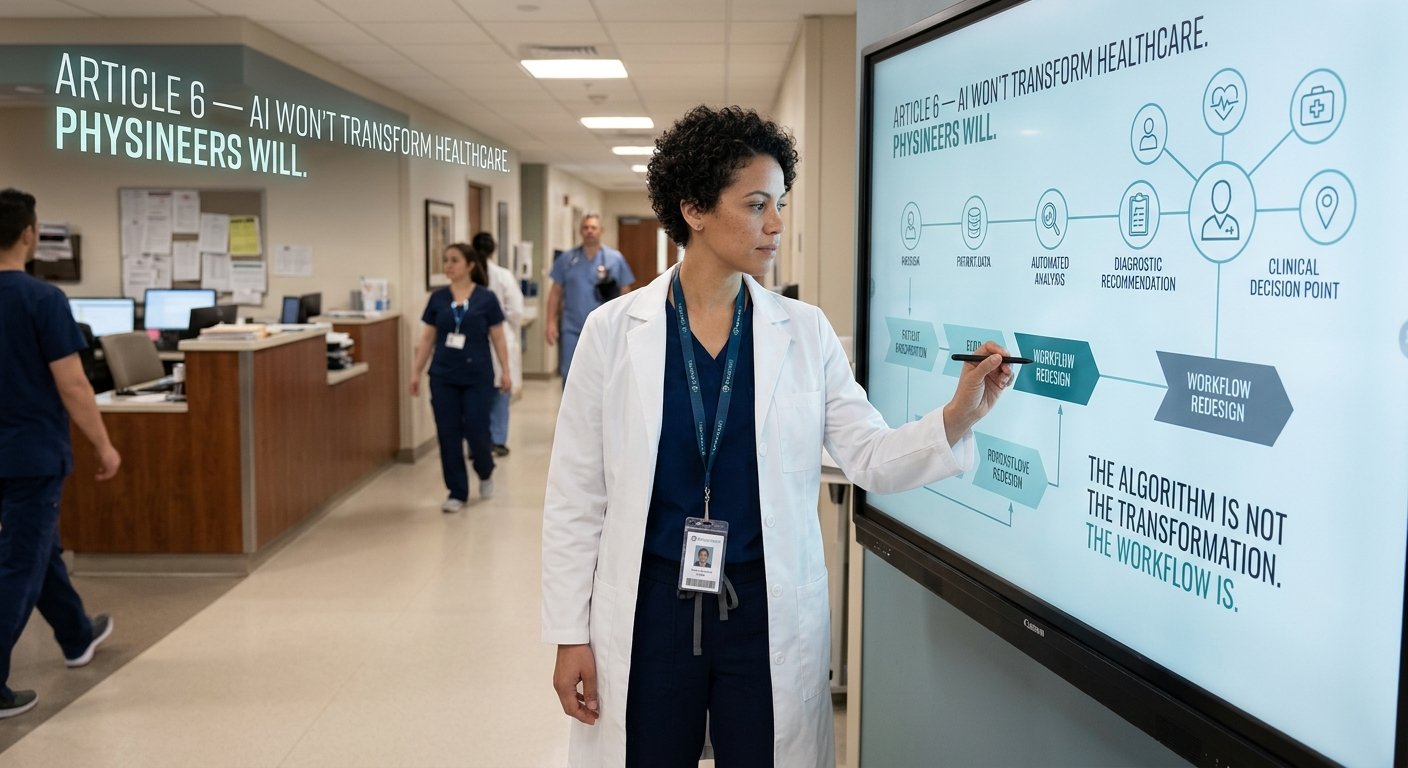
ARTICLE 6 AI Won’t Transform Healthcare. Physineers Will. The algorithm is not the transformation. The workflow is.
Every week, another headline promises that artificial intelligence will revolutionize medicine. A new model detects sepsis six hours earlier. An algorithm predicts readmission risk with 94% accuracy. A large language model passes the medical licensing exam. We have built machines that can diagnose, predict, automate, analyze, and recommend with superhuman consistency.
And yet, walk into almost any hospital on any continent, and the revolution is invisible. The same rounds, the same documentation burdens, the same fragmented handoffs, the same alert fatigue. The algorithms exist. The transformation does not.
Why?
Because AI is not a healthcare transformation. It is a capability. And capabilities, no matter how extraordinary, do not redesign themselves into the messy, regulated, human-centric reality of clinical care. Someone must decide where the algorithm belongs in the patient journey. Someone must redesign the workflow around it. Someone must evaluate whether it is safe, whether it is worth the cost, and whether the physicians will actually use it.
That someone is not the data scientist who trained the model. It is not the physician who sees patients. It is not the IT director who provisions the servers. It is not the administrator who signs the purchase order.
The answer, increasingly, will be the Physineer.
The Missing Profession
Healthcare has spent a decade hiring data scientists to build models and expecting clinicians to absorb them. It has not worked. The gap between a validated algorithm and a transformed clinical process is not a technical gap. It is an integration gap. It spans clinical reasoning, systems engineering, human factors, regulatory compliance, financial modeling, and behavioral change. No existing profession is trained to own all of it.
The Physineer is.
A Physineer is a hybrid professional who operates at the intersection of clinical practice, systems engineering, and organizational strategy. They do not merely “implement” AI. They architect its place in the healthcare system. They are bilingual in medicine and technology, but fluent in the hardest language of all: operational reality.
Where the data scientist asks, “Can we build a model that predicts X?” the Physineer asks, “If we predict X, who acts on it, when, with what authority, and what happens to the patient if we are wrong?”
Where the administrator asks, “What does the AI cost?” the Physineer asks, “What does the system cost once we account for workflow redesign, training, governance, and the opportunity cost of clinician attention?”
Where the physician asks, “Will this help me or slow me down?” the Physineer designs the answer to be both—by embedding the algorithm into a workflow that removes friction rather than adding it.
What the Physineer Actually Does
Let us be concrete. The Physineer answers five questions that no one else is asking together:
1. Where does AI belong in the patient journey?
An algorithm that predicts deterioration is useless if it fires after the nurse has already left the station, or if it requires a physician to log into a fourth dashboard. The Physineer maps the patient journey in granular, temporal detail—who touches the patient, when, with what information, under what time pressure—and identifies the precise moment where an AI-generated insight can change a decision. They do not bolt AI onto existing processes. They redesign the process so that the AI is invisible where it should be invisible, and unmissable where it must be unmissable.
2. Who redesigns the clinical workflow?
Workflow is not a side effect of technology. It is the primary design challenge. The Physineer treats the clinical environment as a socio-technical system. They understand that adding an AI alert without removing an equivalent cognitive burden is not innovation; it is debt. They engineer workflows that redistribute tasks between humans and machines based on comparative advantage: let the algorithm pattern-match across thousands of data points; let the human exercise judgment, empathy, and contextual wisdom. The workflow is the product. The algorithm is only a component.
3. Who evaluates patient safety?
Validation in a lab is not safety in a hospital. The Physineer designs the safety case. They model failure modes not just of the algorithm, but of the human-algorithm system: what happens when the model is confident and wrong? When clinicians override it correctly? When they override it incorrectly? They establish monitoring systems that track not only model drift, but behavioral drift—how clinicians’ interaction with the AI changes over time. They build the governance structures that decide when an algorithm stays, when it is retrained, and when it is retired.
4. Who measures ROI?
The return on AI in healthcare is not the accuracy of a model. It is the delta in clinical outcomes, operational efficiency, and financial sustainability—measured against the total cost of ownership. The Physineer constructs the business case with the same rigor they apply to the clinical case. They measure time-to-decision, length-of-stay, diagnostic yield, burnout indicators, and revenue cycle impact. They know that an algorithm with 99% sensitivity is a financial failure if it requires hiring three full-time equivalent staff to manage its alerts.
5. Who manages physician adoption?
Technology adoption in healthcare is not a marketing problem. It is a trust and workflow problem. The Physineer does not “train” physicians on a tool and hope for the best. They co-design with them. They identify clinical champions, map skepticism to its root causes, and iterate the interface based on real-world use. They understand that physician adoption is the rate-limiting step of every healthcare AI project, and they treat it as a first-class engineering constraint, not a change-management afterthought.
Why Now?
The Physineer is emerging now because healthcare has reached an inflection point. We have proven that AI can perform clinical tasks. We have not proven that healthcare systems can absorb it. The bottleneck has shifted from capability to integration. And integration is a discipline.
Hospitals that recognize this will build Physineer functions—whether as a formal role, a team, or a mindset—before their competitors do. They will stop buying AI as a product and start designing it as infrastructure. They will move from pilot projects that expire when the grant ends to operational systems that improve with every patient.
Those that do not will accumulate a graveyard of algorithms: technically sound, clinically irrelevant, financially unjustified, and politically toxic.
The Algorithm Is Not the Transformation
We must stop confusing intelligence with impact. A neural network can read a scan, but it cannot redesign the radiology department. A predictive model can flag a risk, but it cannot restructure the nursing shift. Natural language processing can draft a note, but it cannot redefine the physician’s relationship with documentation.
These are human, organizational, and engineering challenges. They require professionals who can hold the clinical, technical, operational, and financial dimensions in their head simultaneously and make tradeoffs in real time.
The algorithm is not the transformation. The workflow is.
And the workflow will be transformed not by AI, but by the people who know where AI belongs, how it fits, and what it must become to matter.
The Physineer.