The Hidden Cost of the AI Transformation Journey in Healthcare
Why the Price of AI Is Not the Price of Transformation
Artificial Intelligence is rapidly moving from an experimental technology to a strategic capability across the healthcare industry. Hospitals, laboratories, diagnostic centers, pharmaceutical companies, insurers, and healthcare platforms are investing in AI to improve clinical outcomes, reduce costs, enhance patient experience, automate administrative processes, and support better decision-making.
Yet there is a fundamental financial mistake that many healthcare organizations are making:
they are budgeting for AI technology, but not for AI transformation.
The difference is significant.
The visible cost of AI may include software licenses, cloud infrastructure, algorithms, data platforms, consulting fees, and implementation. The hidden cost lies elsewhere: redesigning workflows, cleaning data, integrating legacy systems, training people, managing change, validating clinical models, strengthening cybersecurity, establishing governance, dealing with regulatory requirements, and maintaining the technology after implementation.
For healthcare organizations, AI transformation is therefore not primarily an IT project. It is an enterprise transformation program with financial, operational, clinical, legal, human, and governance implications.
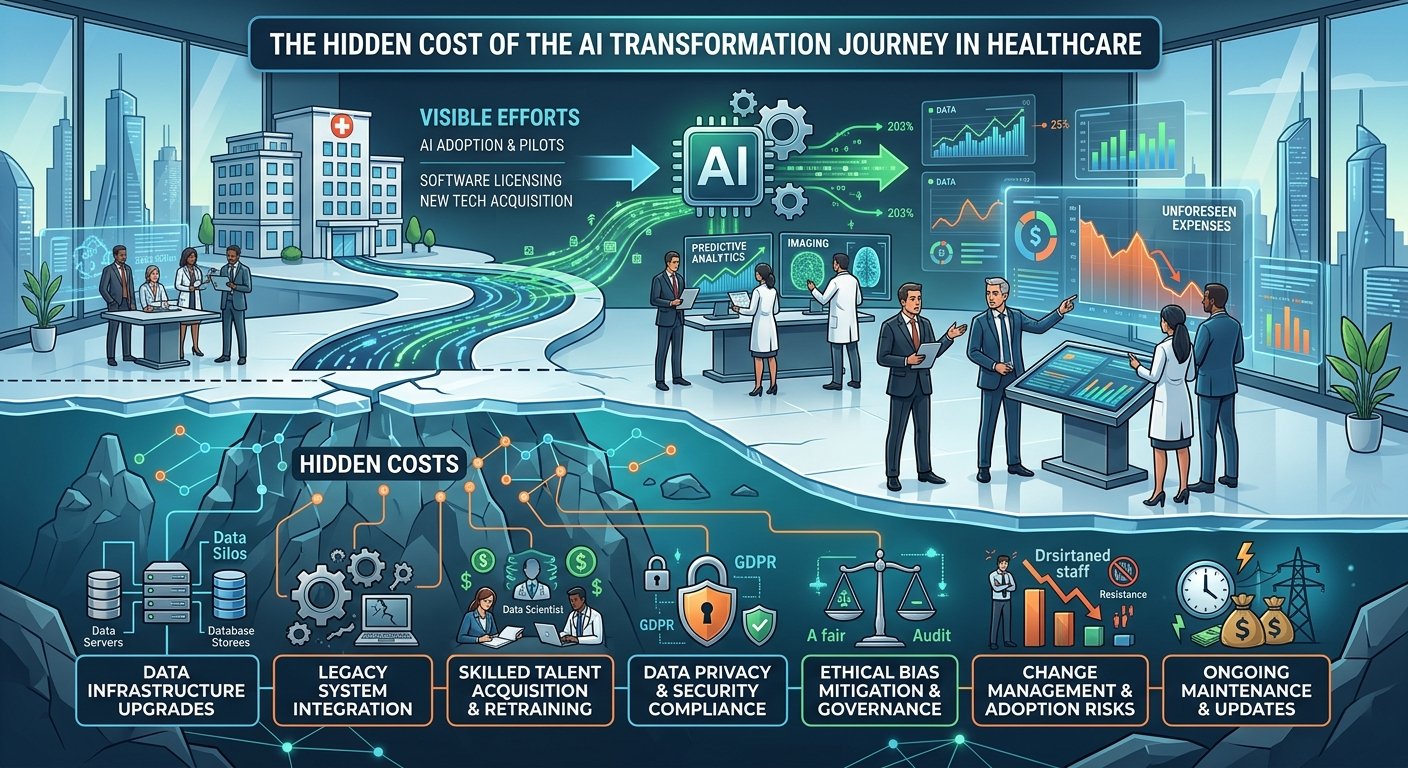
1. The AI Investment Iceberg
The initial AI business case often focuses on the visible investment:
- AI software and licenses
- Cloud computing
- Hardware and infrastructure
- Implementation consultants
- Integration costs
- Data platforms
However, beneath the surface is a much larger transformation layer.
| Visible AI Cost | Hidden Transformation Cost |
|---|---|
| AI software | Workflow redesign |
| Cloud infrastructure | Data migration and cleansing |
| Algorithm implementation | Clinical validation |
| System integration | Legacy-system modernization |
| User licenses | Training and change management |
| Technology deployment | Cybersecurity and governance |
| Initial implementation | Continuous monitoring and model maintenance |
This creates an important financial principle:
The cost of buying AI is usually much smaller than the cost of becoming an AI-enabled healthcare organization.
2. Data: The First Hidden Cost
AI is fundamentally dependent on data. Yet healthcare data is frequently fragmented across electronic medical records, laboratory systems, radiology information systems, pharmacy systems, billing platforms, insurance databases, spreadsheets, paper records, and external providers.
Before AI can generate value, organizations frequently need to invest in:
- Data cleaning
- Data standardization
- Data integration
- Data governance
- Master patient identification
- Interoperability
- Data quality monitoring
- Historical data digitization
- Data security
The problem is that poor-quality data can produce highly sophisticated but unreliable AI.
In healthcare, the principle is particularly important:
garbage in can become clinically dangerous garbage out.
3. The Legacy-System Tax
Many healthcare organizations are attempting to introduce AI into technology environments that were not designed for AI.
Hospitals may operate multiple generations of HIS, EMR, LIS, RIS, PACS, ERP, HR, pharmacy, billing, and insurance systems. These platforms may use different databases, APIs, data structures, coding systems, and security architectures.
AI transformation therefore creates what can be called the “legacy-system tax.”
The organization may have to invest in APIs, middleware, integration engines, cloud migration, cybersecurity upgrades, data warehouses, interoperability platforms, and replacement of obsolete systems.
Consequently, an AI project can expose weaknesses that existed long before AI was introduced.
4. Workflow Redesign Is More Expensive Than Software Installation
Healthcare professionals do not simply “use” AI. AI changes how they work.
Consider an AI-supported radiology workflow. The organization may introduce an algorithm capable of identifying suspicious findings. But implementation requires decisions about:
- Who receives the AI alert?
- Who validates the result?
- How is the result documented?
- What happens when the AI and radiologist disagree?
- Does the AI result enter the medical record?
- Who is accountable for the final diagnosis?
- How are false positives managed?
- How are false negatives monitored?
The technology may take weeks to install, but redesigning the clinical process may take months.
5. The Human Cost of AI Transformation
One of the greatest hidden costs is not technology—it is people.
AI changes roles, responsibilities, workflows, authority, and sometimes professional identity.
Healthcare organizations therefore need investment in:
- AI literacy
- Clinical training
- Digital leadership
- Change management
- New technical roles
- Data science capabilities
- Clinical informatics
- AI governance
The organization may discover that it does not need fewer people as quickly as expected. Instead, it needs different capabilities.
The economic question should therefore not simply be:
“How many employees can AI replace?”
A better question is:
“How can AI increase the productivity and decision-making capacity of our workforce?”
6. Change Management: The Cost That CFOs Often Underestimate
Healthcare transformation frequently fails not because the technology does not work, but because people do not adopt it.
Physicians may distrust algorithms. Nurses may perceive automation as additional work. Administrators may resist new processes. Managers may continue using spreadsheets because they are familiar.
Therefore, AI transformation requires structured change management.
This includes communication, education, stakeholder engagement, pilot programs, user feedback, performance measurement, incentives, and continuous improvement.
The hidden financial consequence is significant:
an AI system that nobody uses has a very high ROI denominator and almost no ROI numerator.
7. Clinical Validation Is Not Optional
Healthcare AI is fundamentally different from many consumer technology applications because mistakes can affect patient safety.
Before deployment, organizations may need to validate whether the AI performs adequately within their own clinical environment.
An algorithm developed using data from one population, hospital, imaging protocol, laboratory system, or clinical pathway may perform differently in another environment.
This creates additional costs related to:
- Local validation
- Clinical testing
- Performance benchmarking
- Bias assessment
- Monitoring of false positives and false negatives
- Clinical governance
- Post-deployment surveillance
In other words, AI validation is a recurring operational activity, not a one-time implementation event.
8. Cybersecurity Becomes More Expensive
AI expands the healthcare organization’s digital attack surface.
More data, more integrations, more APIs, more cloud services, and more external technology providers can create additional cybersecurity exposure.
AI transformation may therefore require additional investment in:
- Identity and access management
- Encryption
- Endpoint protection
- Network segmentation
- Security monitoring
- Vendor risk management
- Incident response
- Backup and disaster recovery
- Privacy controls
For healthcare organizations, cybersecurity should not be treated as an IT overhead.
It is part of the clinical and business continuity infrastructure.
9. AI Governance Has a Price—and Ignoring It Has a Higher Price
AI introduces new governance questions.
Who approves an AI system before deployment? Who monitors its performance? Who can suspend it? Who owns the data? Who is responsible when AI recommendations conflict with professional judgment?
A mature AI governance framework should define:
- AI approval processes
- Accountability
- Risk classification
- Clinical oversight
- Data ownership
- Privacy
- Cybersecurity
- Algorithm monitoring
- Vendor management
- Incident reporting
The board should ultimately understand that AI governance is an extension of corporate governance.
10. Model Drift: The Cost After Go-Live
One of the most misunderstood costs of AI is what happens after implementation.
Healthcare does not remain static. Patient populations change. Clinical guidelines change. equipment changes. Coding practices change. Disease patterns change. Clinical workflows change.
As the environment changes, an AI model may gradually become less accurate.
This phenomenon is commonly associated with model drift.
Organizations therefore need continuous monitoring, periodic validation, retraining, recalibration, version control, and performance reporting.
The AI business case must consequently include a lifetime cost of ownership, rather than simply the implementation cost.
11. The Hidden Cost of AI Vendor Dependency
Another strategic risk is vendor dependency.
An organization may initially purchase an AI solution at an attractive price, but later become dependent on a specific vendor for data architecture, APIs, model updates, technical support, and system integration.
This can create switching costs and reduce negotiating power.
Healthcare executives should therefore evaluate:
- Data portability
- API accessibility
- Interoperability
- Contract termination provisions
- Pricing escalation
- Model ownership
- Data ownership
- Exit strategy
An AI investment without an exit strategy can become a long-term strategic dependency.
12. The Opportunity Cost of AI Transformation
There is another hidden cost that is rarely included in financial models:
opportunity cost.
Capital invested in an AI program cannot simultaneously be invested elsewhere.
Management attention is also limited.
A major AI transformation may compete with investments in:
- New hospitals
- Medical equipment
- Clinical workforce
- Patient experience
- Geographic expansion
- Cybersecurity
- Digital infrastructure
- Research and development
The board therefore needs to evaluate AI investments using the same capital-allocation discipline applied to any major strategic investment.
13. AI Should Be Measured Through Business Value
The ultimate objective should not be “implementing AI.”
The objective should be creating measurable healthcare value.
A mature AI business case should therefore connect technology investment to measurable outcomes such as:
| Value Dimension | Potential KPI |
|---|---|
| Clinical | Diagnostic accuracy, complications, mortality, readmissions |
| Operational | Length of stay, turnaround time, utilization |
| Financial | Revenue, margin, cost per case, cash conversion |
| Productivity | Cases per FTE, physician productivity, administrative hours |
| Patient | Waiting time, access, satisfaction |
| Risk | Errors, incidents, compliance events |
This changes the conversation from:
“How much does the AI system cost?”
to:
“How much enterprise value can this AI capability create, and at what total cost?”
14. A Better AI Transformation Financial Model
Healthcare organizations should consider building an AI transformation business case around the concept of Total AI Transformation Cost (TAITC).
Conceptually:
TAITC = Technology + Data + Integration + People + Change + Governance + Cybersecurity + Validation + Maintenance + Opportunity Cost
This provides a more realistic basis for calculating ROI.
Similarly, the return should not be limited to direct cost savings.
AI Value = Revenue Growth + Cost Reduction + Productivity + Quality Improvement + Risk Reduction + Strategic Value
The resulting investment decision becomes significantly more sophisticated than simply comparing software subscription costs with expected savings.
15. The Board-Level Question
The board of directors should not ask only:
“How much will this AI project cost?”
It should ask five broader questions:
- What strategic problem are we solving?
- What transformation is required beyond the technology?
- What is the total cost of ownership over five years?
- What measurable clinical, operational, and financial value will be created?
- What risks and governance mechanisms are required?
Conclusion: AI Transformation Is an Enterprise Journey
The healthcare industry is entering an era in which AI will increasingly influence diagnosis, treatment, operations, finance, research, patient engagement, workforce productivity, and strategic decision-making.
But the organizations that will benefit most from AI will not necessarily be those that purchase the most sophisticated algorithms.
They will be the organizations that successfully build the organizational infrastructure around AI.
The real investment is not simply in artificial intelligence.
It is in data maturity, digital infrastructure, people, governance, clinical trust, cybersecurity, workflow redesign, and organizational capability.
Therefore, healthcare leaders should stop thinking about AI as a technology procurement exercise and start treating it as a capital-intensive enterprise transformation journey.
The most dangerous AI cost is not the cost that appears on the budget.
It is the hidden cost of implementing AI without preparing the organization to absorb it.
Executive Takeaway
AI transformation should be evaluated on Total Cost of Transformation—not software price alone. For healthcare CEOs, CFOs, CIOs and boards, the real question is not whether the organization can afford AI. The question is whether it can afford to transform the organization required to make AI deliver sustainable value.