Healthcare R&D: How Much Should Advanced Economies Invest in the Future of Health?
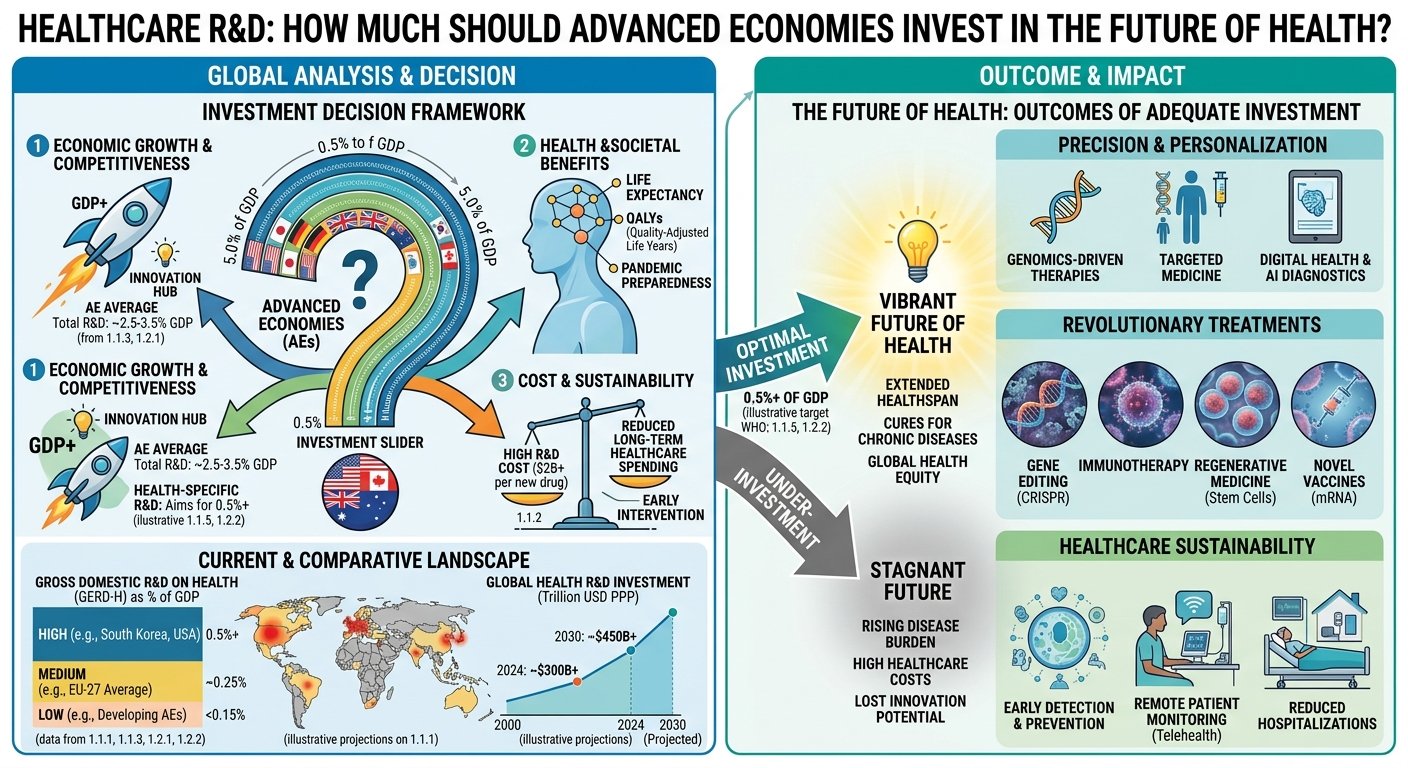
From Healthcare Expenditure to Healthcare Innovation:
The next global healthcare race will not necessarily be won by the countries
that spend the most on healthcare, but by those that convert healthcare
expenditure into research, innovation, intellectual property, technology
and sustainable economic value.
Healthcare Is No Longer Simply an Expenditure
Healthcare is increasingly becoming one of the world’s most important
innovation-driven economic sectors, connecting medicine,
biotechnology, pharmaceuticals, medical devices, diagnostics, artificial
intelligence, genomics, digital health and advanced manufacturing.
The critical question for governments, healthcare investors and healthcare
companies is therefore no longer simply:
How much does a country spend on healthcare?
The more strategic question is:
How much of that healthcare economy is being converted into
research, innovation and future value creation?
This distinction is becoming increasingly important as developed economies
compete for leadership in biotechnology, precision medicine, AI-enabled
healthcare, advanced diagnostics and next-generation pharmaceuticals.
1. Healthcare Already Represents a Major Share of GDP
The scale of the healthcare economy is enormous.
According to the latest OECD
Health at a Glance 2025, OECD countries allocated approximately
9.3% of GDP to healthcare in 2024.
The United States was an exceptional outlier at approximately
17.2%, followed by Germany at approximately
12.3%.
A large group of developed economies spend between 10% and 12% of GDP on
healthcare.
The Strategic Reality
For many developed economies, healthcare represents approximately
one dollar out of every ten generated by the economy.
Yet only a relatively small proportion of this enormous economic resource
is directed toward R&D.
That is where the strategic opportunity begins.
2. How Much Goes Into Healthcare R&D?
There is an important measurement challenge.
There is no single internationally standardized indicator called
“healthcare R&D as % of healthcare expenditure”
covering every component of health innovation.
Health-related R&D can include:
- Pharmaceutical R&D
- Biotechnology
- Medical devices
- Diagnostics
- Clinical trials
- Basic biomedical research
- Translational research
- Health artificial intelligence
- Digital health
- Genomics
- Public-health research
- University medical research
- Government-funded health research
- Hospital and clinical research
The OECD therefore reports several complementary measures rather than one
universal healthcare-R&D ratio.
OECD data show that governments in 35 OECD countries collectively budgeted
approximately US$73 billion for health-related R&D
in 2022.
The United States alone accounted for approximately
US$49.5 billion.
At the same time, the pharmaceutical industry invested approximately
US$129 billion in R&D globally in 2022.
A Critical Business Insight
Healthcare innovation is financed by both governments and businesses.
Government tends to support basic and early-stage research, while
industry plays a major role in translating scientific discoveries into
commercial products, medicines, diagnostics and technologies.
3. The United States: The World’s Healthcare Innovation Engine
The United States provides perhaps the clearest example of the relationship
between healthcare expenditure and innovation.
The country spent approximately 17.2% of GDP on healthcare in
2024, by far the highest proportion among OECD economies.
In 2022:
- Government health-related R&D budgets were approximately
US$49.5 billion. - Pharmaceutical industry R&D was approximately
US$103.9 billion in the United States.
Pharmaceutical companies therefore invested more than twice the amount of
the US government health-related R&D budget.
represented approximately 0.5% or more of US GDP,
before considering significant R&D in biotechnology, medical devices,
universities, hospitals, digital health and other innovation sectors.
4. Europe: Smaller Than the US — But Highly Concentrated
Europe presents a different innovation model.
The European Union invested approximately
€403 billion in total R&D in 2024, equivalent to
approximately 2.24% of GDP.
Business enterprises represented approximately
66.5% of total EU R&D expenditure.
Healthcare innovation, however, is highly concentrated in several
economies, particularly:
- Switzerland
- Belgium
- Denmark
- Germany
- Sweden
- United Kingdom
Pharmaceutical R&D has historically represented particularly high
proportions of GDP in countries such as Switzerland and Belgium.
What This Means for Investors
A country does not necessarily need the largest healthcare market to
become a healthcare innovation leader.
It needs the right combination of
research, capital, industry, universities, clinical
infrastructure, intellectual property and commercialisation.
5. Germany: A Large Healthcare Economy With Strong R&D Capacity
Germany spent approximately 12.3% of GDP on healthcare in
2024, making it one of the highest healthcare-spending economies
in the OECD.
Germany also maintains one of Europe’s strongest overall R&D systems.
Total R&D intensity reached approximately
3.1% of GDP in 2024.
The strategic issue is therefore not whether Germany invests heavily in
R&D. It clearly does.
The more important question is how effectively healthcare R&D is
connected to its pharmaceutical, biotechnology, medical-device,
engineering and hospital ecosystems.
6. Japan: Healthcare Meets Advanced Technology
Japan represents another important model.
It combines:
- A rapidly ageing population
- High healthcare expenditure
- Strong pharmaceutical companies
- Advanced medical technology
- Robotics
- Artificial intelligence
- Biomedical research
Japan budgeted approximately US$3.3 billion for
government health-related R&D in 2022.
Japan demonstrates how demographic pressure can become an innovation
opportunity.
longevity, chronic disease management, robotics, home healthcare,
diagnostics and digital health.
7. Switzerland: A Small Country With an Outsized Innovation Economy
Switzerland is one of the most interesting examples for healthcare
investors.
Despite its relatively small population, Switzerland has developed an
extraordinarily strong pharmaceutical and life-sciences ecosystem.
Pharmaceutical R&D has historically reached approximately
0.6–0.8% of GDP, depending on the year and methodology.
The Swiss Lesson
A country does not need to allocate an enormous proportion of GDP to
R&D.
It needs to create an environment where
R&D generates high economic value per dollar invested.
8. The Bigger Benchmark: Total National R&D
Healthcare R&D must also be viewed in the context of total national
R&D.
OECD estimates indicate that overall R&D expenditure across OECD
economies reached approximately 2.7% of GDP in 2024.
The EU average was approximately 2.24% of GDP.
Selected R&D-Intensive Economies
| Country / Region | Total R&D Intensity | Strategic Position |
|---|---|---|
| Israel | >5% of GDP | Global innovation leader |
| South Korea | ~5% of GDP | Technology + biotechnology |
| Sweden | ~3.6% | Advanced research economy |
| Belgium | ~3.4% | Pharmaceutical and biotechnology powerhouse |
| Austria | ~3.3% | High R&D intensity |
| Finland | ~3.2% | Technology + research |
| Germany | ~3.1% | Industrial + healthcare innovation |
| Denmark | ~3.0% | Pharmaceutical + life sciences |
| European Union | ~2.24% | Large innovation ecosystem |
| OECD | ~2.7% | Advanced-economy benchmark |
9. The Most Useful Healthcare R&D Benchmark
For investors and policymakers, it would be misleading to use one single
number such as:
“Healthcare R&D should equal X% of GDP.”
A much stronger approach is to monitor several complementary ratios.
Ratio 1 — Healthcare Intensity
Total Healthcare Expenditure ÷ GDP
This measures the economic importance of healthcare.
Ratio 2 — National Innovation Intensity
Total R&D Expenditure ÷ GDP
This measures how strongly the economy invests in future productivity.
Ratio 3 — Healthcare Innovation Intensity
Health-related R&D Expenditure ÷ GDP
This measures how much of national economic resources are directed toward
future healthcare innovation.
Ratio 4 — Healthcare R&D Intensity
Health-related R&D ÷ Total Healthcare Expenditure
The Key Strategic Question
How much of the healthcare economy is being reinvested into creating
the healthcare products and services of tomorrow?
10. A Practical International Benchmark
Based on international OECD patterns covering government health-related
R&D and pharmaceutical R&D, a useful strategic framework can be
developed.
| Health Innovation Intensity | Strategic Interpretation |
|---|---|
| <0.10% of GDP | Low health-R&D intensity |
| 0.10–0.25% | Developing innovation capacity |
| 0.25–0.50% | Strong health innovation ecosystem |
| 0.50–0.75% | Global health innovation leader |
| >0.75% | Exceptional concentration of life-science R&D |
Note: These ranges are not an official OECD classification. They are a
strategic business framework derived from international patterns in
government health-related and pharmaceutical R&D.
11. Why Healthcare R&D Matters to Investors
The significance of R&D is not simply the amount of money invested.
It is the economic multiplier generated by that investment.
A successful health innovation ecosystem can create value through:
→
IP
→
Clinical Trials
→
Regulatory Approval
→
Manufacturing
→
Commercialisation
→
Exports
For example, investment in oncology research can generate value across
multiple sectors:
- New pharmaceuticals
- Companion diagnostics
- Molecular testing
- AI diagnostics
- Clinical trials
- Precision medicine platforms
- Healthcare data businesses
- Specialised manufacturing
- Medical tourism
- International licensing revenues
12. The Opportunity for Emerging Healthcare Markets
This has major implications for emerging healthcare markets such as
Egypt and other developing economies.
Many emerging markets focus primarily on:
- Hospitals
- Clinics
- Pharmacies
- Medical equipment
- Healthcare insurance
These investments are essential, but they primarily represent the
consumption side of healthcare.
The next stage is to build the production side of healthcare
knowledge.
This requires investment in:
- Clinical research centres
- Translational medicine centres
- Biotechnology laboratories
- Genomics platforms
- AI-health laboratories
- Medical-device innovation centres
- Digital-health laboratories
- Academic medical centres
- Clinical-trial networks
- Healthcare venture-capital funds
The Strategic Transformation
The objective should be to transform healthcare from
A sector that consumes capital
into
A sector that creates intellectual property, technology, companies
and export revenues.
13. What Should Be the Target?
For an emerging economy seeking to become a regional healthcare and
life-sciences hub, a reasonable long-term strategic ambition could be
progressively building toward:
of GDP in health-related R&D
while simultaneously increasing:
of GDP in total national R&D
The critical issue is that this should not be achieved through government
spending alone.
The Ideal Innovation Model
| Stakeholder | Primary Role |
|---|---|
| Government | Basic and strategic research |
| Universities | Scientific discovery |
| Hospitals | Clinical research and real-world evidence |
| Private Sector | Product development |
| Pharma & Biotech | Commercialisation |
| Investors | Scale-up capital |
| Healthcare Operators | Implementation and adoption |
| Regulators | Trust, safety and market access |
14. R&D Is Not a Cost Centre — It Is a Value-Creation Engine
Perhaps the most important change in thinking is managerial.
Traditional healthcare accounting often treats R&D as an expense.
A modern healthcare strategy should increasingly treat R&D as:
The potential return can come through:
- New products
- Patents
- Licensing
- New companies
- Higher productivity
- Better clinical outcomes
- Reduced cost of care
- International exports
- Foreign investment
- Medical tourism
- Healthcare data assets
- Strategic competitive advantage
Healthcare companies that understand this shift will increasingly behave
less like traditional service providers and more like
technology and life-science companies.
15. The New Healthcare Investment Equation
A country can spend 12–17% of GDP on healthcare and still have a
relatively weak innovation ecosystem.
Conversely, a country with a smaller healthcare market can become a global
life-sciences leader if it creates an efficient ecosystem connecting:
+
Capital
+
Talent
+
Clinical Data
+
Universities
+
Industry
+
Regulation
+
Intellectual Property
The United States demonstrates the scale of this model.
Switzerland demonstrates the power of concentration.
Germany demonstrates the importance of industrial R&D.
Denmark and Belgium demonstrate the power of pharmaceutical
specialisation.
Japan demonstrates the opportunity created by demographic transformation.
South Korea demonstrates how technology investment can rapidly transform
an innovation ecosystem.
Conclusion: The Next Competition Is for Healthcare Innovation
The global healthcare market is already enormous.
OECD countries collectively spend approximately
9.3% of GDP on healthcare, while the United States reaches
approximately 17.2%.
But the countries that will dominate the next decade will not necessarily
be those that spend the most.
They will be the countries that
convert the greatest proportion of healthcare expenditure into
innovation, intellectual property, productivity and scalable businesses.
Healthcare R&D should therefore become a strategic national KPI —
not merely a scientific expenditure.
For policymakers, healthcare executives and investors, the objective should
no longer be simply to build more hospitals.
The objective should be to build an ecosystem capable of producing:
- The next medicine
- The next diagnostic platform
- The next healthcare AI company
- The next medical device
- The next biotechnology breakthrough
- The next generation of healthcare businesses
Healthcare spending keeps people healthy.
Healthcare R&D creates the future of healthcare.
Methodological Note
The OECD does not publish one perfectly comparable
“total healthcare R&D as % of GDP” indicator for
every country. The strongest international approach is therefore to
examine government health-related R&D and business/pharmaceutical
R&D separately and distinguish these measures from total national
R&D.
The strategic benchmarks presented in this article should therefore be
interpreted as analytical benchmarks rather than official OECD
classifications.