
Financial Sustainability in Healthcare: Navigating the Debt Trap
22 March 2025
Introduction: The Hidden Financial Risk Facing Healthcare
Dear Healthcare Leaders and Managers,
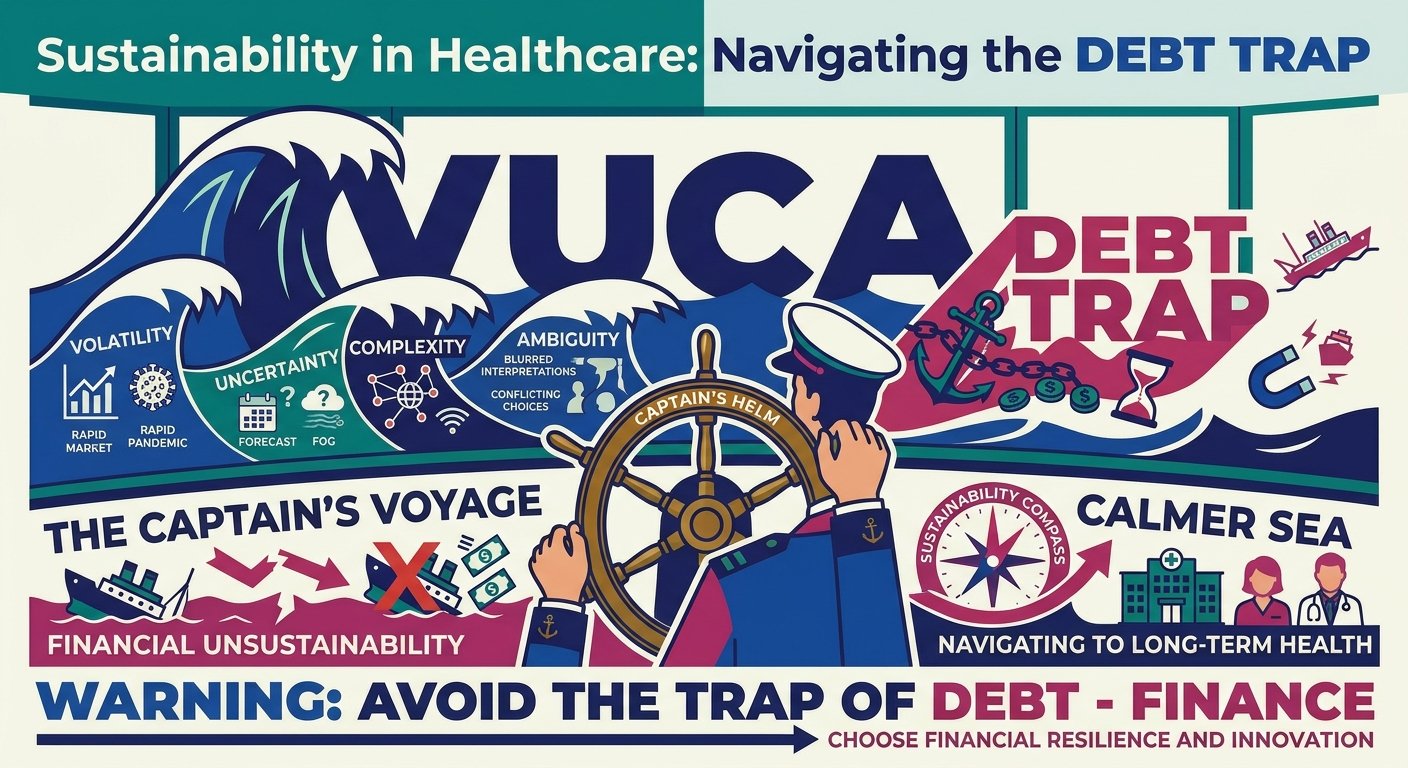
Financial sustainability has become one of the most critical challenges facing healthcare organizations today. While debt financing is often viewed as a practical solution to funding shortages, it can become a dangerous trap when used in an environment characterized by liquidity constraints, high interest rates, inflation, and currency volatility.
For healthcare organizations, the challenge is not simply how to obtain financing. The real question is whether the organization can generate sufficient and predictable cash flow to service that financing without compromising clinical quality, operational capacity, or future growth.
In a cash-deficit economy, excessive reliance on debt can gradually transform a financing solution into a structural financial vulnerability.
The Reality of Debt Financing in a Cash-Deficit Economy
Egypt, like many emerging economies, operates within a challenging liquidity environment. Persistent cash-flow pressures, elevated financing costs, inflation, and currency fluctuations have created a difficult environment for businesses across multiple sectors, including healthcare.
Healthcare providers are particularly exposed because they must continuously finance salaries, medical supplies, utilities, pharmaceuticals, equipment maintenance, technology, and infrastructure while dealing with potentially delayed payments from patients, insurers, corporate clients, and other payers.
This can create a dangerous cycle:
Cash shortage → borrowing → higher financial costs → reduced available cash → additional borrowing.
When this cycle becomes structural, debt stops supporting growth and begins financing day-to-day survival.
High Interest Rates: When Financing Becomes a Burden
A high-interest-rate environment affects healthcare providers through two major channels.
1. Rising Cost of Borrowing
Hospitals and healthcare companies that depend on loans for expansion, equipment procurement, working capital, or operational expenses may face significantly higher financing costs. Interest payments can absorb cash that would otherwise be directed toward clinical services, technology, staffing, quality improvement, or expansion.
2. Reduced Investment and Growth
When the cost of capital becomes excessive, organizations may postpone investments in infrastructure, medical technology, digital transformation, workforce development, and new services.
The strategic danger is clear: an organization may continue growing its debt while its underlying operating capacity and profitability fail to grow at the same pace.
Currency Volatility: The Hidden Multiplier of Healthcare Costs
Currency depreciation creates an additional layer of financial pressure for healthcare organizations, particularly those dependent on imported medical equipment, pharmaceuticals, consumables, spare parts, and technology.
- Higher Procurement Costs: Currency depreciation increases the local-currency cost of imported medical equipment, supplies, and technologies.
- Inflationary Pressure: Currency movements can contribute to higher operating costs, including utilities, rent, salaries, maintenance, and outsourced services.
- Erosion of Purchasing Power: When healthcare costs rise faster than household income, patients may postpone or reduce healthcare consumption, potentially affecting provider revenues.
- Higher Real Debt Exposure: Organizations that finance imported assets or foreign-currency obligations may face a significant increase in their effective financial burden following currency depreciation.
This is why healthcare leaders should not evaluate debt only by looking at the interest rate. The currency structure, repayment profile, asset life, revenue currency, and expected cash flow must also be considered.
Cash Flow: The Core of Financial Sustainability
Profitability does not necessarily mean liquidity.
A healthcare organization can report accounting profits and still face serious difficulty paying salaries, suppliers, banks, or other short-term obligations. For this reason, healthcare managers must understand and actively manage the cash flow statement.
There are two principal approaches to preparing a cash flow statement:
Direct Method
The direct method presents actual cash inflows and outflows from operating activities, providing a transparent view of how cash is generated and consumed.
Indirect Method
The indirect method begins with net income and adjusts for non-cash items and changes in working capital to reconcile accounting profit with operating cash flow.
Both approaches provide valuable information. However, the cash flow statement should never be analyzed independently from the organization’s profitability, balance sheet, working capital, and debt position.
Why Healthcare Leaders Must Read All Three Financial Statements Together
One of the most common weaknesses in financial management is focusing on a single financial statement.
Income Statement
The income statement helps management understand revenue, expenses, margins, and profitability. However, profitability alone does not demonstrate that sufficient cash is available.
Balance Sheet
The balance sheet provides a snapshot of assets, liabilities, and equity. It is essential for understanding financial structure, leverage, and solvency, but it does not provide a real-time view of liquidity.
Cash Flow Statement
The cash flow statement reveals how cash is generated and consumed and provides a critical indication of the organization’s ability to sustain operations and meet financial obligations.
When these three statements are analyzed together, management can:
- Identify early warning signs of financial distress.
- Monitor working-capital pressure.
- Assess the organization’s true debt-servicing capacity.
- Optimize cash conversion.
- Reduce unnecessary borrowing.
- Prioritize investments according to their financial and strategic returns.
- Build resilience against economic and currency volatility.
From Debt Management to Financial Resilience
The objective should not be to eliminate debt completely. Debt can be an important strategic tool when it finances productive assets and generates returns that exceed its effective cost.
The problem begins when debt is used repeatedly to finance operating deficits without a credible plan to improve the underlying economics of the business.
Healthcare leaders should therefore ask five fundamental questions before taking on additional debt:
- What exactly will the financing fund?
- Will the investment generate sufficient incremental cash flow?
- What is the true cost of financing?
- How sensitive is the project to interest-rate and currency movements?
- Can the organization continue servicing the debt under a downside scenario?
Factoring, Leasing and Non-Bank Financial Institutions in Egypt
As traditional financing becomes more expensive or difficult to access, Egypt has witnessed the development of a broader ecosystem of non-bank financial institutions and fintech platforms.
These institutions can provide alternative mechanisms for managing liquidity, financing assets, and facilitating consumer or business payments.
Factoring
Factoring can help organizations convert eligible receivables into liquidity rather than waiting for customers or payers to settle invoices according to extended payment cycles.
For healthcare providers, this can be particularly relevant where receivables from corporate clients, insurers, or other institutional payers create significant working-capital pressure.
Financial Leasing
Leasing can provide an alternative mechanism for financing expensive assets such as medical equipment, diagnostic systems, vehicles, and other capital-intensive assets without requiring the organization to fund the entire acquisition cost upfront.
Fintech and Digital Financing
Fintech platforms and installment-based financing models have created new mechanisms for consumers and businesses to spread payments over time. In healthcare, these models may support access to selected elective or planned services, provided that appropriate consumer-protection and affordability principles are maintained.
Examples of Non-Bank Financial Players in Egypt
The Egyptian non-bank financial ecosystem includes companies operating across factoring, leasing, consumer finance, microfinance, and fintech-enabled financial services.
- Factoring: Companies such as Contact Factoring and EgyFactor operate in the receivables-financing segment.
- Leasing: Companies such as GB Lease and Cairo Leasing Corporation provide asset-financing solutions.
- Consumer Finance and Fintech: Platforms and companies such as ValU, MNT-Halan, and Sympl provide installment-based and digitally enabled financing solutions across different market segments.
These institutions can help bridge financing gaps, but the cost, contractual structure, repayment obligations, and regulatory framework must always be carefully assessed.
Why Non-Bank Financing Has Become Increasingly Relevant
- High Financing Costs: Businesses and consumers may seek alternatives to conventional borrowing.
- Inflation and Purchasing-Power Pressure: Installment models can spread the cost of selected purchases and services.
- Delayed Receivables: Factoring can help organizations manage liquidity while waiting for eligible receivables to be collected.
- High Equipment Costs: Leasing can facilitate access to capital-intensive medical assets.
- Digital Transformation: Fintech solutions can simplify financing processes and expand access to financial services.
However, alternative financing is not automatically cheaper financing. Healthcare organizations must compare the effective annual cost, fees, collateral requirements, repayment structure, and risk exposure before choosing any financing mechanism.
NFI Market Indicators
Available market indicators demonstrate the growing importance of non-bank financial services in Egypt. Reported figures for November 2024 included approximately EGP 31.9 billion in factoring balances or volume, representing substantial year-on-year growth, while financial leasing contracts were reported at approximately EGP 102 billion. The microfinance portfolio was reported at approximately EGP 40.3 billion, serving millions of beneficiaries.
Note: Market figures should be validated against the latest official Financial Regulatory Authority publications before being used for investment, regulatory, or board-level decisions.
The Impact of Non-Bank Financing on Healthcare
Potential Benefits
- Improved access to healthcare financing for selected patients.
- Potential increase in demand for private healthcare services.
- Additional financing options for healthcare providers.
- Greater flexibility in financing medical equipment and technology.
- Potential partnerships between healthcare providers and fintech companies.
Potential Risks
- Higher transaction and financing costs.
- Delayed settlement and potential pressure on provider cash flow.
- Risk of excessive patient indebtedness.
- Potential mismatch between financing terms and healthcare revenue cycles.
- Regulatory and consumer-protection risks.
- Potential widening of healthcare inequality if financing becomes the only mechanism for accessing essential services.
A Strategic Framework for Healthcare Financial Sustainability
Healthcare organizations should move from a traditional mindset of “How much financing can we obtain?” toward a more disciplined question:
“How much financing can our sustainable cash flow safely support?”
This shift requires management to integrate financial planning with operational performance.
- Protect Cash Flow: Monitor collections, receivables, inventory, payables, and daily liquidity.
- Control Leverage: Match debt obligations with realistic operating cash flow.
- Stress-Test Financing: Model higher interest rates, currency depreciation, inflation, and lower-than-expected revenues.
- Optimize Working Capital: Reduce unnecessary cash tied up in receivables and inventory.
- Evaluate Alternative Financing: Compare bank loans, factoring, leasing, equity, and other financing structures based on their total economic cost.
- Link Investment to Returns: Prioritize projects that generate measurable clinical, operational, strategic, or financial value.
- Strengthen Governance: Ensure that major financing decisions are subject to appropriate financial, operational, legal, and risk review.
Conclusion: The Path Forward
Debt is not inherently bad. In a well-managed healthcare organization, appropriately structured debt can accelerate expansion, modernize infrastructure, acquire advanced technology, and create long-term value.
The danger arises when debt becomes a substitute for sound operating economics.
In an environment characterized by high financing costs, inflation, liquidity constraints, and currency volatility, healthcare leaders must place cash-flow resilience at the center of financial strategy.
The most sustainable healthcare organizations will not necessarily be those with the largest facilities or the highest levels of financing. They will be the organizations capable of converting their clinical activity into sustainable revenue, their revenue into cash, and their cash into long-term value.
Financial sustainability is therefore not simply an accounting responsibility. It is a healthcare leadership responsibility.
By integrating the income statement, balance sheet, and cash flow statement; controlling leverage; managing working capital; preparing for currency volatility; and intelligently using alternative financing mechanisms, healthcare organizations can protect both their financial health and their ability to deliver quality care.
“`