El Kasr El Aini: Two Centuries of Professors, Business Leaders and Entrepreneurs Who Reimagined Healthcare
There are healthcare institutions that become successful businesses, and there are healthcare institutions that become part of the history of a nation.
El Kasr El Aini Hospitals in Giza belongs to the second category.
For nearly two centuries, El Kasr El Aini has represented something much greater than a collection of buildings, departments and hospital beds. It represents a living institution built around a powerful combination of medicine, education, philanthropy, leadership and social responsibility.
Its extraordinary legacy was not created by capital alone. It was created by generations of great professors, physicians, administrators, business leaders, philanthropists and creative entrepreneurs who understood a fundamental principle:
Healthcare infrastructure can be financed not only by consuming capital, but by mobilizing society’s capital, generosity and sense of responsibility.
This is what makes the El Kasr El Aini story particularly remarkable.
A Different Definition of Healthcare Investment
The conventional healthcare investment model is straightforward.
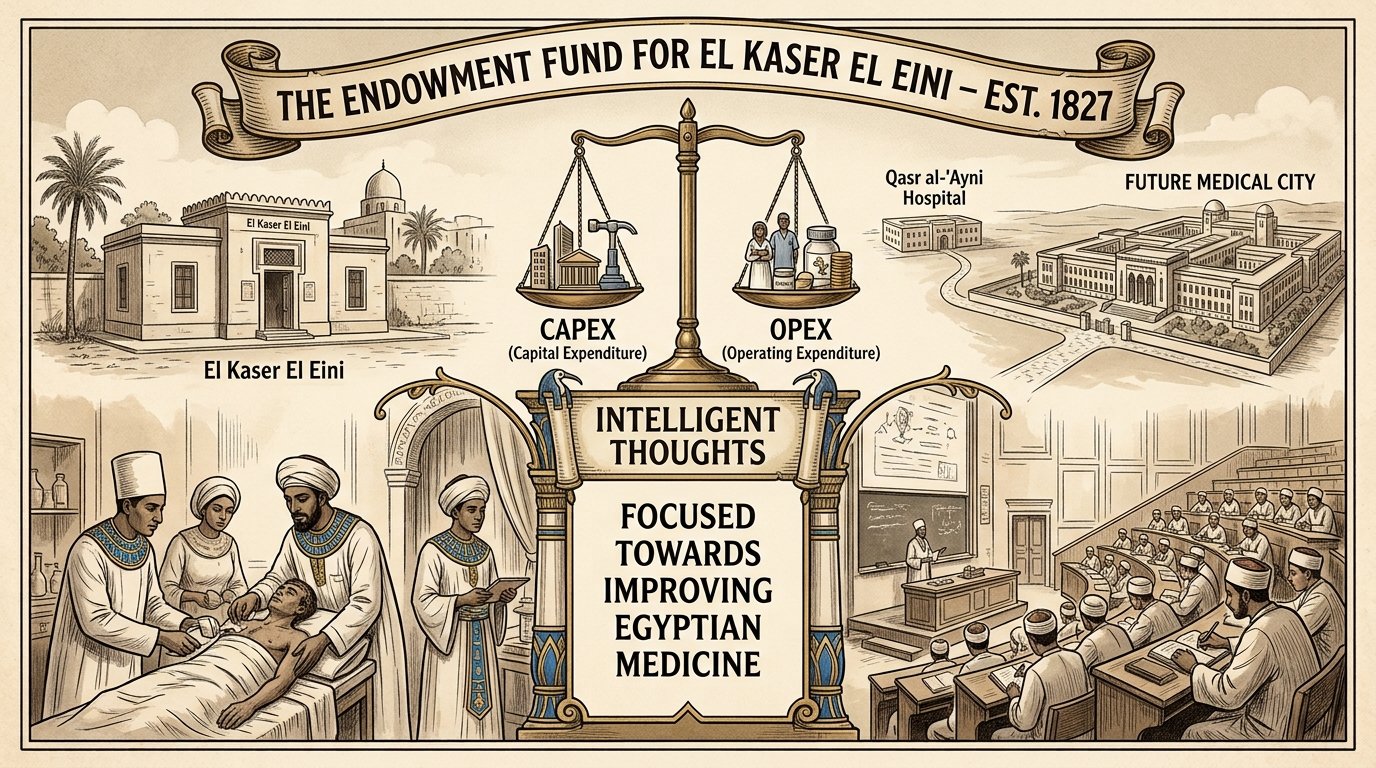
An investor provides the CAPEX required to construct the hospital, purchase equipment and establish the infrastructure. The hospital then generates sufficient OPEX through patient revenues, insurance payments, government funding or other operating income to maintain the institution.
But the historical El Kasr El Aini experience represents a fundamentally different philosophy.
Its development demonstrates how society can participate in healthcare infrastructure through donation, philanthropy, charitable endowment and institutional support, reducing the burden of capital expenditure while creating mechanisms capable of supporting the recurring costs of healthcare and education.
In modern financial language, this represents an extraordinarily innovative approach to healthcare sustainability.
Instead of asking:
“Who will finance the hospital?”
The model asks a much more sophisticated question:
“How can society collectively build the hospital and create a sustainable economic mechanism that allows it to continue serving future generations?”
From CAPEX Donation to Sustainable Social Capital
One of the most remarkable concepts associated with the historic development of El Kasr El Aini is the idea of combining philanthropic support for physical infrastructure with charitable endowment mechanisms capable of generating recurring resources.
In today’s terminology, this can be understood as a combination of:
- Philanthropic CAPEX
- Charitable endowment
- Recurring social income
- Cross-subsidization
- Institutional reinvestment
- Education funding
- Patient-support funding
The power of such a model is that the donor does not merely finance today’s patient.
The donor contributes to infrastructure that can potentially serve thousands or millions of patients across generations.
More importantly, the institution becomes a platform for educating physicians, developing professors, training healthcare professionals, conducting research and continuously improving clinical practice.
The social return can therefore become dramatically greater than the original financial contribution.
The Real Asset Was Never the Building
A hospital building can deteriorate.
Medical equipment becomes obsolete.
Technology changes.
Clinical protocols evolve.
But an institution that continuously produces knowledge, physicians, professors and healthcare leaders can renew itself indefinitely.
That is why the true asset of El Kasr El Aini was never simply its buildings.
Its greatest asset has been its human capital and intellectual capital.
Generation after generation of professors transformed the hospital into a place where healthcare delivery and medical education were inseparable.
The patient was not merely receiving treatment. The patient was also contributing to a broader ecosystem:
Clinical Care → Medical Education → Training → Research → Innovation → Better Clinical Care
This circular model represents one of the strongest forms of institutional sustainability in healthcare.
Professors as Institution Builders
The great professors associated with El Kasr El Aini did more than practice medicine.
They built schools of thought.
They created departments.
They trained generations of physicians.
They established standards of practice.
They developed clinical disciplines.
They mentored future professors.
And, perhaps most importantly, they created an institutional culture in which knowledge was considered a public asset rather than a private possession.
This is one of the defining characteristics of great academic medical centers around the world.
The professor is simultaneously:
Clinician + Teacher + Researcher + Mentor + Institution Builder
El Kasr El Aini demonstrated this philosophy on a remarkable scale.
Business Leaders and Entrepreneurs Behind the Institution
Healthcare institutions do not survive on medical excellence alone.
They require people who understand:
Finance. Governance. Operations. Infrastructure. Procurement. Human Resources. Fundraising. Partnerships. Risk Management.
The history of El Kasr El Aini illustrates the importance of individuals who could translate social responsibility into sustainable institutional structures.
These were, in many ways, the healthcare entrepreneurs of their time.
They did not necessarily build institutions primarily for personal profit.
They built institutions for public value.
Their entrepreneurship was different.
It was social entrepreneurship before the term became fashionable.
The Endowment: Perhaps the Most Powerful Idea
The concept of Waqf, or charitable endowment, deserves particular attention.
A well-designed endowment can transform philanthropy from a one-time donation into a potentially perpetual source of support.
Imagine two donors.
The first donates EGP 10 million to treat patients this year.
The second contributes EGP 10 million to an income-generating charitable endowment whose returns are continuously directed toward patient care and medical education.
The first donation creates an immediate impact.
The second can potentially create an intergenerational impact.
That is the extraordinary power of endowment.
In modern financial terminology, the concept resembles the creation of a perpetual social investment fund, where the underlying capital is preserved while the income generated from it supports the mission.
This principle remains highly relevant to healthcare investment today.
Funding Patients, Education and Continuous Learning
The most powerful aspect of this philosophy is that resources are not directed exclusively toward buildings.
They support the entire healthcare ecosystem.
Patients need treatment.
Physicians need education.
Young doctors need training.
Professors need research infrastructure.
Healthcare professionals need continuous learning.
Hospitals need maintenance and modernization.
A sustainable healthcare institution therefore needs to finance multiple dimensions simultaneously:
1. Patient Care
Making healthcare accessible to patients regardless of their financial circumstances.
2. Medical Education
Creating the next generation of physicians and healthcare professionals.
3. Continuous Professional Development
Ensuring that knowledge does not stop with graduation and that healthcare professionals continue to learn throughout their careers.
4. Research and Innovation
Generating new knowledge and improving clinical outcomes.
5. Infrastructure Sustainability
Maintaining and modernizing physical infrastructure, medical equipment and technology.
This is much more than charity.
It is institution building.
An Early Form of ESG and Social Impact
If we look at this philosophy through today’s corporate language, the historical model contains many principles now associated with ESG and social impact investing.
Environmental: responsible infrastructure development and resource utilization.
Social: access to healthcare, education, training and support for patients.
Governance: institutional structures, professional leadership and accountability.
But there is an additional dimension that modern ESG frameworks sometimes underestimate:
Intergenerational Responsibility
The objective is not merely to create value for today’s stakeholders.
It is to create an institution capable of continuing to create social value 100 or even 200 years into the future.
The CAPEX-OPEX Innovation
The historical model becomes even more interesting when viewed through the lens of healthcare finance.
In a conventional hospital:
CAPEX → Hospital Construction → OPEX → Patient Revenue → Maintenance → Reinvestment
The philanthropic-endowment model introduces another pathway:
Social Donation → CAPEX → Hospital Infrastructure
combined with:
Charitable Endowment → Investment Income → OPEX Support → Patients + Education + Research
This changes the economics of the institution.
The hospital is no longer dependent exclusively on patient revenue to finance its mission.
Instead, it can potentially be supported by a portfolio of social capital, philanthropic capital, operating revenue and institutional resources.
This diversification can strengthen long-term resilience when appropriately governed and managed.
Why This May Be One of the Greatest Healthcare Models of the Last 200 Years
Over the last two centuries, healthcare has experienced extraordinary technological transformation.
- From basic surgery to minimally invasive surgery.
- From clinical observation to precision diagnostics.
- From empirical medicine to evidence-based medicine.
- From handwritten records to digital health and artificial intelligence.
Yet one principle remains remarkably powerful:
The best healthcare institutions are those capable of continuously reproducing knowledge and social value.
That is why the historical achievement represented by El Kasr El Aini deserves recognition.
It was not simply the construction of hospitals.
It was the construction of an ecosystem.
An ecosystem in which:
- Philanthropy supported infrastructure.
- Endowment supported continuity.
- Professors generated knowledge.
- Physicians delivered care.
- Students became future physicians.
- Research improved medicine.
- Patients became part of the educational environment.
And the institution continuously renewed itself.
A Lesson for Modern Egypt
Egypt today faces a very different healthcare environment.
The country needs substantial investment in:
- Hospitals
- Primary healthcare
- Specialized centers
- Diagnostic infrastructure
- Digital health
- Medical education
- Nursing
- Research
- Rehabilitation
- Long-term care
The question is whether all of this must be financed exclusively through government expenditure or conventional private investment.
The history of El Kasr El Aini suggests another possibility.
Egypt could once again develop modern healthcare endowment models capable of mobilizing wealthy individuals, corporations, foundations, diaspora communities, physicians and socially responsible investors.
A modern healthcare endowment could support:
Hospital Construction → Equipment → Scholarships → Residency Programs → Research → Patient Support → Continuous Education
This could become one of the most powerful tools for healthcare development in Egypt.
From Waqf to Modern Healthcare Investment
The opportunity today is not to reproduce the historical model exactly.
It is to modernize its philosophy.
Imagine establishing professionally governed healthcare endowment funds where:
- The principal capital is protected.
- Investment returns finance healthcare services.
- Governance is independent and transparent.
- Financial reporting follows international standards.
- Medical outcomes are measured.
- Scholarships are funded.
- Research is supported.
- Patients in need receive assistance.
- Technology and equipment are continuously upgraded.
This would effectively create a new generation of Healthcare Social Investment Institutions.
The concept would combine the wisdom of traditional Waqf with the tools of modern finance, governance, investment management and impact measurement.
The Greatest Legacy Is Not What Was Built — But What Continues to Be Built
Perhaps the greatest tribute to the founders, professors, business leaders and entrepreneurs who contributed to the development of El Kasr El Aini is not simply to celebrate its history.
It is to understand the idea behind it.
They demonstrated that healthcare can be built through collective responsibility.
They demonstrated that philanthropy can become infrastructure.
They demonstrated that infrastructure can become education.
They demonstrated that education can become medical knowledge.
And medical knowledge can return to society through better patient care.
That is the real cycle of sustainable healthcare.
Conclusion: A 200-Year Lesson for the Future
El Kasr El Aini is more than a hospital.
It is a story about what happens when medicine meets philanthropy, education meets entrepreneurship, and social responsibility meets institutional vision.
The extraordinary contribution of the generations who built and maintained this institution lies not only in the buildings they created, but in the model they helped establish:
Build for society.
Finance through society.
Educate for society.
Treat for society.
Invest for future generations.
In an era when healthcare projects are increasingly evaluated through EBITDA, CAPEX, OPEX, IRR and valuation multiples, the El Kasr El Aini experience reminds us that there is another measure of value:
How many lives can an institution improve, how many physicians can it educate, and how many generations can benefit from the capital invested in it?
That may be the most important healthcare investment metric of all.
And perhaps this is why, when we look back across the last two hundred years of healthcare development in Egypt, El Kasr El Aini should not be remembered merely as one of Egypt’s oldest and most influential healthcare institutions.
It should be remembered as a remarkable example of social entrepreneurship, medical education, philanthropic infrastructure and sustainable healthcare institution-building.
Its greatest lesson is timeless: when capital, knowledge and philanthropy are structured around a clear social mission, a healthcare institution can become much more than a hospital — it can become a legacy that serves generations.