
Egypt Healthcare M&A: The Next Consolidation Opportunity?
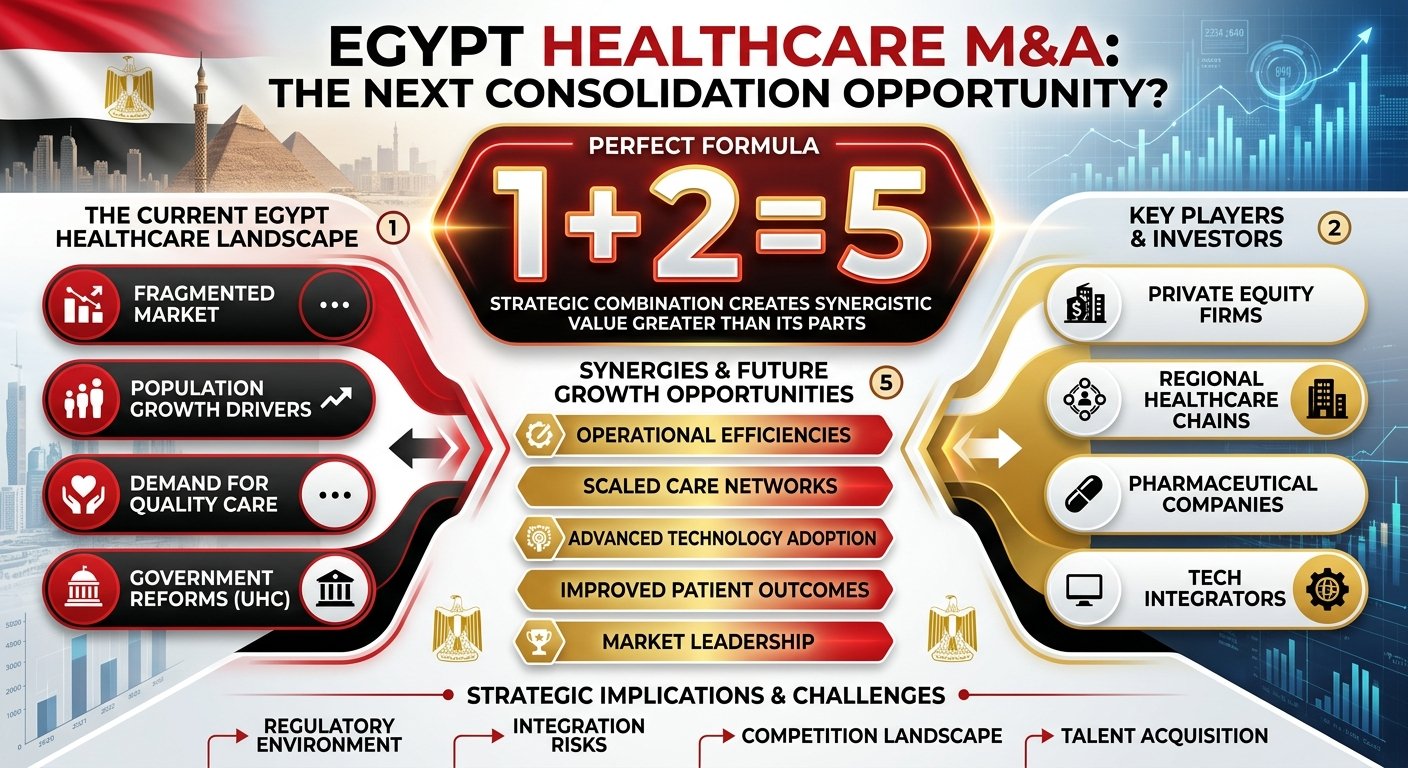
From Individual Assets to Integrated Healthcare Platforms
Egypt may be entering an important new chapter in healthcare M&A.
For years, the Egyptian healthcare investment story was largely built around individual hospitals, diagnostic centres, pharmaceutical companies and specialist clinics. Investors assessed each asset independently, focusing on its location, bed capacity, revenue, profitability, physicians and potential for operational improvement.
That model is beginning to look increasingly outdated.
The next phase of healthcare investment in Egypt may be less about acquiring one hospital and more about building a connected healthcare platform capable of coordinating the patient journey across multiple points of care.
One hospital is an asset.
A connected healthcare platform is a business model.
For M&A investors, private equity funds, strategic healthcare groups and regional operators, this could make Egypt one of the most interesting healthcare consolidation opportunities in Africa.
Why Egypt?
Egypt possesses a combination of healthcare characteristics that is difficult to replicate elsewhere in the region.
It has a very large population, a deep physician base, a substantial network of public and private healthcare facilities, established pharmaceutical manufacturing capabilities and a strategically important geographic position between Africa and the Middle East.
But population size alone does not create an M&A opportunity.
The real investment opportunity comes from the combination of:
Scale + fragmentation + rising demand + operational inefficiency + increasing healthcare sophistication.
A fragmented market creates an opportunity for consolidation.
If multiple independent providers operate diagnostic centres, clinics, specialty facilities, pharmacies, home-care businesses and hospitals without meaningful integration, an investor can potentially create value by connecting them.
That is the fundamental logic behind the next generation of Egyptian healthcare M&A.
The Market Is Moving Beyond the Hospital
The traditional healthcare investment thesis often starts with the hospital.
An investor identifies a hospital, examines its occupancy, average revenue per patient, operating margin, physician relationships and available capacity, and then determines whether the asset can be improved.
That approach remains relevant.
But it may not be sufficient for the next stage of the Egyptian market.
Healthcare consumption increasingly takes place outside the traditional inpatient hospital environment.
Patients move through a healthcare journey:
Primary Care → Specialist Consultation → Diagnostics → Pharmacy → Procedure → Hospitalization → Rehabilitation → Home Care → Chronic Disease Management.
The company capable of controlling or coordinating multiple stages of this journey can potentially capture considerably more value than a company operating a single hospital.
This is where the platform model becomes powerful.
The Emerging Egyptian Healthcare Platform
The potential Egyptian healthcare platform could be built around several interconnected verticals.
1. Diagnostics
Diagnostics may be one of the most attractive consolidation targets.
Laboratories and imaging centres are often fragmented geographically, while the underlying services are highly repeatable and capable of benefiting from centralized management.
A diagnostic platform can potentially consolidate:
- Laboratories
- MRI
- CT
- X-ray
- Ultrasound
- Mammography
- PET-CT
- Nuclear medicine
- Pathology
- Molecular diagnostics
The strategic advantage comes from network density.
A patient may visit a laboratory close to home, while the same platform provides advanced imaging at another location and specialist consultation at a third.
The investor is therefore not simply buying machines.
It is building a patient access network.
2. Outpatient Networks
The second opportunity is the outpatient market.
Egypt has thousands of physicians operating through individual clinics and medical centres.
This creates an enormous but highly fragmented healthcare ecosystem.
The opportunity is to organize these services into structured outpatient platforms offering:
- Family medicine
- Internal medicine
- Pediatrics
- Obstetrics and gynecology
- Cardiology
- Orthopaedics
- Dermatology
- Ophthalmology
- Urology
- ENT
- Neurology
- Gastroenterology
- Preventive medicine
The future outpatient network could become the front door of the healthcare platform.
Instead of patients entering the system through an emergency department, they enter through a network of accessible clinics.
From there, the platform can direct patients toward its own diagnostic, pharmaceutical, surgical and hospital services.
Internal Patient Capture
A platform does not necessarily need to spend the same amount on acquiring every patient if it can retain patients within its ecosystem.
A patient visiting an outpatient clinic may subsequently use:
Laboratory → Imaging → Specialist → Surgery → Pharmacy → Rehabilitation → Home Care.
Each additional service creates another economic opportunity.
3. Specialty Centres
Specialty healthcare may become one of the strongest areas of Egyptian M&A.
Rather than building expensive general hospitals, investors can create networks of specialized centres.
Potential areas include:
- Oncology
- Cardiology
- Orthopaedics
- Fertility
- Women’s health
- Ophthalmology
- Urology
- Neurosciences
- Gastroenterology
- Rehabilitation
- Vascular medicine
- Bariatric surgery
- Advanced surgery
Specialty platforms can be attractive because they combine clinical differentiation with potentially higher-value services.
More importantly, they can become regional referral centres.
A successful oncology or fertility platform in Cairo, for example, does not necessarily need to depend exclusively on the local population.
It can potentially attract patients from across Egypt and from other African and Middle Eastern markets.
4. Fertility: A Particularly Interesting Vertical
Fertility deserves separate attention.
Fertility treatment is highly specialized, physician-driven and increasingly technology-dependent.
It also has an important medical-tourism component.
An investor can potentially create a fertility platform combining:
IVF Centres + Women’s Health Clinics + Genetics + Laboratories + Embryology + International Patient Services.
The value of such a platform is significantly greater than that of an individual fertility clinic.
It becomes a recognizable regional brand.
For Egypt, this could be particularly interesting because the country has a large physician base and comparatively competitive operating costs.
5. Oncology: From Hospital Service to Regional Platform
Oncology is another sector where consolidation could create substantial value.
Modern cancer care is no longer limited to inpatient hospitals.
The cancer-care pathway includes:
Screening → Diagnostics → Pathology → Molecular Testing → Medical Oncology → Radiation Oncology → Surgery → Pharmacy → Follow-up → Palliative Care.
A fragmented market creates opportunities to integrate these services.
An Egyptian oncology platform could potentially combine several of these components across multiple locations.
This creates a much more sophisticated business model than simply operating an oncology department inside a hospital.
It creates an end-to-end cancer-care ecosystem.
6. Home Healthcare: The Missing Layer
One of the most underdeveloped opportunities in traditional healthcare M&A is home healthcare.
As healthcare systems mature, hospitals increasingly need to reduce unnecessary inpatient utilization.
Patients who do not require hospital-level care can potentially receive services at home.
This includes:
- Nursing
- Physiotherapy
- Chronic disease management
- Post-operative care
- Elderly care
- Medication management
- Home laboratory collection
- Home diagnostics
- Remote monitoring
Home healthcare also creates an important connection with hospitals.
A patient discharged from the hospital does not necessarily leave the healthcare ecosystem.
The platform can continue managing that patient at home.
This increases continuity of care while potentially creating another recurring revenue stream.
7. Pharmaceutical Manufacturing: A Strategic M&A Layer
Egypt’s pharmaceutical manufacturing base makes the market particularly interesting.
The M&A opportunity is not necessarily limited to acquiring pharmaceutical manufacturers.
It may also involve:
- Generic manufacturers
- Specialty pharmaceuticals
- Contract manufacturing
- Biosimilar capabilities
- Consumer healthcare
- Pharmaceutical distribution
- Medical supplies
- API-related businesses
- Export-oriented manufacturers
The strategic opportunity is to connect healthcare delivery with pharmaceutical production.
Imagine a healthcare platform that controls:
Hospitals + Clinics + Diagnostics + Pharmacies + Pharmaceutical Manufacturing.
The resulting organization would have significantly greater strategic depth than a conventional hospital group.
8. Health Technology: The Layer That Connects Everything
Technology may ultimately become the most important element of the consolidation story.
A healthcare platform needs a digital infrastructure capable of connecting:
- Patient records
- Appointments
- Diagnostics
- Imaging
- Pharmacy
- Billing
- Insurance
- Physician networks
- Home healthcare
- Patient engagement
- Analytics
- Artificial intelligence
Without technology, consolidation can simply produce a larger fragmented organization.
With technology, consolidation can create an integrated operating system for healthcare.
This is why healthtech should not be viewed only as a separate investment category.
It should be viewed as the infrastructure supporting healthcare M&A.
The Real Opportunity: Patient Flow
The greatest value of healthcare consolidation may not be the physical assets.
It may be patient flow.
Consider a hypothetical patient entering an integrated healthcare platform.
The patient starts with a consultation.
The physician orders laboratory tests.
The patient receives imaging.
A specialist reviews the results.
The patient undergoes a procedure.
The hospital provides inpatient care.
The patient receives medication.
After discharge, home healthcare continues the treatment.
The platform now controls or participates in almost the entire patient journey.
That creates an entirely different economic model.
From EBITDA to Lifetime Patient Value
Traditional healthcare M&A tends to focus heavily on EBITDA.
That remains essential.
But platform investors may increasingly look at another metric:
Lifetime Patient Value
The question becomes:
How much economic value can the healthcare platform generate from a patient over the entire care journey?
A patient who only visits a laboratory once has limited economic value.
A patient who enters through primary care and subsequently uses diagnostics, specialist care, surgery, pharmacy and home healthcare represents a much more valuable relationship.
This changes the strategic objective from:
Acquire more patients
to:
Acquire, retain and manage the patient relationship across the healthcare journey.
The Insurance Connection
Private medical insurance could accelerate this platform model.
Insurers increasingly prefer organized provider networks because they can manage:
- Cost
- Quality
- Utilization
- Patient access
- Claims
- Clinical pathways
An integrated healthcare platform can therefore become attractive not only to patients, but also to insurers and corporate healthcare buyers.
This creates the possibility of a three-sided ecosystem:
Patient + Provider + Payer.
The company that can connect all three may develop a powerful competitive position.
Why Regional Investors May Be Interested
Egypt becomes particularly interesting when viewed from the perspective of Middle Eastern investors.
A Saudi, UAE or Gulf-based healthcare group looking at Egypt may see several strategic advantages.
Population Scale
Egypt offers access to a very large healthcare market.
Medical Talent
The country has a substantial physician and healthcare professional base.
Cost Advantage
Operating costs can be comparatively attractive when measured against many Gulf markets.
Manufacturing
Egypt has an established pharmaceutical manufacturing ecosystem.
Geography
Egypt provides a strategic bridge between the Middle East and Africa.
Medical Tourism
The country has the potential to develop further as a destination for regional healthcare services.
Export Potential
Healthcare services, pharmaceuticals and medical expertise can potentially be exported to neighboring African and Middle Eastern markets.
Egypt can potentially become not only a healthcare market, but a healthcare production and export platform.
The Medical Tourism Opportunity
Medical tourism could become an important component of Egyptian healthcare M&A.
A consolidated healthcare group can invest in more than clinical infrastructure.
It can build an international patient platform incorporating:
- International marketing
- Multilingual patient services
- Travel coordination
- Medical concierge
- International insurance relationships
- Accommodation partnerships
- Follow-up care
- Cross-border telemedicine
The result is a healthcare model designed not only for domestic patients but also for international demand.
Potential target markets include Africa, the Gulf and other neighboring regions.
What Will Make an Egyptian Healthcare Target Attractive?
The next generation of buyers is likely to assess targets differently.
A healthcare company may become attractive because it possesses:
Strong Physician Network
Physician relationships remain one of the most important intangible assets in healthcare.
Geographic Density
Multiple locations can create network effects.
Strong Brand
A trusted healthcare brand reduces customer-acquisition costs.
Digital Infrastructure
Good data and technology infrastructure can dramatically improve integration.
Clinical Governance
Strong clinical governance reduces regulatory and reputational risk.
High Patient Conversion
A platform that successfully converts consultations into diagnostics, procedures and treatment can generate significant value.
Recurring Revenue
Chronic care, diagnostics, subscriptions and home healthcare can create predictable revenue streams.
Expansion Potential
Investors will increasingly ask whether the platform can be replicated in other cities.
The Most Attractive M&A Targets May Not Be the Largest
This is perhaps the most important point for Egyptian healthcare entrepreneurs.
The largest hospital is not automatically the most attractive acquisition target.
A smaller healthcare company may command greater strategic value if it possesses something difficult to replicate.
A 20-branch diagnostic network with strong physician relationships may be more strategically valuable than a single 200-bed hospital.
A specialty fertility platform with an established brand may be more scalable than a conventional general hospital.
A pharmaceutical company with strong registrations and African distribution may be more valuable than a larger domestic manufacturer with limited export capability.
The M&A question is therefore increasingly:
What can this company become inside a larger platform?
The Consolidation Map
The Egyptian healthcare market could potentially evolve toward several major platforms.
| Platform | Potential Configuration |
|---|---|
| Platform A — Integrated Healthcare | Clinics + Diagnostics + Hospitals + Pharmacy + Home Care |
| Platform B — Specialty Healthcare | Oncology + Cardiology + Surgery + Diagnostics |
| Platform C — Women’s Health | Gynecology + Fertility + Neonatal + Genetics |
| Platform D — Diagnostics | Laboratories + Imaging + Pathology + Molecular Diagnostics |
| Platform E — Pharmaceutical | Manufacturing + Distribution + Specialty Products + Export |
| Platform F — Digital Healthcare | EMR + AI + Telemedicine + Patient Engagement + Analytics |
The most powerful groups may eventually combine several of these models.
What Could Stop the Consolidation?
The opportunity is significant, but consolidation will not be easy.
Several challenges must be addressed.
Regulation
Healthcare is highly regulated, and transactions can require multiple approvals.
Physician Dependence
Some healthcare businesses are heavily dependent on a small number of physicians.
Fragmented Ownership
Many healthcare assets have complicated ownership structures.
Valuation Expectations
Owners may value their businesses based on future potential rather than current cash flow.
Integration
Acquiring multiple healthcare businesses does not automatically create a functioning platform.
Technology Integration
Different EMR, laboratory, billing and administrative systems can create substantial integration costs.
Clinical Governance
Scaling healthcare without maintaining quality can destroy value.
Financing
Interest rates, currency volatility and capital availability can materially affect transaction economics.
The New M&A Playbook for Egypt
The successful investor may therefore follow a different strategy.
- Acquire a Platform: Start with a strong healthcare company possessing a recognizable brand and management team.
- Add Complementary Assets: Acquire diagnostics, clinics, specialty centres or home healthcare companies.
- Integrate Technology: Create a common digital infrastructure.
- Centralize Operations: Consolidate procurement, finance, HR, marketing, IT and selected clinical-support functions.
- Strengthen Clinical Governance: Create standardized clinical pathways, quality systems and performance indicators.
- Increase Patient Capture: Move patients across the platform while maintaining appropriate clinical independence and patient choice.
- Expand Geographically: Move beyond Cairo into Alexandria, Delta, Upper Egypt and selected regional markets.
- Build Regional Capability: Use Egypt as a platform for Africa and potentially the Middle East.
M&A Radar: Egypt
| Factor | M&A Attractiveness |
|---|---|
| Population scale | 🔴 Very High |
| Physician availability | 🔴 High |
| Healthcare demand | 🔴 Very High |
| Hospital fragmentation | 🔴 High |
| Diagnostics opportunity | 🔴 Very High |
| Specialty care | 🔴 High |
| Pharmaceutical manufacturing | 🔴 Very High |
| Healthtech | 🟠 High |
| Medical tourism | 🟠 High |
| Regional expansion potential | 🔴 Very High |
| Consolidation potential | 🔴 Very High |
Overall M&A Radar Signal: HIGH → VERY HIGH
Tashawer M&A View
Egypt should not be viewed simply as a country with thousands of healthcare assets waiting to be acquired.
It should be viewed as a market where fragmented healthcare capabilities can potentially be assembled into integrated platforms.
That distinction is fundamental.
The winning strategy may not be:
Buy a hospital → improve EBITDA → sell.
It may instead become:
Acquire platform → consolidate complementary services → integrate technology → improve clinical governance → increase patient retention → expand geographically → create regional healthcare platform.
That is a much more ambitious investment thesis.
And it explains why the next wave of Egyptian healthcare M&A may occur outside the traditional hospital sector.
The most attractive opportunities could emerge in the spaces between healthcare verticals:
- Diagnostics connected to clinics.
- Clinics connected to hospitals.
- Hospitals connected to home healthcare.
- Fertility connected to genetics.
- Oncology connected to diagnostics and pharmacy.
- Pharmaceutical manufacturing connected to healthcare distribution.
- Healthcare services connected to technology.
The strategic prize is therefore not necessarily the individual asset.
It is the ecosystem.
Egypt’s next healthcare M&A cycle may not be about buying hospitals. It may be about building healthcare companies large enough, integrated enough and sophisticated enough to become regional platforms.
For investors looking at Africa and the Middle East, that is precisely why Egypt deserves a place on the M&A radar.