The Top 10 Middle Eastern Pharmaceutical Players to Watch in 2026
Coverage: 2026
The Middle East pharmaceutical industry is entering a new phase. The strategic question is no longer simply who manufactures the largest number of medicines, but which companies are building the capabilities required to compete across the complete pharmaceutical value chain.
That means moving from conventional generics toward complex medicines, injectables, biosimilars, biotechnology, APIs, R&D, technology transfer, advanced manufacturing and international exports.
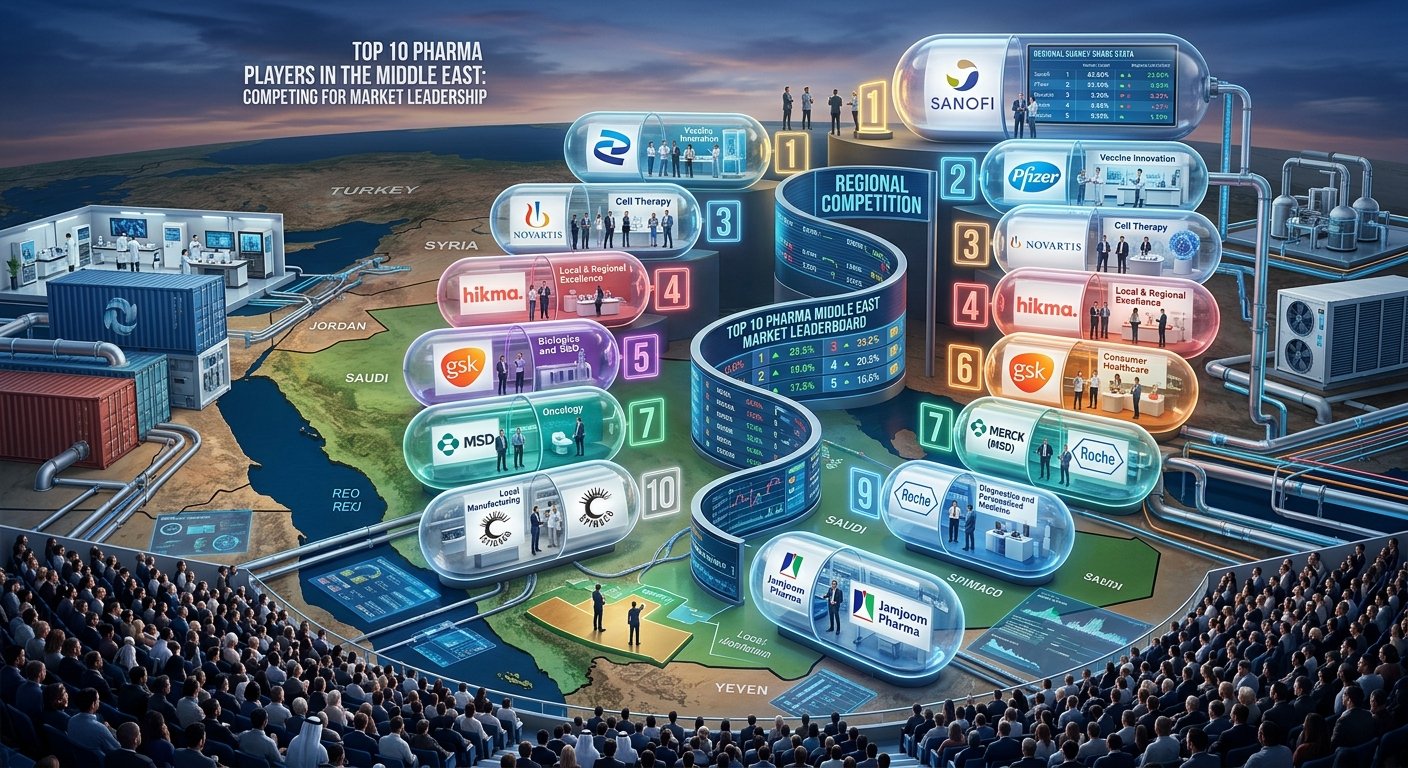
Against this background, ten companies deserve particular attention. This is not a financial or market-cap ranking. Rather, it is a strategic selection based on industrial scale, regional influence, manufacturing capabilities, R&D, biotechnology exposure, international reach and potential to shape the next phase of pharmaceutical development.
1. Hikma Pharmaceuticals — Jordan / UK
Hikma Pharmaceuticals stands in a category of its own among Middle Eastern-origin pharmaceutical companies.
Its transformation from a Jordanian pharmaceutical business into a multinational pharmaceutical group illustrates what regional companies can achieve when they combine local market knowledge with international manufacturing, R&D and commercialization capabilities.
Hikma operates across three major businesses—Injectables, Branded and Hikma Rx—with manufacturing and R&D operations spanning MENA, Europe and the United States. The company has also continued to increase its focus on complex products and R&D.
Its strategic importance is particularly strong in injectables, complex generics and biosimilars.
Why watch it: Hikma provides perhaps the clearest regional blueprint for converting a Middle Eastern pharmaceutical company into a global healthcare platform.
2. SPIMACO — Saudi Arabia
SPIMACO is one of the most strategically important companies in Saudi Arabia’s pharmaceutical localization programme.
Established in 1986, SPIMACO has developed into a vertically integrated pharmaceutical manufacturer with a presence across multiple MENA markets. Its capabilities cover tablets, capsules, sterile products, oncology products and other pharmaceutical dosage forms.
Its trajectory is also increasingly connected to biopharma. SPIMACO identifies the launch of its first Saudi-made biosimilar as an important milestone in its development.
Why watch it: SPIMACO is becoming an important bridge between Saudi pharmaceutical localization and the Kingdom’s ambition to develop more sophisticated domestic manufacturing capabilities.
3. Jamjoom Pharma — Saudi Arabia
Jamjoom Pharma has emerged as one of Saudi Arabia’s most dynamic pharmaceutical companies.
Its importance goes beyond revenue growth. The company is increasingly participating in the structural transformation of Saudi manufacturing through capacity expansion, strategic transactions and localization of pharmaceutical production.
One of the most significant developments in 2026 was Jamjoom’s agreement to acquire Pfizer’s pharmaceutical manufacturing facility in Saudi Arabia. Such transactions demonstrate a new form of localization: rather than relying exclusively on greenfield investment, Saudi companies can acquire established industrial assets, technologies and manufacturing capabilities.
This model potentially accelerates the development of local pharmaceutical capacity while strengthening the position of domestic companies.
Why watch it: Jamjoom represents the rise of a new generation of Saudi pharmaceutical champions capable of combining domestic growth with industrial consolidation.
4. Tabuk Pharmaceuticals — Saudi Arabia
Tabuk Pharmaceuticals is another major Saudi pharmaceutical platform with regional significance.
Its strategic role should be viewed in the context of Saudi Arabia’s broader pharmaceutical localization agenda. The next stage of growth for companies such as Tabuk is likely to involve greater emphasis on complex pharmaceuticals, technology partnerships, specialized therapies, manufacturing sophistication and exports.
Saudi Arabia’s domestic market provides scale, while the country’s investment environment provides opportunities to expand manufacturing capabilities and attract international partnerships.
Why watch it: Tabuk is positioned to benefit from the transition of Saudi Arabia from a pharmaceutical consumption market into a pharmaceutical production and export platform.
5. Julphar — United Arab Emirates
Julphar remains one of the Gulf’s most recognizable pharmaceutical manufacturing companies.
Its strategic importance is closely linked to the UAE’s role as a regional logistics, investment and commercial hub.
The UAE offers a different proposition from Saudi Arabia. Saudi Arabia provides enormous domestic demand and major national investment programmes; the UAE offers international connectivity, logistics infrastructure, financial services and access to global markets.
This creates an attractive platform for pharmaceutical companies seeking to serve the Gulf, Africa, Asia and other international markets.
Why watch it: Julphar demonstrates how a Gulf-based pharmaceutical manufacturer can leverage the UAE’s global connectivity to build regional and international reach.
6. Avalon Pharma — Saudi Arabia
Avalon Pharma is particularly interesting because it sits at the intersection of pharmaceutical localization, biotechnology and biosimilars.
Its agreement with China’s Bio-Thera Solutions concerning a proposed pembrolizumab biosimilar illustrates a potentially important model for the region: international biotechnology expertise can be combined with Saudi commercialization capabilities and, over time, local manufacturing and technology transfer.
This model is strategically significant.
Instead of simply importing finished biological medicines, regional companies can progressively build capabilities in registration, commercialization, technology transfer and biomanufacturing.
Why watch it: Avalon could become an example of how international biotechnology partnerships can accelerate the creation of a local biosimilar ecosystem.
7. Abdi İbrahim — Türkiye
Abdi İbrahim represents the depth of Türkiye’s pharmaceutical ecosystem.
Türkiye has a substantially developed pharmaceutical manufacturing and scientific infrastructure, and Abdi İbrahim is one of its most prominent companies.
The company has continued to invest in R&D and biotechnology-related capabilities, highlighting the increasing importance of biotechnological medicines and locally developed pharmaceutical technologies.
Türkiye’s role in the regional pharmaceutical landscape is particularly important because it combines industrial manufacturing, scientific expertise, domestic demand and proximity to European, Middle Eastern and Central Asian markets.
Why watch it: Abdi İbrahim illustrates the potential of Turkish pharmaceutical companies to move beyond traditional generics and strengthen their position in innovation and biotechnology.
8. DEVA Holding — Türkiye
DEVA Holding represents another important pillar of Türkiye’s pharmaceutical manufacturing base.
The company’s significance lies in its integrated pharmaceutical capabilities, including finished products and API-related activities, supported by manufacturing and logistics infrastructure.
This type of vertical integration is increasingly important as pharmaceutical markets become more sophisticated.
The future competitive advantage will increasingly depend on the ability to control more elements of the value chain—from active ingredients and formulation development to manufacturing, regulatory approval and international distribution.
Why watch it: DEVA demonstrates the importance of industrial depth and vertical integration in building a resilient pharmaceutical supply chain.
9. Nobel İlaç — Türkiye
Nobel İlaç may be one of the most strategically interesting companies in the region from a biotechnology perspective.
Nobel operates across chemical and biotechnological pharmaceuticals and has developed R&D and manufacturing capabilities in Türkiye as well as international operations in Kazakhstan and Uzbekistan.
Its biotechnology capabilities are particularly relevant because they move the company beyond conventional pharmaceutical manufacturing toward actual biomanufacturing capability.
This makes Nobel an important example of how a regional pharmaceutical company can combine APIs, R&D, biotechnology and manufacturing within an increasingly international platform.
Why watch it: Nobel demonstrates the potential for a regional pharmaceutical company to develop a cross-border R&D and biomanufacturing network.
10. EVA Pharma — Egypt
EVA Pharma represents the scale and potential of Egypt’s pharmaceutical industry.
Egypt has several structural advantages: a large domestic market, a long-established pharmaceutical manufacturing base, a significant scientific and medical workforce and geographic access to Africa and the Middle East.
EVA Pharma has developed an international presence extending across multiple markets, supported by manufacturing operations in Egypt and Saudi Arabia.
The opportunity for EVA and other Egyptian pharmaceutical companies is now to move further upstream into complex generics, biosimilars, biotechnology, CDMO activities, clinical research and higher-value exports.
Why watch it: EVA embodies the potential for Egypt to evolve from a major pharmaceutical consumption and manufacturing market into a broader MENA-Africa pharmaceutical production and export hub.
What These 10 Companies Tell Us About the Region
These ten companies are not identical. In fact, their differences are precisely what makes the comparison interesting.
- Hikma demonstrates global scale.
- SPIMACO demonstrates Saudi localization and vertical integration.
- Jamjoom Pharma demonstrates the rise of domestic Saudi pharmaceutical champions.
- Tabuk Pharmaceuticals demonstrates the potential of Saudi manufacturing and regional expansion.
- Julphar demonstrates the UAE’s international platform model.
- Avalon Pharma demonstrates the growing importance of biosimilars and technology transfer.
- Abdi İbrahim demonstrates Türkiye’s R&D and pharmaceutical depth.
- DEVA Holding demonstrates vertical integration.
- Nobel İlaç demonstrates the transition toward biotechnology and biomanufacturing.
- EVA Pharma demonstrates Egypt’s potential to combine manufacturing scale with regional expansion.
Together, they reveal a much larger transformation taking place across the region.
The New Competitive Battlefield
The pharmaceutical competition in the Middle East is increasingly moving away from who sells the most conventional medicines toward who controls the highest-value parts of the pharmaceutical ecosystem.
The emerging hierarchy is likely to be determined by five capabilities:
- R&D and intellectual property
- Biotechnology and biosimilar development
- Advanced pharmaceutical and biological manufacturing
- Clinical and regulatory capabilities
- International commercialization and exports
Companies capable of combining these capabilities will have a significant strategic advantage.
The most important development is therefore not simply the growth of pharmaceutical sales in the Middle East.
It is the emergence of regional pharmaceutical companies capable of becoming technology owners, development partners, manufacturers and exporters.
Executive Takeaway
The next generation of Middle Eastern pharmaceutical leadership will not be built solely through larger factories.
It will be built through science, technology, capital, partnerships and governance.
The ten companies highlighted here represent different versions of that emerging model. Some are already global. Others are rapidly scaling. Some are particularly strong in manufacturing, while others are moving aggressively into biotechnology, biosimilars or R&D.
But they share one defining characteristic:
They are moving beyond the traditional role of pharmaceutical supplier toward becoming strategic owners of pharmaceutical value.
For investors, governments and healthcare leaders, these are therefore not simply companies to watch.
They are companies to watch because their evolution may provide an early indication of where the Middle East pharmaceutical industry itself is heading.