The Hospital Is Becoming a Machine — But Patients Aren’t Smart hospitals need something smarter than technology: human-centered design.
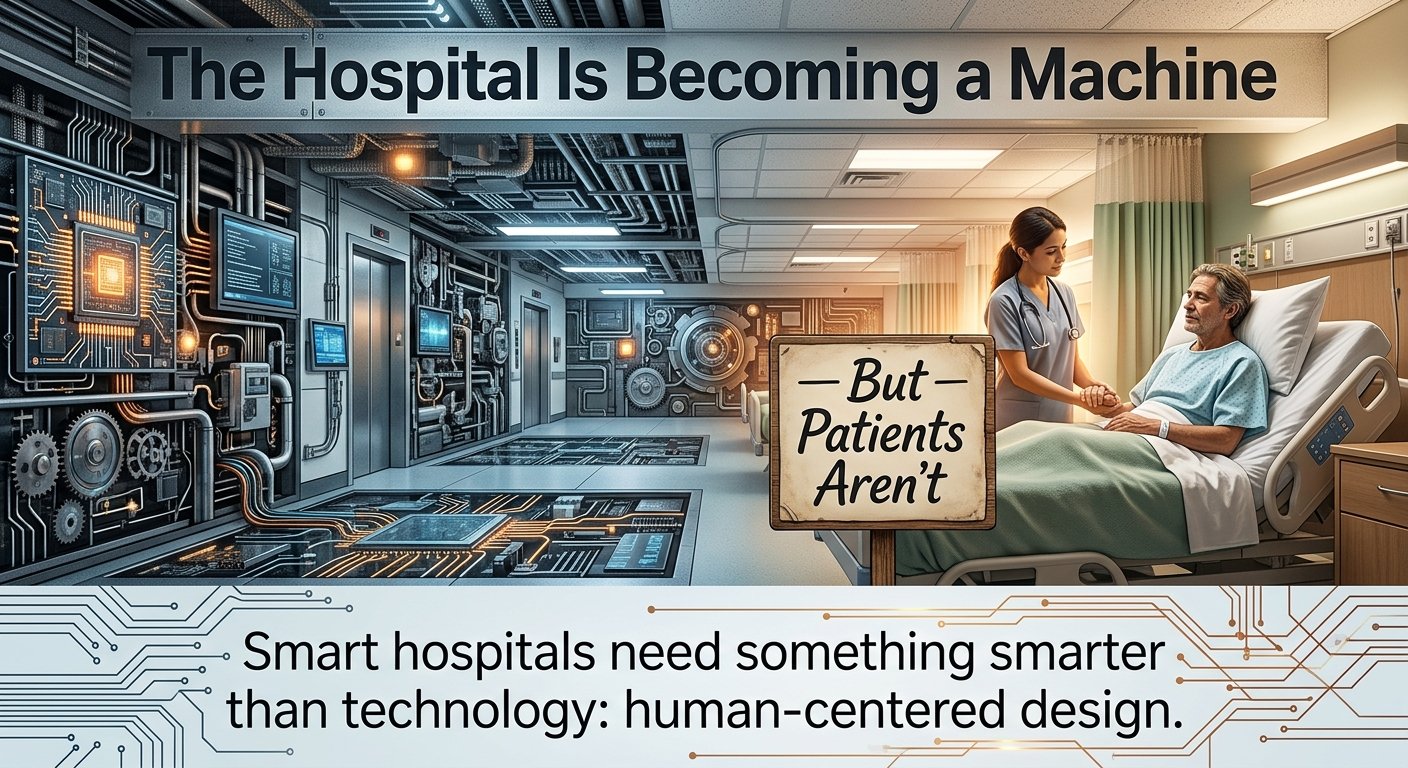
Hook: Smart hospitals need something smarter than technology: human-centered design.
The modern hospital is undergoing a profound metamorphosis. Once a place defined by white coats, paper charts, and bedside intuition, it is now a dense network of intelligent systems — AI, robotics, automation, IoT, digital twins, predictive analytics, remote monitoring, and smart infrastructure. These technologies are not add-ons; they are becoming the central nervous system of care delivery.
In many ways, the hospital is becoming a machine — highly orchestrated, data-driven, and relentlessly efficient. But this transformation carries a critical risk: in our pursuit of operational excellence, we must not forget that the patients within these walls are not code, not sensors, not algorithms. They are people — fragile, emotional, and deeply human.
The Intelligent Hospital: A Symphony of Systems
AI & Machine Learning
Diagnostics, risk stratification, clinical decision support.
Robotics
Surgical precision, logistics, sterilisation, and rehabilitation.
IoT & Smart Sensors
Real-time vitals, bed occupancy, equipment tracking, environmental monitoring.
Digital Twins
Virtual replicas for simulation, workflow optimisation, and predictive modelling.
Predictive Analytics
Patient deterioration, readmission risk, staffing demand, supply chain.
Remote Monitoring
Wearables, home-based care, chronic disease management, virtual wards.
Smart Infrastructure
Energy efficiency, wayfinding, automated HVAC, lighting, and security.
The machine is powerful. But power without purpose is noise.
⚡ The Critical Principle
Technology must serve the patient —
not the other way around.
This is not a sentimental afterthought. It is a strategic, operational, and ethical imperative. When we design systems that prioritise data dashboards over human connection, we risk creating a hospital that is clinically superb but emotionally barren. The patient is not a user; the patient is the purpose.
Human-Centered Design: The Antidote to Dehumanisation
Human-centered design (HCD) is not about adding a “compassion” layer on top of technology. It is about inverting the design process — starting with the patient’s emotional and physical journey, and then asking how technology can enhance, not interrupt, that experience.
Empathy in the Algorithm
AI should flag risks — but also prompt a human conversation, not a robotic alert.
Digital Twins for Patient Journeys
Simulate not only workflows but also patient anxiety, waiting times, and family communication.
Automation with a Human Touch
Robots handle logistics; nurses handle hand-holding. Clear division of labour that amplifies human connection.
The Business Case: Why HCD Drives Performance
- Higher patient satisfaction — HCD directly improves HCAHPS scores, patient loyalty, and brand reputation.
- Fewer errors & readmissions — When technology reduces cognitive load and clarifies communication, clinical outcomes improve.
- Staff retention & well-being — Clinicians want tools that help them care, not hinder. HCD reduces burnout by eliminating friction.
- Faster ROI — Technology that is adopted and used effectively yields returns far sooner than solutions that are resisted or misunderstood.
The Future Is Hybrid: High-Tech, High-Touch
The hospital of the future will not be a choice between machine and human — it will be a synthesis. Artificial intelligence will augment clinical judgment, not replace it. Robotics will handle the repetitive, so that staff can focus on the relational. Digital twins will predict, but clinicians will interpret and comfort.
●
The measure of our success will not be the sophistication of our algorithms, but the humanity of our outcomes.
Article 7 — The Hospital Is Becoming a Machine—But Patients Aren’t
A strategic perspective from [Your Organisation] — where innovation meets compassion.