The Dentistry Industry: From Clinical Care to a Global Healthcare and Dental Tourism Economy
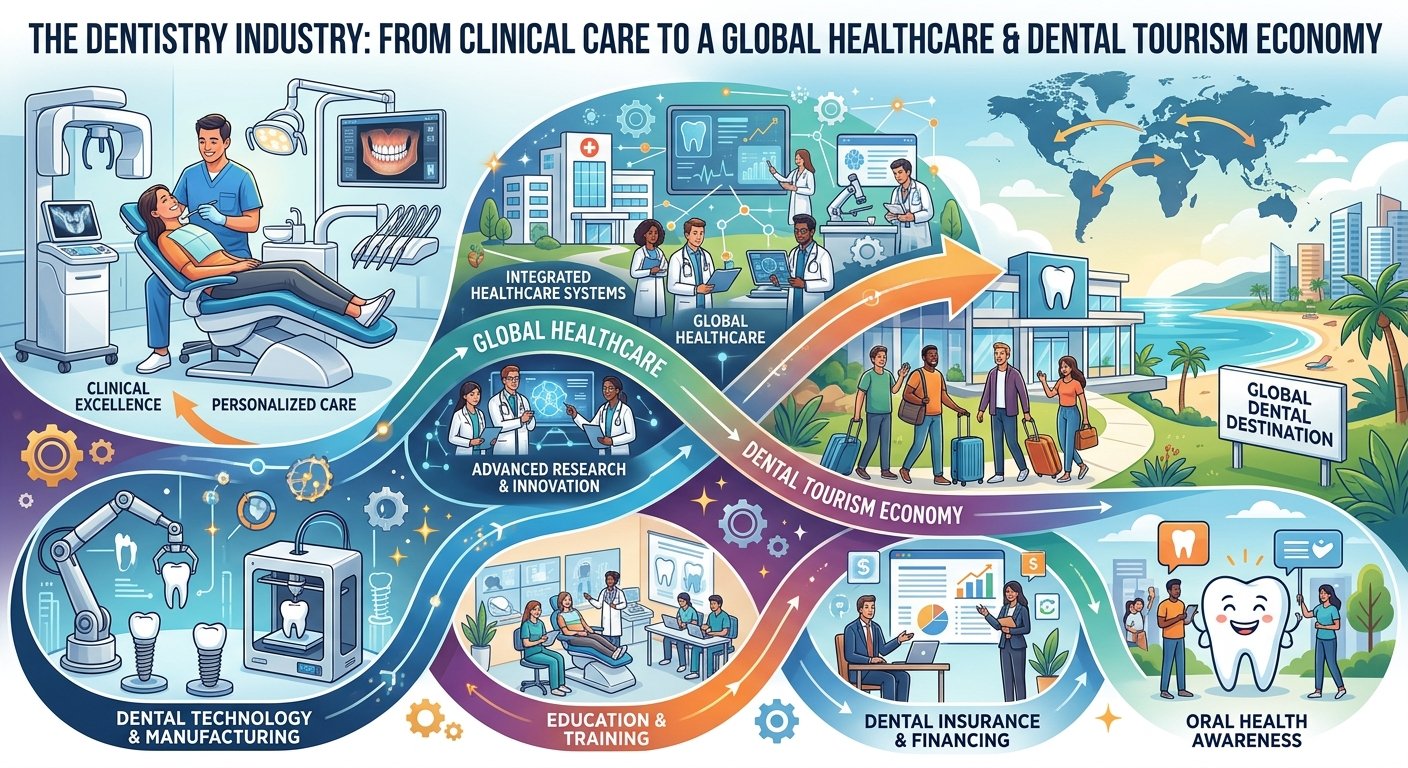
How dentistry is evolving from a traditional medical service into a technology-driven, investment-oriented and internationally competitive healthcare industry.
The global dental industry is being reshaped by changing demographics, greater awareness of oral health, rising demand for cosmetic dentistry, technological innovation and the growing willingness of patients to travel internationally for high-quality and competitively priced treatment.
This transformation creates a significant opportunity for the Middle East and North Africa (MENA), particularly countries such as Saudi Arabia, Egypt, the United Arab Emirates, Morocco and Jordan, to develop internationally competitive dental healthcare destinations.
1. Dentistry Is Becoming a Strategic Healthcare Industry
The modern dentistry sector is no longer limited to fillings, extractions and routine preventive care. Contemporary dental care increasingly includes:
- Implantology and advanced oral surgery
- Orthodontics and clear aligner therapy
- Cosmetic and aesthetic dentistry
- Digital smile design
- Prosthodontics and restorative dentistry
- Periodontology
- Pediatric dentistry
- Endodontics and microsurgical procedures
- Maxillofacial surgery
- Digital dentistry and CAD/CAM laboratories
- 3D printing and digitally manufactured dental prostheses
- Artificial intelligence-supported diagnosis and treatment planning
The result is a sector with multiple revenue streams, specialized clinical pathways and increasing opportunities for institutional investment.
2. The Rise of the Corporate Dental Model
One of the most important developments in dentistry is the movement from the traditional single-doctor clinic toward organized dental groups and multi-site healthcare platforms.
Corporate dental organizations can achieve advantages through centralized procurement, standardized clinical protocols, centralized marketing, shared laboratories, technology platforms, professional management and stronger utilization of expensive equipment.
The next generation of dental groups will increasingly operate as integrated healthcare businesses rather than collections of individual practices.
The future dental organization will not simply sell dental procedures. It will manage the complete patient journey — from diagnosis and treatment planning to financing, treatment, follow-up and long-term oral-health management.
3. Technology Is Changing the Dental Value Chain
Digital transformation is becoming one of the strongest drivers of dental-sector growth.
Intraoral scanners, digital radiology, cone-beam CT, CAD/CAM systems, milling machines, 3D printing, digital treatment planning and artificial intelligence are increasingly connecting the dental clinic with the dental laboratory.
This creates a new digital value chain:
Digital Diagnosis → Digital Treatment Planning → Digital Manufacturing → Clinical Treatment → Digital Follow-Up
The integration of clinical dentistry and dental laboratories is particularly important because it can reduce treatment time, improve consistency and create opportunities for centralized manufacturing.
4. Cosmetic Dentistry Is Expanding the Market
Dentistry is increasingly influenced by the global aesthetics economy. Patients are no longer seeking treatment only because of pain or disease. They are also seeking improvements in appearance, confidence and quality of life.
Procedures such as veneers, crowns, implants, whitening, orthodontics and smile makeovers have created a substantial elective-care market.
Social media has accelerated this trend. Patients are exposed to before-and-after cases, digital smile designs and international treatment experiences, increasing awareness of available dental technologies and treatment options.
For dental operators, this creates both an opportunity and a responsibility: growth must be built around clinical quality, transparent communication and appropriate patient selection, rather than aggressive cosmetic marketing alone.
5. Dental Tourism: A Major Opportunity
Dental tourism has become an important component of the international healthcare economy. Patients may travel to another country because treatment is more affordable, because specialized expertise is available, because waiting times are shorter, or because they can combine healthcare with travel and hospitality.
Dental tourism is particularly attractive because many procedures can be completed within relatively short treatment journeys compared with complex medical interventions.
Common dental-tourism services include:
- Dental implants
- Full-mouth rehabilitation
- All-on-4 and other implant-supported solutions
- Cosmetic dentistry
- Veneers and crowns
- Orthodontic treatment
- Advanced oral surgery
- Periodontal treatment
- Combined restorative and aesthetic treatment plans
6. What Makes a Successful Dental Tourism Destination?
Price alone does not create a successful dental tourism destination. International patients increasingly evaluate the entire experience.
- Clinical reputation: Experienced dentists and credible specialist teams.
- Quality assurance: Standardized clinical protocols and measurable outcomes.
- Technology: Modern diagnostic and digital dentistry capabilities.
- Accreditation: Recognized quality and patient-safety standards.
- Communication: Multilingual patient coordinators and clear treatment plans.
- Transparent pricing: Clearly defined packages and treatment costs.
- Convenience: Airport transfers, accommodation coordination and appointment scheduling.
- Continuity of care: Structured follow-up after the patient returns home.
Therefore, the competitive product is not simply a dental procedure. It is an end-to-end international patient experience.
7. Egypt: A Potential Dental Tourism Hub
Egypt possesses several characteristics that could support the development of a stronger dental tourism industry. These include a large medical workforce, a substantial domestic patient base, internationally recognized medical specialists, competitive operating costs, extensive hospitality infrastructure and strong tourism connectivity.
Cairo, Alexandria, Sharm El Sheikh, Hurghada and other major destinations could potentially develop specialized dental tourism ecosystems combining dental care with hospitality and tourism services.
However, Egypt’s opportunity should not be based exclusively on low prices. Sustainable competitiveness requires investment in quality systems, digital dentistry, international patient management, clinical governance, accreditation and outcome measurement.
8. Saudi Arabia: From Domestic Demand to Regional Dental Leadership
Saudi Arabia represents another major opportunity for the dental industry. A growing healthcare sector, increasing private-sector participation, investment in healthcare infrastructure and a large domestic market create an attractive environment for modern dental platforms.
Riyadh, Jeddah and other major Saudi cities can support increasingly sophisticated dental networks serving both local patients and international or regional patients.
Saudi dental groups can also use the Kingdom as a platform for regional expansion, particularly where strong brands, specialist expertise and integrated healthcare management can be replicated across neighboring markets.
9. MENA Dental Tourism: The Regional Opportunity
The MENA region has the potential to develop several complementary dental tourism hubs rather than relying on a single market.
- Egypt: Potential advantage in clinical talent, cost competitiveness and tourism infrastructure.
- Saudi Arabia: Strong domestic demand, investment capacity and healthcare transformation.
- United Arab Emirates: Premium international healthcare environment and global connectivity.
- Jordan: Established reputation in medical tourism and specialist healthcare.
- Morocco: Geographic proximity to Europe and growing potential for medical and dental tourism.
The opportunity is therefore to build a MENA dental healthcare corridor in which each market develops its own competitive proposition.
10. Dental Tourism Requires More Than a Clinic
One of the most common mistakes in dental tourism is to think that international patients can be acquired simply by advertising discounted procedures online.
A professional dental tourism platform should include:
- International patient department
- Multilingual patient coordinators
- Digital pre-consultation
- Remote review of radiographs and clinical records
- Pre-treatment quotation
- Treatment scheduling before arrival
- Airport and hotel coordination
- Dedicated patient navigation
- Post-treatment follow-up
- Coordination with dentists in the patient’s home country
This converts dental tourism from a marketing activity into a structured healthcare business model.
11. The Economics of the Dental Business
Dental businesses can generate attractive economics because several procedures have significant value per patient, while technology and specialist capacity can support multiple revenue streams.
Key commercial indicators should include:
- Patient acquisition cost
- Consultation-to-treatment conversion
- Average revenue per patient
- Revenue per dental chair
- Chair utilization
- Specialist utilization
- Laboratory cost as a percentage of revenue
- Material cost per procedure
- Patient retention
- Referral rate
- International patient contribution
- EBITDA margin
The strongest operators will manage dentistry using the same discipline applied to other modern healthcare businesses: capacity planning, revenue-cycle management, clinical governance, quality measurement and financial analytics.
12. The Dental Laboratory: An Underestimated Strategic Asset
The dental laboratory is increasingly becoming a strategic component of the dental value chain.
Large dental organizations can benefit from centralized laboratories using CAD/CAM and 3D printing to support multiple clinics. This can create economies of scale while improving coordination between clinicians and technicians.
A sophisticated regional dental platform could potentially combine:
Dental Clinics + Specialists + Digital Laboratory + Imaging + Patient Financing + International Patient Services
13. Artificial Intelligence and the Future of Dentistry
Artificial intelligence is expected to become increasingly important in dental diagnosis, imaging analysis, treatment planning, workflow management and patient engagement.
AI may support clinicians by identifying radiographic findings, assisting treatment planning, analyzing patient records and improving operational efficiency.
The strategic value, however, will not come from AI alone. The winning model will be the integration of AI + clinicians + digital imaging + electronic medical records + laboratory technology + patient data.
14. Investment Opportunities in Dentistry
Dentistry offers multiple investment models beyond traditional clinic ownership.
- Multi-site dental clinic networks
- Specialized implant centers
- Cosmetic dentistry centers
- Orthodontic networks
- Digital dental laboratories
- Dental imaging centers
- Dental technology platforms
- Dental financing solutions
- Dental insurance and managed-care platforms
- International dental tourism platforms
- Dental education and simulation centers
This makes dentistry increasingly relevant to private equity, healthcare funds, strategic investors and healthcare operators seeking scalable outpatient healthcare models.
15. Governance Will Become a Competitive Advantage
As dental organizations become larger, clinical governance and corporate governance will become increasingly important.
Dental groups need clear separation between ownership, management and clinical decision-making. Clinical protocols, credentialing, infection prevention, patient safety, complaints management, informed consent and outcome measurement should be institutionalized rather than dependent on individual practitioners.
The transition from a physician-owned practice to a professional healthcare organization requires a corresponding transition from individual reputation to institutional reputation.
16. The Future Dental Platform
The next generation of successful dental companies will probably look very different from the traditional dental clinic.
CLINICAL EXCELLENCE
+ DIGITAL DENTISTRY
+ SPECIALIST NETWORK
+ CENTRAL LABORATORY
+ AI & DATA
+ PATIENT FINANCING
+ INTERNATIONAL PATIENT SERVICES
+ CORPORATE GOVERNANCE
Such a platform can potentially create a scalable regional healthcare business capable of serving domestic patients while attracting patients from neighboring countries and international markets.
17. Tashawer Perspective: Dentistry Is Moving Toward Platform Healthcare
From a healthcare investment and management perspective, the most important development in dentistry is not simply the growth in the number of dental clinics. It is the emergence of integrated dental healthcare platforms.
The competitive advantage will increasingly come from combining clinical talent with professional management, technology, centralized procurement, digital laboratories, patient financing, data analytics and international patient services.
Dental tourism can become a powerful additional growth engine, but only when it is built around measurable clinical quality and a complete patient journey.
Our view is clear: the future of dentistry in MENA will not belong simply to the largest number of clinics. It will belong to the organizations that successfully integrate clinical excellence, technology, governance, affordability and international patient experience.
Conclusion
Dentistry is evolving from a fragmented professional service into a sophisticated healthcare industry with significant potential for consolidation, digital transformation and international expansion.
Dental tourism adds another dimension by transforming oral healthcare into an internationally tradable healthcare service. Countries that can combine clinical excellence, competitive economics, advanced technology, quality accreditation, hospitality and professional patient management can establish themselves as regional dental destinations.
For MENA, the opportunity is particularly significant. Egypt, Saudi Arabia, the UAE, Jordan and Morocco each possess different competitive advantages that can support the emergence of a regional dental healthcare ecosystem.
The next decade could therefore see dentistry become one of the most dynamic segments of outpatient healthcare — driven not only by local demand, but also by technology, consolidation, investment and the growing international movement of dental patients.
“`