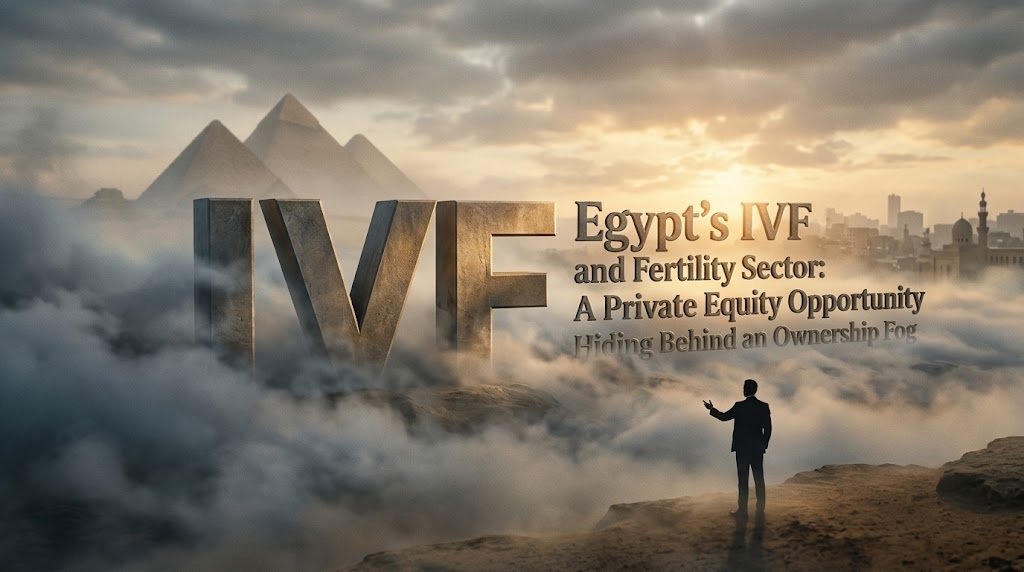
Egypt’s IVF and Fertility Sector: A Private Equity Opportunity Hiding Behind an Ownership Fog
For GCC family offices, sovereign-backed healthcare funds, and English private equity houses hunting for defensive, high-margin healthcare assets, Egypt’s assisted-reproduction market ticks an unusual number of boxes: a population of over 110 million, a fertility rate that remains well above Western levels, a deeply entrenched cultural preference for larger families, and a large, fragmented base of physician-owned clinics with almost no institutional consolidation to date.
But the sector presents a paradox. The clinics are easy to find. The owners are not.
This article maps what is publicly knowable about Egypt’s IVF, ICSI and assisted-reproduction centres — and explains why any serious investor must move from a directory of clinic names to a verified ownership and market-intelligence database before committing capital.
1. A Large, Fragmented, and Largely Unconsolidated Market
Publicly available sources — the Egypt IVF Registry, international IVF directories, Egyptian medical directories and current business listings — identify at least 69 IVF, ICSI and assisted-reproduction facilities across the country. They cluster around:
- Cairo and Giza — the dominant hub, with 41 identified centres, concentrated in Dokki, Mohandessin, Maadi, Heliopolis and Nasr City, plus newer satellite clusters in Sheikh Zayed and New Cairo.
- Alexandria — 11 centres, largely physician-owned or hospital-based.
- Delta and Canal cities — 10 centres, including Mansoura, Zagazig, Port Said and Shebin El Kom.
- Upper Egypt — 7 centres, spanning Assiut, Qena, Minia and Sohag.
The majority are independent, physician-led clinics with modest physical footprints, one or two IVF laboratories, and a single high-profile consultant acting as both founder and brand. A smaller subset are hospital-based IVF units — including Nile Badrawi, Abd El Kader Fahmy, the American Hospital, Egypt Air Hospital, Hasabo International, Louran International, Agial and Shatby Maternity — where the IVF unit is a service line rather than a stand-alone business.
For a private equity investor, this is precisely the profile that historically precedes consolidation: a long tail of owner-operated businesses, limited professional management, weak branding, and no dominant national platform.
2. The Ownership Fog: Why a Directory Is Not a Deal Pipeline
Publicly available information in Egypt does not consistently disclose the legal shareholders or beneficial owners of IVF centres. Across the 69 listings, the ownership picture looks roughly as follows:
- Named founder or medical director only — the majority. The physician is the public face of the clinic; whether he or she is the shareholder, a salaried director, or a minority partner is usually undisclosed.
- Hospital-based unit — the IVF service sits inside a hospital or university structure, with the parent institution as the effective owner.
- “Ownership not verified” — a large minority of listings, including many of the most commercially prominent Cairo and Alexandria clinics.
- Corporate owner — identifiable in only a handful of cases, typically where a clinic is part of a broader hospital group.
This is the single most important due-diligence point in the sector. A physician named as medical director is not necessarily the shareholder or the legal owner. Conversely, many clinics operate under trading names — Eve Clinics / IVF Egypt, for example, or the Rahem Fertility Center with reported branches in Zagazig and New Cairo — that mask a more complex corporate structure.
For GCC investors accustomed to clean shareholder registers, this opacity is both a risk and an entry point: the first mover who builds verified ownership intelligence gains a structural advantage in sourcing and pricing.
3. The Physician Leadership: A Map of Sector Influence
The Egypt IVF Registry identifies 16 participating centres and their medical directors. These names are the most reliable starting point for investor conversations, because they identify the actual clinical decision-makers behind the sector — and, very often, the economic owners.
| Centre | Physician |
|---|---|
| Egyptian IVF-ET Center | Prof. Gamal Serour |
| Dar Al Teb | Prof. Ahmed Awadalla |
| El Hayah Center | Prof. Hassan El-Maghraby |
| Ajyal IVF | Prof. Mohamed Yehia |
| Amshag IVF | Prof. Mohamed Sabry |
| Banon IVF | Prof. Ahmed Nabil |
| El Tarik IVF | Prof. Tarek Fouad |
| Hawaa Fertility | Prof. Ahmed Samy Abdelaziem |
| Ibn Sina IVF | Prof. Hazem Abdelghafaar |
| Integrated Fertility | Prof. Mohamed Elsaied Ghanem |
| International Islamic Center for Population Studies | Prof. Gamal Serour |
| Nasser Allakkany Center | Prof. Nasser Allakany |
| Qena IVF | Prof. Osama Elkereity |
| Queens IVF | Prof. Mohamed Yehia |
| Rahem Fertility | Prof. Eman Elgindy |
| Repro IVF | Prof. Yasseer Oreif |
| Walad Webent Center | Prof. Taher Ismaiel |
Source: Egypt IVF Registry – Registry Body.
Two structural observations matter for investors. First, a small number of physicians appear across multiple entities — Prof. Gamal Serour at both the Egyptian IVF-ET Center and the International Islamic Center for Population Studies; Prof. Mohamed Yehia at both Ajyal and Queens; Prof. Eman Elgindy across the Rahem branches. This pattern suggests embryonic multi-site groups that could serve as anchor platforms for consolidation. Second, the geographic spread of registry-listed directors confirms that credible clinical leadership exists outside Cairo — in Assiut, Qena, Sohag and Zagazig — which is where GCC investors may find the most attractive entry valuations.
4. Regional Breakdown
Cairo and Giza
The capital region is the commercial centre of the market. Of the 41 identified centres, roughly half carry no verifiable ownership disclosure. Several are prominent hospital-based units (Nile Badrawi, Abd El Kader Fahmy, American Hospital, Egypt Air Hospital, Hasabo International). Others are well-known physician brands — Mohamed Fayez, Mohsen Khairy, Ashraf Sabry (Al Hayah / EVE), Amr Abdel Aziz (Eve Clinics / IVF Egypt), Ahmed Shamel, and Prof. Eman Elgindy (Rahem). Newer clusters in Sheikh Zayed and New Cairo — including PyraMedicine and Ahmed Shamel’s Twin Towers clinic — reflect the migration of affluent patient demand to the western and eastern suburbs.
Alexandria
Alexandria’s 11 centres are a mix of independent clinics (Alexandria Fertility Center, Repro IVF under Prof. Yasseer Oreif, El Amal, El Madina, Miami IVF/ICSI) and hospital-based units (Agial, Louran International, Shatby Maternity). Physician-branded clinics — Dr. Ahmed El Mesiry, Dr. Marwa El Sherif, Dr. Mohamed Samir Fouad — are typical of the city’s owner-operated model.
Delta and Canal Cities
This region is the least consolidated and the least transparent. Several listings — El Tarik, Ajyal, Amshag, Queens — carry “location to verify” notes, a signal that directory records may be historical or incomplete. The presence of registry-listed directors (Prof. Tarek Fouad, Prof. Mohamed Yehia, Prof. Mohamed Sabry, Prof. Ahmed Samy Abdelaziem) confirms clinical activity, but the commercial footprint is unclear. For a value-oriented investor, this is both the highest-risk and highest-potential region.
Upper Egypt
Upper Egypt’s 7 centres — in Assiut, Qena, Minia and Sohag — are anchored by university and hospital units (Assiut University IVF Center, Ibn Sina Hospital in Sohag) alongside physician-led clinics (Banon IVF under Prof. Ahmed Nabil, Qena IVF under Prof. Osama Elkereity). Patient travel to Cairo is common, which suggests latent demand that a well-capitalised regional platform could capture.
5. What the Directory Does Not Tell You — and Why It Matters
The 69 entries should not be read as 69 confirmed, independent, currently operating centres. Three due-diligence issues must be resolved before any transaction:
- Hospital units are not stand-alone businesses. Acquiring an IVF unit inside a hospital requires negotiating with the parent institution, not the physician.
- Multi-name and multi-branch entities. Rahem, Eve Clinics / IVF Egypt, Ajyal / Queens and Al Hayah / EVE all appear under more than one name or location. These are potential platforms — or potential double-counting.
- Historical or inactive listings. Some directory records may not establish that the centre is currently performing IVF procedures.
And, critically: the physician named as medical director is not necessarily the shareholder or legal owner. Any valuation, share-purchase agreement or partnership must be built on verified corporate and beneficial-ownership data, not on directory entries.
6. Building the Egypt IVF Market Intelligence Database
For a healthcare investment, acquisition, partnership or market-entry exercise, we recommend building a structured database with the following fields — the minimum standard a GCC or English private equity investment committee should expect before screening targets.
| Information | Required detail |
|---|---|
| Centre identity | English and Arabic name |
| Location | Governorate, city, address, GPS |
| Ownership | Legal company, shareholders, beneficial owners |
| Management | Chairman, CEO, medical director |
| Clinical team | IVF consultants, embryologists, laboratory director |
| Facilities | Number of IVF laboratories, operating rooms, beds |
| Operations | IVF cycles per year, ICSI cycles, capacity |
| Financials | Estimated revenue, EBITDA, investment value |
| Accreditation | GAHAR, ISO and other relevant accreditation |
| Corporate structure | Independent, hospital subsidiary, physician-owned |
| Contact | Website, telephone, email |
7. The Investment Thesis in Brief
For GCC family offices and English private equity, Egypt’s IVF sector offers a rare combination: structural demand growth, a fragmented owner-operated market, and a first-mover advantage in ownership intelligence. The clinics are visible; the shareholders are not. The investor who resolves that gap — who can distinguish a genuine platform from a hospital service line, a real multi-site group from a duplicated directory entry, and a medical director from a beneficial owner — will be able to source, price and structure deals ahead of the competition.
The next step is not another directory. It is a verified Excel database that separates confirmed ownership, medical leadership, unverified ownership, and potential acquisition or strategic partnership targets — the foundation of any credible Egypt IVF market-entry or consolidation strategy.
Disclaimer: Addresses and named clinical associations in this article are compiled from directory and professional-registry records. Some require direct confirmation before commercial use. This article does not constitute investment advice.