Morocco Healthcare System 2025–2026
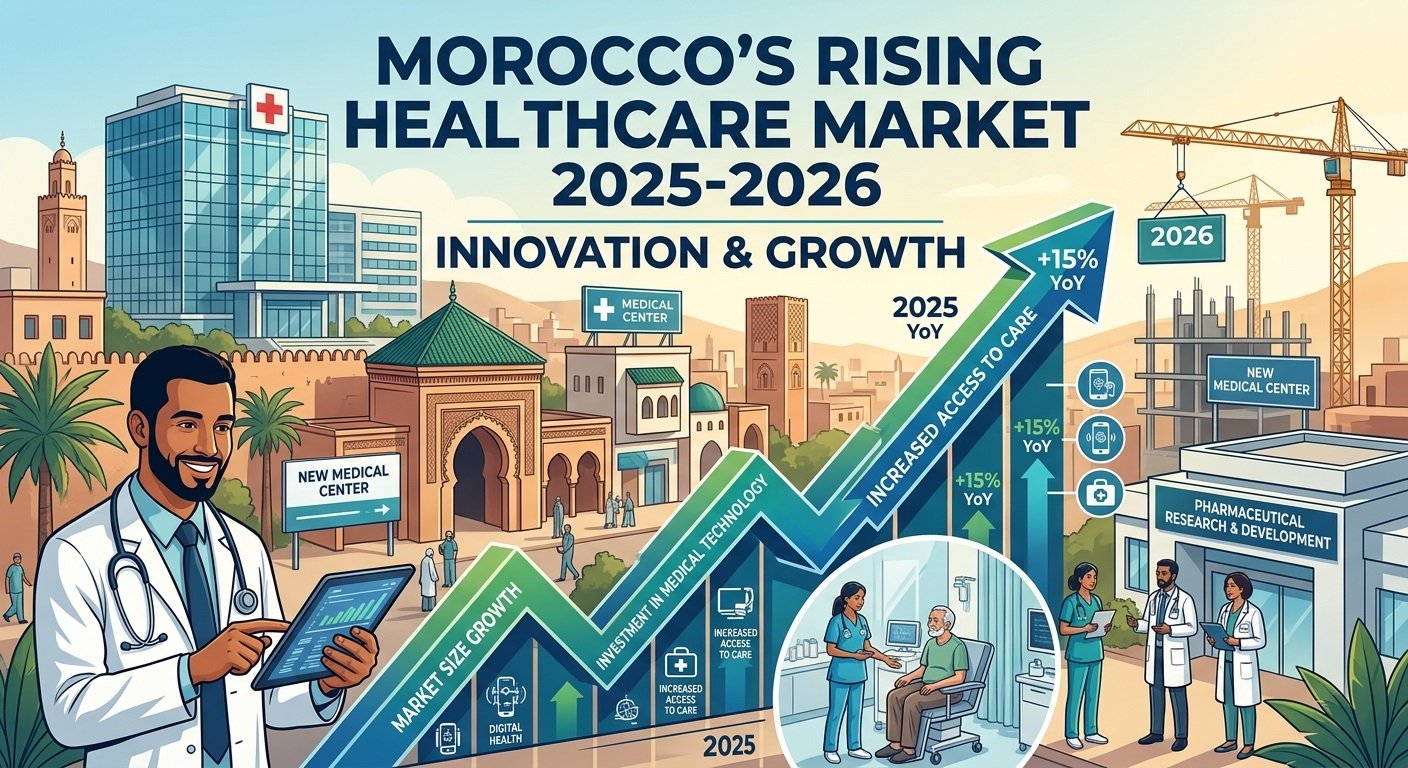
Understanding the Moroccan Healthcare Market: From Universal Coverage to a New Healthcare Economy
Executive Summary
Morocco is entering a defining phase in the development of its healthcare system.
The country is moving beyond the traditional model of a predominantly public and
fragmented healthcare system toward a more integrated model built around
universal health insurance, stronger hospital infrastructure, regional governance,
private-sector participation, digital transformation and greater healthcare sovereignty.
The transformation is substantial. Morocco’s compulsory health insurance framework,
Assurance Maladie Obligatoire (AMO), has dramatically expanded healthcare
coverage. Yet universal coverage is not synonymous with universal access. The country
continues to face regional inequalities, healthcare workforce shortages, infrastructure
constraints and relatively high out-of-pocket expenditure.
For investors, healthcare operators, pharmaceutical companies, medical-device manufacturers
and international healthcare groups, this creates an increasingly attractive market
characterized by large unmet demand, expanding insurance coverage, public investment
and growing private-sector participation.
The opportunity is therefore no longer simply to build hospitals. The emerging Moroccan
healthcare market is increasingly about integrated healthcare platforms, specialized
care, diagnostics, pharmaceuticals, medical devices, health technology, hospital management,
insurance-linked healthcare delivery and public-private partnerships.
1. The Moroccan Healthcare Market at a Glance
Morocco has a population of approximately 38 million people and one of North Africa’s
more diversified healthcare systems. It combines a large public healthcare network with
an increasingly important private sector.
The public sector remains the principal provider of healthcare services, while private
healthcare represents a significant share of healthcare expenditure. This creates a
distinctive market structure in which the government remains a major healthcare provider
while private providers play an increasingly important economic and clinical role.
The Moroccan healthcare market can therefore be understood through five major characteristics:
- Strong public-sector presence and extensive government infrastructure.
- Rapid expansion of compulsory health insurance.
- Growing private healthcare utilization and investment.
- Significant regional disparities in healthcare access and infrastructure.
- Increasing healthcare industrialization in pharmaceuticals and medical devices.
2. The Structure of the Moroccan Healthcare System
Morocco’s healthcare system can broadly be understood through five interconnected layers:
Primary Healthcare
Primary healthcare includes community health centers, outpatient services, preventive
medicine, maternal and child health, vaccination and basic diagnosis.
The public system has a broad territorial network, although access and quality remain
uneven between urban and rural areas.
Secondary Healthcare
Provincial and regional hospitals provide general medical and surgical services, emergency
care, maternity services and other specialties.
Tertiary and University Healthcare
Morocco has major university hospital centers serving as referral and teaching institutions
in cities including Rabat, Casablanca, Fez, Oujda, Marrakech and Tangier.
These institutions are critical for complex surgery, oncology, cardiovascular care,
transplantation, advanced diagnostics and medical education.
Private Healthcare
The private sector includes hospitals, clinics, diagnostic centers, physician practices,
laboratories and specialized healthcare providers.
The private healthcare market is particularly concentrated in major urban centers,
creating significant opportunities for regional expansion and consolidation.
Military Healthcare
Morocco also maintains a military healthcare network, creating another institutional
component of the national healthcare ecosystem.
3. The Biggest Transformation: Universal Health Insurance
One of the most important structural changes in Moroccan healthcare is the expansion of
AMO — Assurance Maladie Obligatoire.
The country has been implementing a comprehensive social-protection reform designed to
move healthcare financing toward compulsory insurance coverage.
This represents a fundamental change in the healthcare economy.
Household Income → Ability to Pay → Access to Private CareEmerging Model:
Population Coverage → Insurance Entitlement → Provider Utilization → Healthcare Expenditure
According to the IMF, AMO coverage increased from approximately 42% of the population
in 2021 to around 88% in 2025. The remaining challenge is to reach full effective coverage,
particularly among informal workers, non-salaried workers and vulnerable populations.
4. AMO Is Changing the Healthcare Business Model
The expansion of AMO creates a new economic relationship between:
Government → Insurer / Payer → Healthcare Provider → Patient
This is gradually replacing the traditional:
Patient → Cash Payment → Provider
For healthcare operators, scale, contracting capability, quality, utilization management
and cost control are therefore becoming increasingly important.
Healthcare providers increasingly need to manage:
- Insurance contracts
- Reimbursement schedules
- Claims management
- Medical coding
- Utilization controls
- Clinical pathways
- Cost per case
- Length of stay
- Readmission rates
- Patient experience
- Quality indicators
The healthcare provider is therefore evolving from a medical facility
into a managed healthcare business.
5. The Remaining Problem: Out-of-Pocket Spending
Despite significant progress toward universal coverage, Morocco still faces an important
healthcare financing challenge.
Current healthcare expenditure represents a meaningful share of GDP, while out-of-pocket
expenditure remains relatively high. This demonstrates that insurance expansion alone
does not automatically guarantee complete financial protection.
The central policy question is therefore:
Can Morocco expand insurance coverage while simultaneously reducing the amount
patients have to pay directly for healthcare?
The answer will strongly influence the next phase of healthcare reform and the economics
of private healthcare delivery.
6. The Public Healthcare System: Large but Under Pressure
Morocco’s public healthcare network remains the backbone of the national system. However,
the sector faces several structural constraints.
- Shortages and uneven distribution of healthcare professionals
- Regional disparities
- Infrastructure limitations
- Hospital capacity constraints
- Pressure on emergency departments
- Unequal access to specialized care
- Aging infrastructure in some facilities
- Growing demand caused by demographic and epidemiological change
These challenges create a substantial investment agenda. The opportunity is not simply
to construct new hospitals, but also to modernize, operate and optimize existing capacity.
7. The Regionalization of Healthcare
One of the strategically important reforms is the movement toward greater regional
organization of healthcare.
Morocco is developing a model in which healthcare resources and management become more
closely connected to regional population needs.
Planning → Resource Allocation → Referral Systems → Hospital Management → Accountability
The reform architecture includes territorial health groups and institutional reforms
designed to strengthen healthcare governance.
For healthcare companies, regionalization creates opportunities to develop
regional healthcare platforms rather than isolated facilities.
8. The Private Healthcare Market
The Moroccan private healthcare sector is one of the most attractive components of the
market.
Private hospitals and clinics are particularly concentrated in major urban areas, especially
along the Casablanca–Rabat corridor.
The market remains relatively fragmented, with many facilities independently owned.
This creates potential opportunities for:
- Hospital consolidation
- Healthcare networks
- Management contracts
- Strategic partnerships
- Mergers and acquisitions
- Diagnostic networks
- Specialized centers
- Regional healthcare platforms
The next stage of the Moroccan private healthcare market may therefore be characterized
by professionalization, consolidation and network development.
9. From Independent Clinics to Healthcare Networks
The traditional Moroccan private healthcare model has often been physician-led and
facility-based. The future model is likely to become more network-oriented.
↓
Specialist Clinics
↓
Laboratory & Radiology
↓
Day Surgery
↓
Hospital
↓
Rehabilitation & Home Healthcare
Such an integrated platform can improve patient retention, reduce duplication of
infrastructure and create stronger negotiating capabilities with insurers and institutional
purchasers.
10. Diagnostics: One of the Most Attractive Segments
Diagnostics represents an important growth opportunity as insurance coverage expands
and healthcare utilization increases.
Potential growth areas include:
- Laboratory testing
- CT
- MRI
- Ultrasound
- Mammography
- PET-CT
- Molecular diagnostics
- Pathology
- Cardiac diagnostics
Diagnostics also offers a significant scalability advantage because it can be developed
through centralized laboratories and regional satellite facilities.
This produces a healthcare model based on volume, standardization, technology
utilization and network economics.
11. Oncology and Chronic Disease
Morocco’s healthcare needs are increasingly shifting toward chronic and non-communicable
diseases.
- Cardiovascular disease
- Diabetes
- Cancer
- Kidney disease
- Obesity
- Respiratory disease
- Neurological disorders
- Aging-related conditions
High-Potential Specialties
Oncology
Radiotherapy, chemotherapy, oncology surgery, pathology, molecular diagnostics and
multidisciplinary cancer centers.
Cardiology
Cath labs, cardiac surgery, electrophysiology, cardiovascular imaging and chronic
cardiac management.
Nephrology
Dialysis, vascular access, transplantation pathways and chronic kidney disease management.
Diabetes
Integrated diabetes centers and long-term chronic disease management.
Women’s Health
Maternity, fertility, gynecology, breast cancer and women’s diagnostic services.
12. Pharmaceuticals: From Consumption to Industrial Sovereignty
Morocco is not looking only at healthcare consumption. The country is increasingly pursuing
healthcare industrial sovereignty.
Pharmaceutical production, medical devices and healthcare manufacturing are becoming
strategic components of national healthcare policy.
Potential investment areas include:
- Generic pharmaceuticals
- Biosimilars
- Vaccines
- Medical consumables
- Sterile products
- Hospital supplies
- Diagnostics
- Medical devices
- Contract manufacturing
- Cold-chain logistics
From importing healthcare products to producing healthcare products locally and potentially
using Morocco as a regional export platform.
13. The Medical Device Market
Medical devices represent another significant opportunity.
The expansion of AMO and hospital infrastructure is expected to support demand for medical
equipment, while Morocco’s industrial policy is increasingly focused on local production
and healthcare sovereignty.
Potential areas include:
- ICU equipment
- Imaging equipment
- Surgical equipment
- Patient monitoring
- Laboratory equipment
- Emergency equipment
- Medical consumables
- Orthopedic devices
- Cardiovascular devices
- Digital healthcare technologies
The long-term opportunity is not simply to sell equipment into Morocco, but potentially
to manufacture or assemble products locally and use Morocco as a regional platform
for African markets.
14. Digital Health and Artificial Intelligence
Healthcare digitalization is becoming increasingly important in Morocco.
The strongest opportunities are likely to be practical technologies that directly improve
access, capacity, cost and quality.
- Electronic medical records
- Digital patient registration
- Telemedicine
- AI-supported radiology
- Laboratory information systems
- Hospital information systems
- Revenue-cycle management
- Digital claims
- Clinical decision support
- Remote patient monitoring
- Population-health analytics
The real opportunity is to use technology to solve the Moroccan healthcare system’s
structural challenges:
ACCESS + CAPACITY + COST + QUALITY + GEOGRAPHY
15. Healthcare Infrastructure: The Massive Investment Opportunity
Morocco’s healthcare transformation requires significant physical infrastructure.
Government plans include new regional teaching hospitals, urgent-care hospitals and
university hospitals, alongside rehabilitation and expansion of existing facilities.
This creates opportunities beyond construction.
Design → Build → Equip → Operate → Manage → Digitalize → Maintain
Potential investment models include:
- Public-private partnerships
- Management contracts
- Joint ventures
- Long-term concessions
- Specialized hospital development
- Equipment financing
- Hospital management platforms
16. Public-Private Partnerships
PPP models could become increasingly important as Morocco seeks to expand healthcare
capacity while improving efficiency and service quality.
The private sector can contribute:
- Capital
- Management expertise
- Technology
- Specialized physicians
- Operational efficiency
- Procurement capabilities
- International standards
The most effective PPP models should create shared accountability for healthcare
outcomes, rather than focusing exclusively on construction or infrastructure.
17. Morocco’s Healthcare Workforce Challenge
One of the biggest constraints on healthcare growth is not capital alone. It is
human capital.
Morocco needs more:
- Physicians
- Nurses
- Medical technicians
- Pharmacists
- Allied health professionals
- Hospital administrators
- Health economists
- Digital-health specialists
The distribution challenge is equally important because healthcare professionals remain
concentrated in major urban areas.
Consequently, healthcare education, professional development, retention and digital
support can become important components of future healthcare investment.
18. Medical Tourism: A Potential Growth Engine
Morocco possesses several advantages for healthcare tourism:
- Geographic proximity to Europe
- Strong tourism infrastructure
- French-speaking medical environment
- Competitive healthcare costs
- Growing private hospital sector
- Established specialist physicians
- Access to North and West African markets
Potential areas include:
- Cosmetic surgery
- Dentistry
- Fertility
- Orthopedics
- Ophthalmology
- Rehabilitation
- Specialized surgery
- Wellness and preventive health
The opportunity becomes stronger when providers combine international accreditation,
multilingual patient services and integrated travel coordination.
19. Where Is the Money Going?
| Segment | 2025–2026 Outlook | Strategic Opportunity |
|---|---|---|
| Public Hospitals | High Investment | Infrastructure & Management |
| Private Hospitals | High Growth | Networks & Consolidation |
| Diagnostics | Very Attractive | Regional Networks |
| Oncology | Very Attractive | Specialized Centers |
| Cardiology | High | Advanced Interventions |
| Pharmaceuticals | Strategic | Local Manufacturing |
| Medical Devices | High | Distribution & Localization |
| Digital Health | High | HIS, AI & Telemedicine |
| Primary Care | High | Integrated Networks |
| Home Healthcare | Emerging | Chronic Disease Management |
| Medical Education | High | Workforce Development |
| Medical Tourism | Emerging | Specialized Private Care |
| PPPs | Strategic | Infrastructure & Operations |
20. The Competitive Landscape
The Moroccan healthcare market is not yet dominated by a small number of national
integrated healthcare giants.
The ecosystem includes:
- Independent clinics
- Physician-owned hospitals
- Private hospital groups
- Diagnostic companies
- Pharmaceutical manufacturers
- International suppliers
- Insurance organizations
- Public hospitals
- University hospitals
- Government institutions
- NGOs and foundations
This fragmentation creates both a challenge and an opportunity. The challenge is that
successful market entry requires strong local knowledge, partnerships and regulatory
understanding.
The opportunity is that fragmented healthcare markets can provide attractive
environments for platform-building, professionalization and consolidation.
21. What Investors Should Look For
1. Where Is the Unmet Demand?
Investors should look beyond Casablanca and Rabat toward underserved regional markets
where demand is increasing and healthcare infrastructure remains limited.
2. Who Is the Payer?
Understanding AMO, private insurance, employer-funded healthcare and cash-paying patients
is fundamental to evaluating the economics of any healthcare project.
3. What Is Reimbursed?
The economics of healthcare services depend heavily on reimbursement mechanisms and
negotiated tariffs.
4. What Is the Referral Structure?
A technically excellent hospital without a sustainable referral ecosystem can struggle
to achieve sufficient utilization.
5. Can the Business Scale?
A network model may create substantially greater strategic value than a single isolated
healthcare facility.
6. Can Technology Improve Productivity?
Digital systems, AI and centralized operations can potentially improve quality, efficiency
and financial performance.
7. Can the Model Integrate Multiple Services?
Diagnostics, outpatient care, pharmacy, surgery, hospitalization and homecare can create
a stronger integrated healthcare platform.
22. The Emerging Healthcare Investment Model
The Moroccan healthcare market is gradually moving toward an integrated model.
THE FUTURE HEALTHCARE PLATFORM
Primary Care
↓
Specialty Clinics
↓
Diagnostics
↓
Day Surgery
↓
Hospital
↓
Pharmacy
↓
Rehabilitation
↓
Home Healthcare
↓
Digital Health
This model creates multiple revenue streams while allowing the operator to better manage
the patient’s healthcare journey.
23. 2025–2026: The Strategic Turning Point
The significance of 2025–2026 is that Morocco is moving from
healthcare reform as policy toward healthcare reform as an operating system.
Insurance Expansion
AMO is increasingly becoming the foundation of national healthcare financing.
Institutional Reform
New healthcare institutions and regional structures are changing governance, planning
and accountability.
Healthcare Industrialization
Morocco is increasingly treating medicines, medical devices and healthcare production
as strategic components of national economic and health sovereignty.
24. The Five Biggest Opportunities
Opportunity 1 — Integrated Healthcare Networks
Build regional networks combining clinics, diagnostics, pharmacies and hospitals.
Opportunity 2 — Specialized Centers
Develop focused centers in oncology, cardiology, fertility, orthopedics, nephrology
and women’s health.
Opportunity 3 — Healthcare Manufacturing
Invest in pharmaceutical, medical-device and medical-consumable manufacturing.
Opportunity 4 — Digital Healthcare
Provide infrastructure for electronic medical records, AI, telemedicine and healthcare
analytics.
Opportunity 5 — Hospital Management
International operators can bring modern governance, clinical management, procurement,
quality systems and financial controls to Moroccan healthcare facilities.
25. The Five Major Risks
1. Reimbursement Risk
Insurance expansion does not automatically guarantee attractive provider margins.
2. Regulatory Risk
Healthcare is highly regulated and requires a detailed understanding of Moroccan legislation
and regulatory requirements.
3. Human Capital Risk
Recruiting and retaining specialized healthcare professionals can constrain expansion.
4. Geographic Concentration
The strongest private healthcare ecosystem remains concentrated in major cities, creating
both opportunities and market-entry challenges in other regions.
5. Purchasing Power
Despite insurance expansion, household purchasing power remains an important consideration
for premium healthcare services and consumer health products.
26. Morocco Compared with the Wider MENA Healthcare Market
Morocco occupies an interesting position within the broader MENA healthcare landscape.
It does not possess the enormous fiscal resources of Gulf markets such as Saudi Arabia
or the United Arab Emirates. However, Morocco offers a different combination of strategic
advantages:
- Large population
- Expanding health insurance coverage
- Significant healthcare infrastructure needs
- Growing private healthcare sector
- Industrial development policies
- Geographic proximity to Europe
- Strong links with African markets
This makes Morocco potentially attractive not only as a domestic healthcare market but
also as a regional healthcare investment and manufacturing platform.
27. Strategic Outlook: 2026–2030
The Moroccan healthcare market is likely to evolve around six major themes:
- Universal Coverage:
Moving from broad insurance enrollment toward effective financial protection. - Regional Healthcare:
Strengthening healthcare delivery outside the largest metropolitan areas. - Private-Sector Expansion:
Development of more organized private healthcare networks. - Healthcare Industrialization:
Increasing domestic production of medicines, medical devices and healthcare consumables. - Digital Transformation:
Greater adoption of interoperable digital healthcare systems, AI and telemedicine. - Healthcare Consolidation:
Potential movement from fragmented independent providers toward larger professional
healthcare groups.
Conclusion
Morocco’s healthcare system in 2025–2026 should not be viewed simply as a developing
healthcare market. It should be understood as a healthcare system undergoing
structural transformation.
The country is simultaneously expanding insurance coverage, rebuilding public infrastructure,
reorganizing healthcare governance, strengthening regional delivery, expanding private-sector
participation and pursuing greater pharmaceutical and medical-device sovereignty.
The central investment opportunity lies in the gap between increasing healthcare demand
and the current capacity of the system to deliver accessible, affordable and high-quality care.
Morocco is moving from expanding healthcare access to building a modern healthcare economy.
The next Moroccan healthcare story will not be defined solely by the number of hospitals
built. It will be defined by the creation of integrated healthcare platforms,
specialized centers, diagnostic networks, pharmaceutical and medical-device industries,
digital-health infrastructure and new public-private operating models.
For healthcare companies, investors and international operators, the question is no longer
whether Morocco’s healthcare market will grow.
Who will build, finance, operate, digitalize and integrate the next generation of
Moroccan healthcare?
That is where the opportunity for 2025–2026—and the decade ahead—really begins.