Key Breakthroughs in Infection Prevention & Control (IPC)
Technological advances, material sciences, and modern operational frameworks shaping healthcare safety.
1. AI-Powered Predictive Surveillance & Early Outbreak Detection
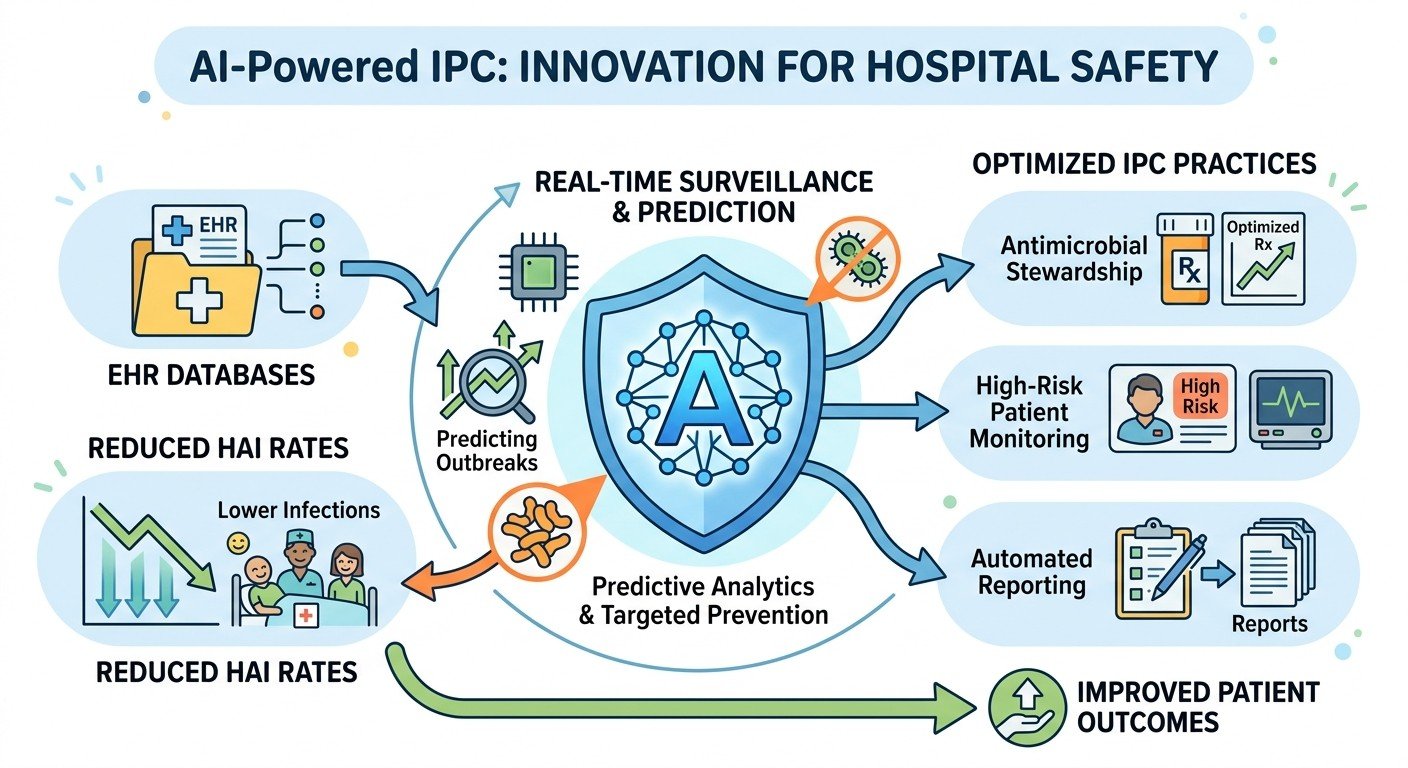
- Real-Time EHR Analytics: Advanced AI models integrate electronic health records (EHRs), microbiology lab results, and pharmacy logs to identify early outbreak clusters (e.g., C. difficile or MRSA) days before conventional detection methods flag them.
- Automated Infection Tracking: AI platforms streamline continuous reporting and monitor high-risk patient profiles, reducing manual auditing burdens while optimizing antimicrobial stewardship programs.
2. Smart Surfaces & Materials Science
- Intrinsically Antimicrobial Surfaces: Hospitals are moving away from temporary chemical coatings to solid copper alloys and copper-infused polymers on high-touch fixtures (bed rails, door handles, IV poles) to destroy pathogens 24/7 on contact.
- Light-Activated & Bio-Inspired Textures: Innovations include photo-catalytic self-disinfecting nano-coatings and non-chemical, bio-engineered physical surface patterns (inspired by shark skin) that prevent bacterial adhesion and biofilm formation.
3. Autonomous Disinfection & Environmental Control
- Swarm & Autonomous UV-C Robotics: Autonomous robots using targeted UV-C light and Vaporized Hydrogen Peroxide (VHP) have become standard for terminal room cleaning, operating rooms, and delicate electronic equipment.
- Aerosol Surveillance Systems: Real-time air sampling platforms continuously scan indoor environment air streams for airborne pathogens (such as respiratory viruses or fungal spores) to dynamically adjust HVAC turnover rates and filtration.
4. Internet of Medical Things (IoMT) & Automated Hand Hygiene Monitoring
- Real-Time Hand Hygiene Tracking: Wearable smart sensors and camera-assisted badge systems monitor compliance at patient touchpoints, offering real-time feedback and high-accuracy behavioral data.
- Smart Asset Sterilization Tracking: Connected endoscopes and surgical tools embed RFID/IoMT sensors that automatically record cleaning cycles, usage, and shelf-life, removing human error from sterilization workflows.
5. Quantitative IPC Assessment & Global Guidelines
- Structured Quantitative Auditing: Hospitals are shifting to data-driven, department-level quantitative evaluation models that systematically tie standard precaution compliance directly to reductions in healthcare-associated infection (HAI) rates.
- WHO Global Action Plan (2024–2030): Updated global IPC frameworks emphasize standardized national and facility-level targets, incorporating digital health tools into routine clinical workflows.
Core Innovation Summary
| Area | Technological Focus | Primary Operational Impact |
|---|---|---|
| Surveillance | AI & Predictive Analytics | Detects transmission risk before clinical onset |
| Infrastructure | Copper alloys, light-activated nano-coatings | Continuous passive pathogen destruction |
| Decontamination | Autonomous UV-C robots & VHP | Rapid, standardized terminal cleaning |
| Compliance | IoMT wearables & RFID tool tracking | Automated, error-free hand hygiene & asset auditing |
Business Case: Automated Electronic Hand Hygiene Monitoring Systems (EHHMS)
While high-tech disinfection methods like UV-C robotics and AI surveillance systems show strong clinical efficacy, Automated Hand Hygiene Monitoring Systems (EHHMS) offer one of the most thoroughly documented financial business cases and direct Return on Investment (ROI) profiles in hospital infection control.
1. Investment Cost Breakdown (500-Bed Acute Care Hospital)
The implementation of an IoMT badge/sensor-based tracking system requires upfront capital and ongoing operational expenses:
Capital Expenditure (CapEx):
- Sensors & Gateway Hardware: $120,000 – $180,000 (room anchors, dispenser monitors, smart badges for staff).
- Integration & Setup: $30,000 – $50,000 (EHR link, Wi-Fi configuration, staff onboarding).
Operating Expenditure (OpEx):
- Software SaaS & Maintenance: $30,000 – $50,000 annually.
Total Year 1 Investment: ~$180,000 – $280,000
Subsequent Annual Costs: ~$30,000 – $50,000
2. Avoided Costs & Measurable Financial Savings
The business case relies on replacing unreliable direct observation (the “Hawthorne Effect”) with 24/7 continuous tracking, raising hand hygiene compliance from an industry baseline of 40%–50% to over 80%–90%.
Cost of Hospital-Acquired Infections (HAIs):
- Central Line-Associated Bloodstream Infections (CLABSI): ~$45,000 – $48,000 per event.
- Methicillin-Resistant Staphylococcus aureus (MRSA) / C. diff: ~$20,000 – $60,000 per event.
- Surgical Site Infections (SSI): ~$25,000 – $40,000 per event.
Infection Reduction Rates: Hospitals implementing EHHMS typically report a 20% to 35% reduction in overall HAIs within 12–18 months.
Financial Impact Calculation:
- A typical 500-bed hospital averages ~150 preventable HAIs per year, costing roughly $4.5 million annually in non-reimbursed care, extended length of stay (LOS), and penalties.
- A modest 25% reduction in HAIs prevents 37.5 infection cases per year.
- Annual Direct Cost Avoidance: 37.5 cases × $30,000 average cost = $1,125,000 saved per year.
3. ROI & Financial Payback Summary
| Financial Metric | Year 1 Projection | Year 3 Cumulative |
|---|---|---|
| Total Investment | ~$250,000 | ~$350,000 |
| Gross Cost Avoidance | ~$1,125,000 | ~$3,375,000 |
| Net Savings | ~$875,000 | ~$3,025,000 |
| ROI (%) | ~350% | >800% |
| Payback Period | 3 to 5 Months | — |
4. Practical Real-World Example
A compelling real-world case study involves St. Mary’s Healthcare System for Children (New York) utilizing an IoMT wearable smartband hand hygiene tracking system:
Problem: Baseline compliance was inconsistent, and hand-wash durations averaged under 5 seconds.
Intervention: Deployed real-time reminder smartbands that vibrated when staff approached patient zones without sanitizing, while logging duration.
Clinical & Financial Result:
- Hand-wash compliance and average duration increased to >10 seconds.
- Monthly HAIs dropped from an average of 11.8 cases/month to near zero over a 7-month post-implementation period.
- The elimination of approximately ~10 HAIs per month prevented estimated operational losses exceeding $2.5 million annually, easily offsetting the technology’s annual subscription cost within the first quarter of operation.
Key References & Supporting Literature (2023–2026)
- AI-Powered Predictive Surveillance & Early Outbreak Detection:
- Generative AI & LLMs in HAI Surveillance: Morgan DJ, Goodman KE, Branch-Elliman W, et al. “Using Generative AI for Healthcare-Associated Infection Surveillance” (Clinical Infectious Diseases, 2025/2026). Explores automated chart reviewing and standardizing HAI identification to replace manual auditing.
- Machine Learning & EHR Integration: Integrative Review in Frontiers in Public Health (2025) “Artificial Intelligence in Hospital Infection Prevention”. Synthesizes 42 studies demonstrating machine learning/deep learning AUCs exceeding 0.80 for early detection of SSIs and UTIs, highlighted by real-time EHR data ingestion.
- Smart Surfaces & Materials Science:
- Antimicrobial Surface Formulations & Durability: Cambridge Core / Infection Control & Hospital Epidemiology (2021–2024 studies) “Antimicrobial efficacy and durability of copper formulations over hospital use”. Evaluates real-world durability and microbial reduction on high-touch copper fixtures across acute care wards.
- Bio-Inspired Physical Textures & Photocatalytic Coatings: Review papers across ACS Applied Materials & Interfaces (2023–2025) detailing anti-adhesive topographical micro-textures (engineered inspired by shark skin) and light-activated photocatalytic nano-coatings for continuous self-disinfection.
- Autonomous Disinfection & Environmental Monitoring:
- Environmental Disinfection Systems: American Journal of Infection Control (AJIC) evaluations of autonomous pulsed UV-C robots and hydrogen peroxide vapor systems for terminal room decontamination and aerosol pathogen monitoring.
- Global Guidelines & Regulatory Frameworks:
- WHO Mandate (2024–2030): World Health Organization (77th World Health Assembly, 2024) “Global Action Plan and Monitoring Framework on Infection Prevention and Control (GAPMF) 2024–2030”. Establishes mandatory facility targets, quantitative monitoring frameworks, and digital integration standards for national IPC programs.
Summary of Key Studies & Frameworks
| Innovation Area | Representative Study / Source | Core Finding |
|---|---|---|
| AI Surveillance | Clin Infect Dis (2025/2026) | Generative AI matches expert infectionist accuracy while eliminating manual chart review. |
| Outbreak Detection | Frontiers in Public Health (2025) | Machine learning integration with EHRs achieves >0.80 AUC for early HAI detection. |
| Smart Materials | Infect Control Hosp Epidemiol | Solid copper and engineered alloys provide durable, continuous 24/7 microbial reduction. |
| Global Standards | WHO GAPMF (2024–2030) | Global framework establishing standardized digital quantitative auditing metrics. |