Exploring the Future of Workforce Trends
Introduction
The future of work is being reshaped by rapid technological advancement, changing employee expectations,
evolving leadership models, and the increasing importance of data-driven decision-making.
Organizations are moving toward more dynamic and responsive workforce ecosystems in which
skills, adaptability, leadership, technology, and continuous learning are central to sustainable growth.
Artificial intelligence (AI), automation, immersive technologies, and workforce analytics are
transforming how organizations recruit, develop, retain, and lead their people. At the same time,
organizations are recognizing that technology alone cannot deliver sustainable performance.
Human-centered leadership, emotional intelligence, governance, and organizational culture remain equally critical.
This article highlights the major workforce trends shaping organizations and explores their relevance
to the evolving business environment, with particular consideration of the challenges facing Egypt.
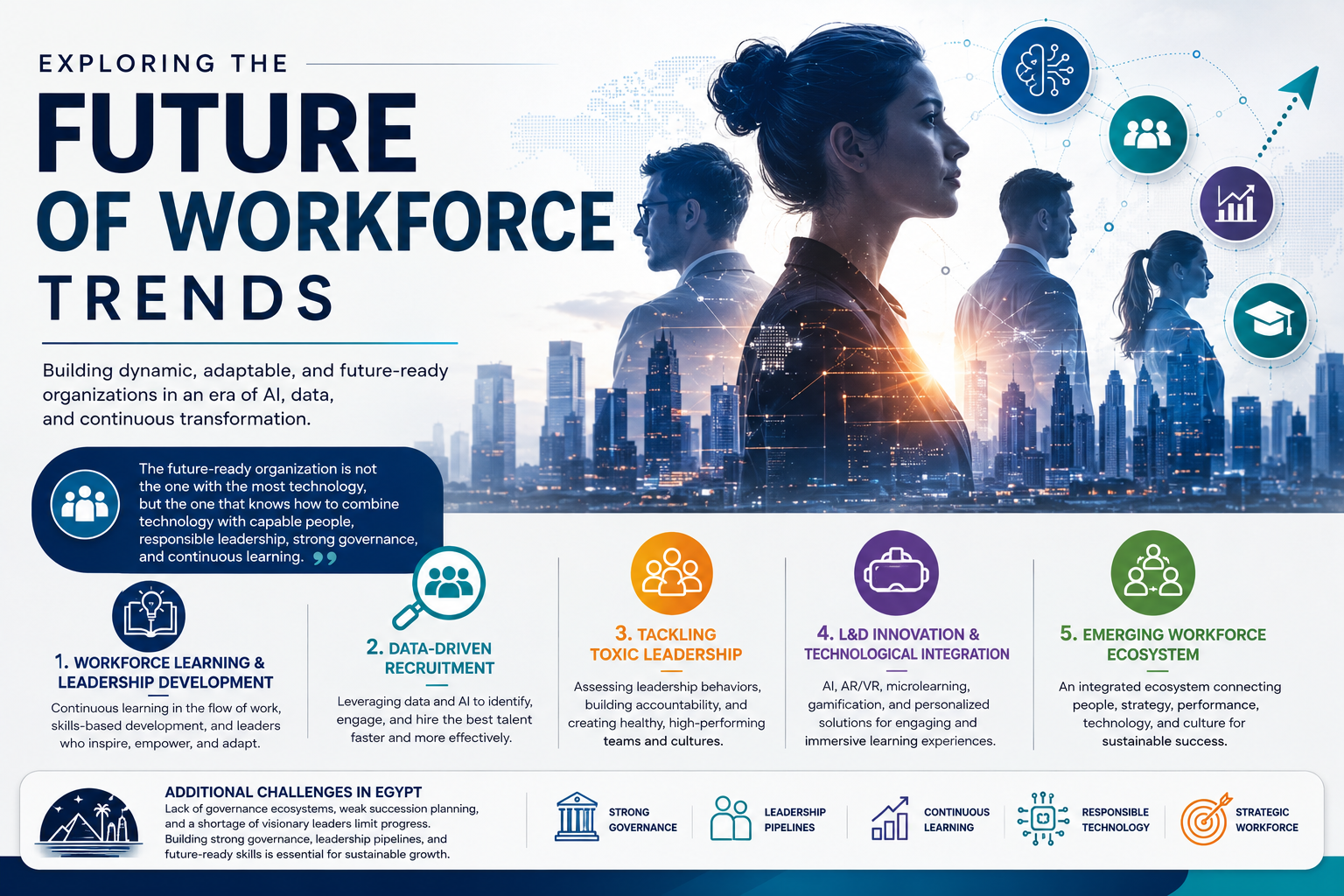
1. Workforce Learning and Leadership Development
Learning and development is moving from a traditional training function toward a
strategic workforce capability. Organizations increasingly recognize that employees
must continuously acquire new skills as technology, markets, and customer expectations evolve.
From Training to Continuous Learning
A major shift is taking place from periodic training programs toward continuous,
skills-based learning ecosystems. Learning is increasingly integrated into everyday work,
allowing employees to develop capabilities while solving real business problems.
- Skills-based workforce development aligned with business strategy.
- Learning in the flow of work rather than relying exclusively on formal courses.
- AI-powered learning analytics to identify individual development needs.
- Personalized learning pathways based on employee capabilities and career objectives.
- Microlearning that delivers short, practical, on-demand content.
- Continuous reskilling and upskilling to prepare employees for emerging roles.
The New Leadership Model
Leadership is also evolving. Modern leaders must operate effectively in environments characterized by
hybrid work, technological disruption, workforce diversity, economic uncertainty, and increasing
expectations around employee well-being.
Future-ready leaders therefore require a combination of technical and human capabilities, including:
- Emotional intelligence and empathy
- Strategic thinking
- Effective communication
- Decision-making under pressure
- Adaptability and resilience
- Conflict management
- Digital and AI literacy
- Coaching and talent development
- Inclusive and collaborative leadership
The successful leader of the future will not simply manage employees.
Instead, the leader will create an environment in which people can
learn, contribute, innovate, collaborate, and grow.
2. Data-Driven Recruitment
Recruitment is becoming increasingly data-driven. Organizations now have access to large volumes
of information that can help them identify, assess, engage, and retain talent more effectively.
Instead of waiting for candidates to apply for vacancies, organizations are increasingly moving toward
proactive talent acquisition. This approach identifies high-potential candidates before
competitors and establishes relationships with them over time.
Key Developments
- Data-driven candidate sourcing
- AI-assisted candidate screening
- Automated candidate profiling and enrichment
- Skills-based recruitment
- Predictive workforce analytics
- Talent-market intelligence
- Personalized candidate engagement
- Measurement of quality-of-hire and time-to-hire
Data can therefore move recruitment from a largely reactive process into a
strategic workforce intelligence function.
However, organizations must ensure that AI and data-driven recruitment are governed appropriately.
Human judgment, transparency, privacy, fairness, and protection against algorithmic bias remain essential.
3. Tackling Toxic Leadership
One of the most important workforce challenges is not technological but behavioral:
toxic leadership.
Poor leadership can damage employee engagement, organizational culture, productivity,
innovation, and ultimately financial performance. Toxic behaviors may include excessive control,
destructive competition, lack of accountability, poor communication, favoritism,
intimidation, or resistance to change.
Why Leadership Assessment Matters
Organizations should establish structured mechanisms for evaluating leadership behavior and its
impact on teams. Leadership assessments can help identify development needs before harmful behaviors
become deeply embedded in the organizational culture.
Effective leadership development should therefore include:
- 360-degree feedback
- Leadership behavior assessments
- Employee engagement feedback
- Team-performance indicators
- Coaching and mentoring
- Individual leadership-development plans
- Clear accountability for leadership behavior
Leaders demonstrating moderate or severe negative behaviors should have clearly defined
development objectives, measurable improvement indicators, and appropriate follow-up.
Leadership is not only measured by what a leader achieves, but also by the
organizational environment created while achieving it.
4. L&D Innovation and Technological Integration
Technology is fundamentally changing how organizations educate and develop their workforce.
AI, augmented reality (AR), virtual reality (VR), gamification, analytics, and mobile learning
are creating more interactive and personalized learning environments.
Immersive Learning
AR and VR can provide employees with realistic environments in which they can practice
procedures, simulate difficult situations, and develop practical skills without the risks
associated with real-world experimentation.
Artificial Intelligence in Learning
AI can support organizations by identifying skills gaps, recommending learning content,
personalizing development pathways, and analyzing learning outcomes.
Microlearning
Microlearning provides short, focused learning experiences that can be accessed when employees
need them. This model is particularly relevant to modern workplaces where employees may not have
the time or flexibility to attend lengthy traditional training programs.
Gamification
Gamification can increase engagement by introducing interactive challenges, simulations,
feedback mechanisms, and achievement-based learning experiences.
5. The Emerging Workforce Ecosystem
The trends above point toward a broader transformation: organizations are moving away from
traditional human-resources models toward integrated workforce ecosystems.
In this model, recruitment, learning, performance management, leadership development,
succession planning, employee engagement, and organizational strategy are interconnected.
| Traditional Approach | Future Workforce Approach |
|---|---|
| Job-based recruitment | Skills-based talent acquisition |
| Periodic training | Continuous learning |
| Annual performance reviews | Continuous performance development |
| Management-focused leadership | People-centered leadership |
| Manual HR decisions | Data-supported workforce decisions |
| Replacement hiring | Strategic succession planning |
6. Additional Challenges in Egypt
While global workforce trends are moving rapidly toward skills-based organizations,
data-driven decision-making, professional governance, and structured succession planning,
organizations in Egypt face additional structural challenges.
Governance and Succession Planning
One of the most important challenges is the limited development of organizational ecosystems
that consistently support good governance, institutional continuity, and succession planning.
In many organizations, leadership succession can remain dependent on individuals rather than
institutional systems. This creates risks when key leaders leave, retire, become unavailable,
or when the organization enters a new phase of growth.
The Leadership Gap
Egypt also needs a stronger pipeline of visionary leaders who can understand future workforce
requirements and translate technological change into organizational value.
Future leaders must be capable of combining business knowledge with governance,
technology, financial discipline, human development, and strategic thinking.
What Organizations Can Do
- Establish formal succession-planning frameworks.
- Develop leadership pipelines rather than relying on individual personalities.
- Introduce objective leadership-performance assessments.
- Build skills-based workforce strategies.
- Use workforce data to support recruitment and development decisions.
- Strengthen corporate governance and accountability.
- Integrate AI and digital technologies responsibly.
- Create continuous learning ecosystems.
- Develop future-ready middle and senior management.
- Connect workforce strategy directly to long-term business strategy.
7. From Human Resources to Human Capital Strategy
The transformation of work requires organizations to rethink the traditional role of Human Resources.
HR can no longer operate only as an administrative function responsible for recruitment,
payroll, training, and employee records.
The future requires HR to become a strategic human-capital function that directly
contributes to organizational performance.
This means connecting people decisions with measurable business outcomes such as:
- Revenue growth
- Productivity
- Innovation
- Employee retention
- Customer satisfaction
- Leadership effectiveness
- Operational efficiency
- Organizational resilience
Conclusion
The future of work is not defined by technology alone. It is defined by the ability of organizations
to combine technology, data, leadership, governance, learning, and human potential.
AI and automation will continue to transform jobs and organizational structures. At the same time,
organizations will increasingly compete based on their ability to attract, develop, engage,
and retain talented people.
The organizations most likely to succeed will be those that move beyond traditional workforce
management and build integrated ecosystems capable of continuously identifying skills,
developing leaders, anticipating workforce needs, and preparing for succession.
For Egypt, this transformation is particularly important. Building stronger governance structures,
developing visionary leadership, institutionalizing succession planning, and embracing responsible
technology adoption can help Egyptian organizations become more resilient and competitive.
The future-ready organization is not the one with the most technology;
it is the one that knows how to combine technology with capable people,
responsible leadership, strong governance, and continuous learning.
Ultimately, the future of workforce development should be viewed not simply as an HR agenda,
but as a core business and governance priority.
“`